


Should you reinvest dividends or take the cash?
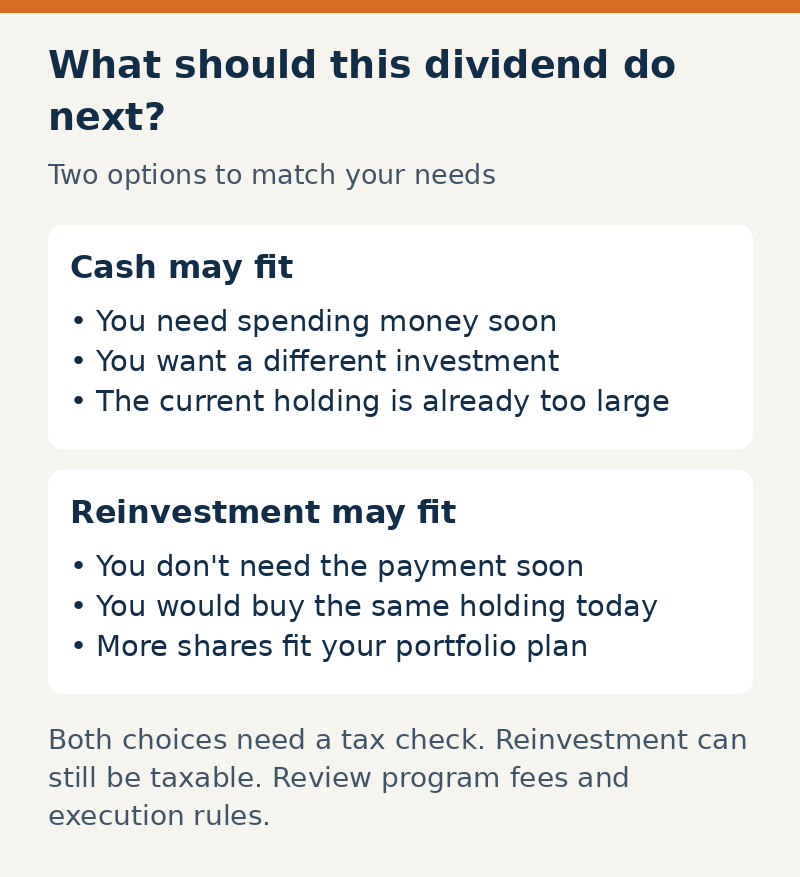
Reinvesting dividends can help you accumulate shares when you’re investing for a longer-term goal. Taking cash can make more sense when you need spending money, want to buy a different investment, or need to manage an oversized position.
Neither choice wins every time. The useful question is: What job does this money need to do next?
Your brokerage’s dividend setting may look like a tiny checkbox. Tiny checkboxes do love being put in charge of important things. Give this one a little thought before you click it and disappear for five years.
What happens when you reinvest a dividend?
Automatic dividend reinvestment uses a cash distribution to buy more of the stock or fund that paid it. Company-sponsored dividend reinvestment plans are often called DRIPs, and brokers may offer reinvestment programs of their own. The SEC’s direct-investing guide explains the basic arrangement and advises checking for fees.
If the program supports fractional shares, the payment doesn’t have to cover a whole share. A $30 distribution reinvested at $60 per share buys 0.5 shares, assuming no fees. Availability and execution rules vary, so check the program’s terms.
Choosing cash generally leaves the payment in the account’s designated cash position rather than placing that automatic purchase. From there, you can use it for spending, keep it for a planned need, or invest it yourself. Check where your broker directs the payment; “cash” doesn’t necessarily mean money has been transferred to your bank.
How reinvestment can support compounding
Extra shares can receive future dividends if they meet the next payment’s eligibility requirements. Reinvest those payments and the share count can continue growing. That’s the appealing part of the process: money previously paid out can participate in future investment results.
Here’s a deliberately simplified example. Assume:
- You begin with 100 shares.
- The investment pays one $1 dividend per share each year.
- You can reinvest immediately at $25 per share, with fractional shares available.
- The dividend and reinvestment price stay unchanged for three years.
- There are no taxes, fees, or other purchases.
After the first payment, $100 buys four shares, bringing the total to 104. The next payment is $104, which buys 4.16 shares. The third payment is $108.16, which buys 4.3264 shares. You finish with 112.4864 shares, worth $2,812.16 at the assumed $25 price. The process repeats the same step each year.
If you instead keep each dividend as cash earning no interest, you finish with the original 100 shares worth $2,500 plus $300 in cash, or $2,800 combined. Counting the cash matters. It hasn’t vanished just because it isn’t wearing a stock ticker. Comparing only the share balances would exaggerate the benefit of reinvesting.
The difference in this example is $12.16. It’s mathematical illustration, not a forecast. Real prices and dividends change, taxes and fees can apply, and reinvested shares can lose value. The fixed price assumption also simplifies away market price movements around distributions.
When automatic reinvestment may fit
Reinvestment may be convenient when you don’t need the money soon and would willingly buy more of the same investment today.
It also reduces the number of decisions between receiving a payment and investing it. Small amounts can accumulate without requiring a separate order each time. Convenience has value, especially if the alternative is leaving money idle in the mental folder marked “I’ll sort that out later.” That folder can get awfully crowded.
Still, an automatic purchase is a real investment decision. Check whether the holding’s risk, valuation, and role in your portfolio remain acceptable. The checkbox doesn’t read balance sheets while you’re asleep, and a dividend arriving doesn’t answer those questions for you.
More shares also don’t guarantee more wealth. As FINRA explains about total return, investment results include both income and gains or losses in value. A falling investment can overwhelm the cash it distributes.
When cash may be the more useful choice
Cash can fit when dividends are part of a spending plan. Reinvesting money that you expect to withdraw shortly afterward can add an unnecessary purchase-and-sale step. However, future dividend payments aren’t guaranteed, so expenses shouldn’t depend on an assumption that every payment will continue unchanged.
Taking cash also gives you a chance to reconsider where the next investment dollar belongs. Perhaps one company already occupies more of the portfolio than intended. Automatically buying still more shares could deepen that concentration. Our portfolio-rebalancing guide explains how cash distributions can help fill underweight allocations instead.
Concentration can also hide inside funds. Our Nvidia portfolio overlap example shows how a hypothetical 10% stock position grows to about 18.84% once the shares inside SPY and XLK are counted.
The SEC’s asset-allocation and diversification guidance emphasizes considering risk tolerance and investing timeframe. Applying that idea here, dividends can be directed toward an underrepresented part of a portfolio instead of always returning to their source.
Cash can also cover a known bill or help reserve money for taxes. Keeping money available for a real near-term purpose can be sensible, even when reinvestment would increase the share count.
Reinvesting doesn’t erase a taxable dividend
For U.S. federal tax purposes in a taxable account, a taxable dividend generally remains reportable when automatically reinvested. You can owe tax even though the payment never reached your bank. The IRS’s reinvested-dividend guidance explains this treatment. If a company DRIP lets you buy shares below fair market value, that discount also counts as dividend income.
The distribution’s tax character matters. Qualified dividends, nonqualified ordinary dividends, capital-gain distributions, and return of capital can receive different treatment. A return of capital generally reduces basis, with additional nondividend distributions becoming taxable capital gains after basis reaches zero. See IRS Topic 404. The reinvestment checkbox doesn’t decide the tax category.
Keep acquisition and cost-basis records for the newly purchased shares. The IRS’s stock-basis guidance explains the importance of identifying shares and maintaining records. Missing reinvestment history can lead to an incorrect gain calculation when you sell. This is a small kindness to future you, who would probably rather not reconstruct years of tiny purchases at tax time.
Planning to sell at a loss? An automatic reinvestment can trigger wash-sale rules if it purchases substantially identical securities within 30 days before or after the loss sale. Some or all of the loss deduction may be disallowed. Review the timing and the Wash Sales section of IRS Publication 550 before assuming the loss is deductible.
Account type changes the picture. Earnings and gains inside a traditional IRA are generally tax-deferred until distributed; qualifying Roth IRA withdrawals are tax-free. Receiving a cash dividend inside an IRA is different from withdrawing money from the IRA. Review the IRS guides to traditional IRAs and Roth IRAs before treating the two steps as interchangeable.
Check the program, then choose deliberately
Before turning reinvestment on or off, ask:
- Are there reinvestment, purchase, or sale fees?
- Which holdings and payments are eligible?
- Are fractional shares supported, and how are they handled if you transfer the account?
- When is the purchase executed, and what is the deadline to change an election?
- Can you choose separately for different holdings?
The SEC’s fractional-share bulletin highlights execution differences, possible fees, and transfer limitations. Don’t assume every program works like the last one you used.
You can also use a mix: reinvest in some holdings and collect cash from others, if your provider allows it. Revisit the settings when income needs or portfolio priorities change.
A helpful final test is simple: If this dividend arrived as cash today, would you buy more of the same investment? If yes, automation may save you a step. If you’d put it somewhere else, taking cash gives you room to do that. You can choose what helps your plan now and revisit it later.
If you’re comparing paid dividend research, our Oxford Income Letter review looks at its separate Instant Income and Compound Income portfolios. The cash-versus-reinvestment decision still comes back to your own plan. That review contains affiliate links; StockHitter may earn a commission if you buy through them.
Educational information only, not individualized investment or tax advice. Tax discussion addresses general U.S. federal rules; state, foreign, account-specific, and personal circumstances can change the result.