


Can you sell on the ex-dividend date and still get paid?
Yes. For a regular U.S. stock cash dividend, you can generally sell on the ex-dividend date and still receive that dividend, provided you bought the shares before the ex-date and held them until then. You usually don’t have to keep the shares until payday.
The important part is confirming the actual ex-dividend date for that particular payment. A large special distribution can follow a different timetable. Four dates for one payment does feel a little excessive. Fortunately, you only need to know what each one does.
Let’s sort out the dates, then walk through a sale so you can see where the payment goes.
What the ex-dividend date actually means
Think of the ex-dividend date as the point when shares begin trading without the upcoming dividend attached. A buyer who purchases on that date generally misses that payment; the eligible seller keeps it. Buying before the ex-date generally establishes eligibility. The SEC explains this basic cutoff in its guide to ex-dividend dates.
Here’s the little cast of characters. They have similar names, but different jobs:
- Declaration date: The company announces the dividend and its terms.
- Ex-dividend date: The trading cutoff for the upcoming distribution.
- Record date: The company determines its shareholders of record.
- Payment date: The company pays the distribution.
A payment date several weeks away doesn’t usually mean you must keep holding for those weeks. Your shares don’t usually need to clock in again on payday.
The T+1 detail that older articles can get wrong
Since May 28, 2024, the standard settlement cycle for most U.S. broker-dealer securities transactions has been one business day after the trade, or T+1. Settlement is when the transaction’s securities and money officially transfer. The SEC’s T+1 investor bulletin explains the change.
For a regular dividend, the ex-date is generally the same as the record date when that date is a business day. If the record date is a nonbusiness day, the ex-date generally moves to the preceding business day. The NYSE’s ex-date explanation confirms the current convention and notes exceptions.
You may still encounter explanations saying the ex-date is always one business day before the record date. That isn’t the standard T+1 rule for an ordinary business-day record date. Check the dated corporate-action notice rather than doing the subtraction from memory. An old article can look perfectly respectable while using yesterday’s calendar rules.
A simple buy-and-sell timeline
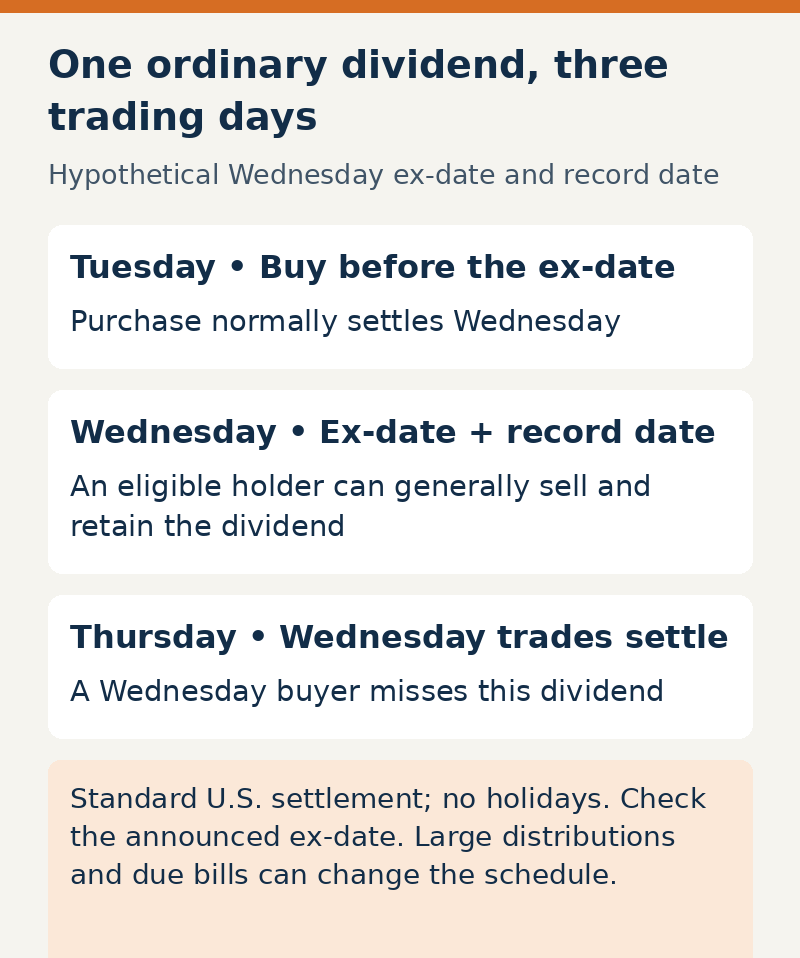
Imagine a hypothetical stock with a Wednesday ex-dividend date and Wednesday record date. Assume there are no intervening market holidays, the dividend follows ordinary procedures, and the trades use standard settlement.
- Buy Tuesday: The purchase normally settles Wednesday, meeting the record-date timing.
- Sell Wednesday: You generally retain that dividend entitlement. The sale normally settles Thursday.
- Buy Wednesday instead: That purchase normally settles Thursday, too late for this dividend.
The practical takeaway is to buy before the announced ex-date if you want that distribution. An unfilled order doesn’t establish a purchase, however enthusiastically you clicked the button. Check the execution date on your trade confirmation if the timing is close.
Suppose the announced dividend is $0.40 per share and you have 150 eligible shares. The gross payment is $60: 150 multiplied by $0.40. Selling those eligible shares on Wednesday doesn’t, by itself, erase the $60 entitlement.
Special distributions can change the calendar
Large distributions deserve an extra pause before you sell. Under FINRA Rule 11140, distributions worth 25% or more of the security’s value normally have an ex-date on the first business day after the payment date. Late announcements and certain foreign-security corporate actions can also require special treatment.
That can create a period after the record date, and even after payment, when a sale still carries the distribution entitlement to the buyer. A due bill is the mechanism used to pass that entitlement along when applicable. Seeing money or shares arrive in your account doesn’t necessarily mean you can sell immediately and keep them.
Stock dividends and spinoffs can also have their own procedures. The SEC’s dividend guide describes due-bill obligations. Follow the announced ex-date and ask your broker about the specific event before trading.
One more wrinkle: the label “special dividend” alone doesn’t settle the issue. “Special” is a description, not a set of scheduling instructions. Check the size, published dates, and applicable corporate-action terms.
Keeping the dividend doesn’t guarantee a profit
Buying immediately before the ex-date and selling on it is often called dividend capture. This is where we put down the calendar and pick up a calculator. Keeping the dividend and making money on the trade are different questions.
A stock can trade lower when it goes ex-dividend because new buyers no longer receive that payment. Other news and market activity affect the price, too, so the actual change needn’t equal the dividend.
Here’s a hypothetical illustration, ignoring taxes, fees, and spreads. You buy 100 shares at $40, for $4,000. A $0.50 dividend gives you $50. If you sell at $39.50, you receive $3,950 from the sale. Combined with the dividend, that’s the original $4,000, before costs. The payment arrived, but it didn’t bring a profit along for the ride.
This is an illustration, not a price forecast. A larger price decline could leave you with a loss. FINRA’s total-return explanation makes the useful point: investment income and changes in value belong in the same calculation.
Dividend eligibility and tax eligibility are different
For U.S. federal taxes in a taxable account, receiving a dividend doesn’t automatically make it a qualified dividend. For most common-stock dividends, the holding-period requirement is more than 60 days within the 121-day window beginning 60 days before the ex-date. Other requirements also apply, and some days with reduced risk of loss don’t count. Preferred-stock rules can differ. See IRS Publication 550.
A quick purchase followed by a sale on the ex-date may therefore qualify you to receive the payment while failing the qualified-dividend holding test. The sale can also create a separate capital gain or loss. Retirement accounts and non-U.S. tax situations need their own analysis.
If you’re selling because a holding has grown beyond your intended allocation, our portfolio-rebalancing guide walks through checking that drift and considering taxes before trading. Dividend timing is one part of the decision.
What to check before selling
- Confirm the security, dividend amount, and announced ex-date.
- Check whether a large distribution, stock dividend, or due-bill period applies.
- Verify your purchase executed before the relevant cutoff.
- Consider the sale price, trading costs, and tax consequences alongside the dividend.
- After payment, check your account activity and ask the broker about any missing or unexpected entry.
The short answer remains yes for a regular dividend: an eligible holder can generally sell on the ex-date and keep the payment. You don’t need to memorize every exception over breakfast. Find the announcement, confirm the actual ex-date, and ask your broker if the event looks unusual. That’s a much more useful habit than trusting a date you half-remember.
Educational information only, not individualized investment or tax advice. This guide addresses standard U.S. stock transactions; particular securities and corporate actions can differ.