

Updated: May 2026 | By Jenna Lofton, StockHitter.com
Jenna’s Bottom Line
A stock chart is not a crystal ball and it is not noise. It is a visual record of every decision every buyer and seller has made about a stock over a given period. Learning to read it does not guarantee you will pick winners. It guarantees you will stop making decisions blind.
Key Takeaways
- Candlestick charts are the standard for serious investors. Each candle shows the open, close, high, and low for a given time period at a glance.
- Volume is the most underrated data point on a chart. Price moves on high volume carry more weight than the same move on thin volume.
- Moving averages (the 50-day and 200-day in particular) tell you whether a stock is in a long-term uptrend or downtrend at a glance.
- Support and resistance levels are where price has repeatedly reversed. They are not guarantees, but they are the most useful reference points on any chart.
- No single indicator tells the full story. The investors who use charts well combine multiple signals and use price history as context, not prediction.
Why Charts Matter Even If You Are a Long-Term Investor
A lot of fundamental investors dismiss charts entirely. Their argument is that if you understand the business and the valuation, the price history is irrelevant. There is some truth in that, but it misses something important.
Charts show you what the market actually thinks about a stock right now, not what it should think. A company can have great fundamentals and a terrible chart, which usually means institutional investors are selling for reasons that may not be visible in the quarterly filings yet. A stock breaking out to new highs on rising volume is telling you something about demand that no earnings report captures in real time.
You do not have to be a technical trader to benefit from reading charts. You just have to be willing to use price history as one more data point alongside the fundamentals. The investors who ignore charts entirely sometimes walk into deteriorating situations that a two-minute chart review would have flagged immediately.
The Anatomy of a Stock Chart
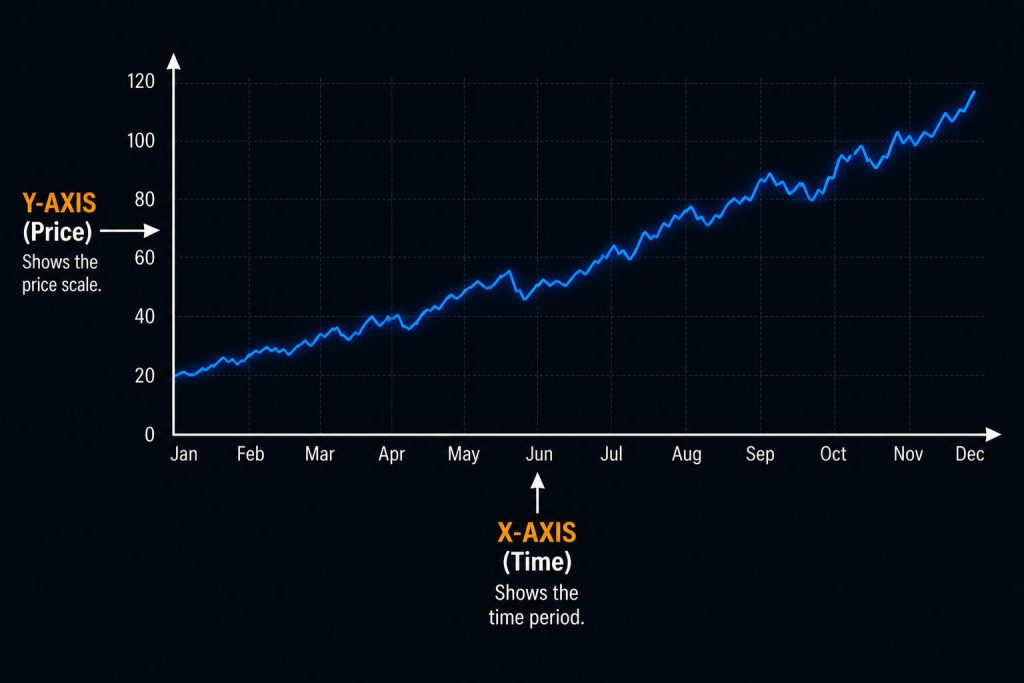
Every stock chart has the same basic components. Once you know what each one represents, the chart stops looking like noise and starts looking like a story.
The X-axis is time. The Y-axis is price. The line, bar, or candle shape in between represents how the stock traded during each time interval, whether that is one minute, one day, one week, or one month depending on your chart settings.
The time frame you choose changes what the chart is telling you. A one-year daily chart shows the broad trend. A five-year weekly chart shows the bigger picture across multiple market cycles. A three-month chart on a daily basis is useful for identifying a near-term entry point. A one-day chart broken into five-minute intervals is for active traders managing intraday positions. Long-term investors should start with the one-year or five-year view before zooming in.
Candlestick Charts: The Standard Worth Learning
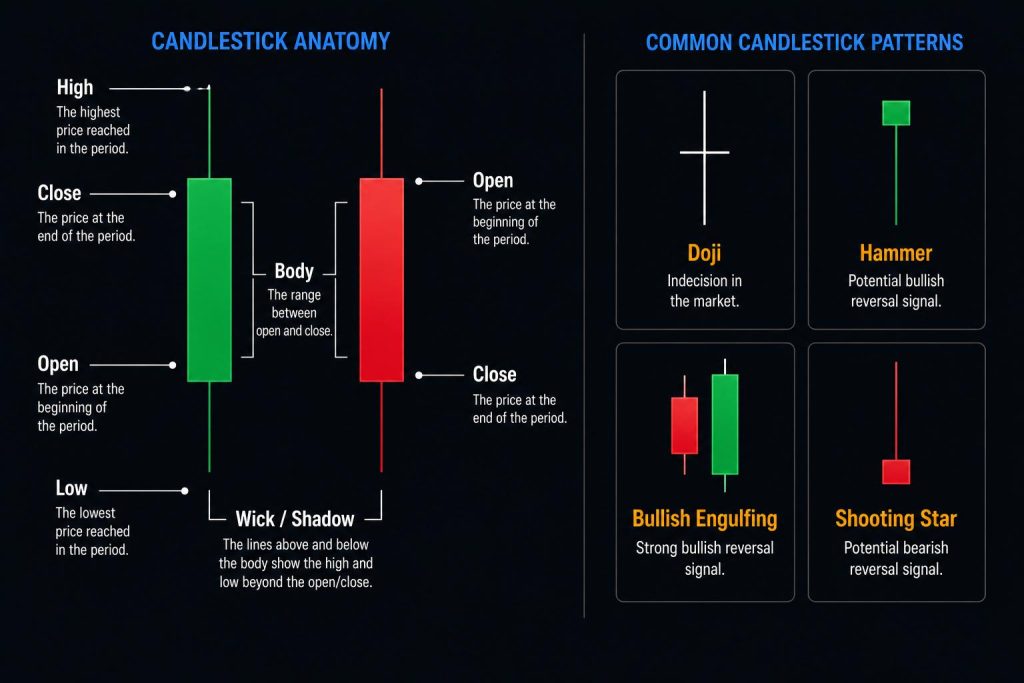
There are three main chart types: line charts, bar charts, and candlestick charts. Line charts connect closing prices and are clean and simple. Bar charts add open, high, and low information. Candlestick charts do everything bar charts do but in a format that is faster to read visually, which is why they became the professional standard.
Each candlestick represents one time period. A green (or white) candle means the stock closed higher than it opened. A red (or black) candle means it closed lower. The body of the candle shows the range between open and close. The thin lines extending above and below the body, called wicks or shadows, show the high and low reached during that period.
A tall green candle with a small wick means buyers were in control all session. A small candle with long wicks on both sides means the session was indecisive, buyers and sellers fought to a near draw. A long red candle with almost no upper wick means sellers dominated from open to close with no meaningful pushback. These patterns carry real information about market sentiment when read in context.
A few candlestick patterns worth recognizing:
- Doji: open and close at nearly the same price, long wicks on both sides. Indecision. Often appears before a reversal.
- Hammer: small body at the top, long lower wick. Buyers rejected a significant intraday selloff. Bullish signal when it appears after a downtrend.
- Engulfing candle: one candle’s body completely covers the previous candle’s body. A bullish engulfing after a downtrend or a bearish engulfing after an uptrend signals a potential reversal.
- Shooting star: small body at the bottom, long upper wick. Buyers pushed the price up significantly during the session but sellers took it back. Bearish signal after an uptrend.
No pattern is a guarantee. Every pattern is a probability statement that becomes more meaningful when confirmed by volume and the surrounding price context.
Experience Transparency
The first time I looked at a candlestick chart I spent about 20 minutes trying to memorize pattern names before I understood a single thing about what the chart was actually showing me. That is backwards. The right starting point is not the patterns. It is learning to read volume alongside price and understanding what the trend is doing before you look at anything else. The patterns come into focus naturally once you have that foundation. Skip straight to memorizing patterns and you end up with a collection of shapes that mean nothing without context.
Volume: The Most Underrated Number on the Chart
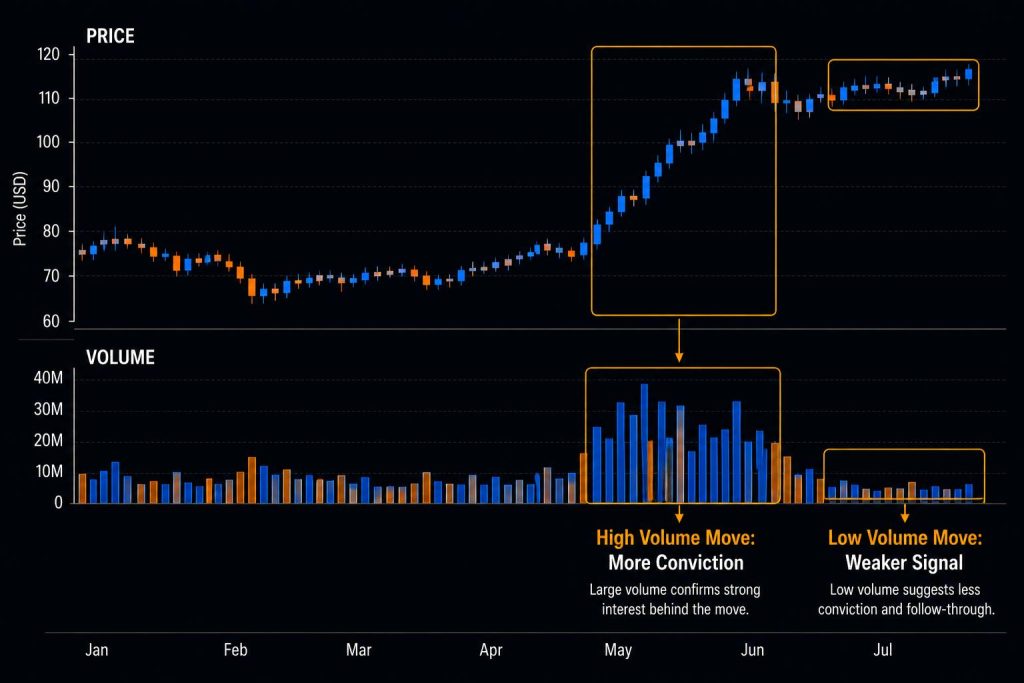
Volume is the number of shares traded during a given period. It sits at the bottom of most charts as a bar graph, usually color-coded green for up days and red for down days. Most beginners ignore it. That is a mistake.
Price tells you what happened. Volume tells you how much conviction was behind it. A stock that rises 3 percent on three times its average daily volume is making a very different statement than one that rises 3 percent on half its average volume. The first move has institutional participation behind it. The second might be nothing more than a low-volume drift that reverses the next session.
The same logic applies to selloffs. A stock dropping on declining volume is often just weak-handed sellers exiting with no real institutional pressure behind the move. The same stock dropping on two or three times average volume is telling you that large holders are reducing positions, which is a materially different and more serious signal.
Average daily volume for a stock is usually shown directly on your broker’s platform or on a data site like Finviz. Get in the habit of comparing any given day’s volume to the average before drawing conclusions from a price move.
Moving Averages: The Trend at a Glance
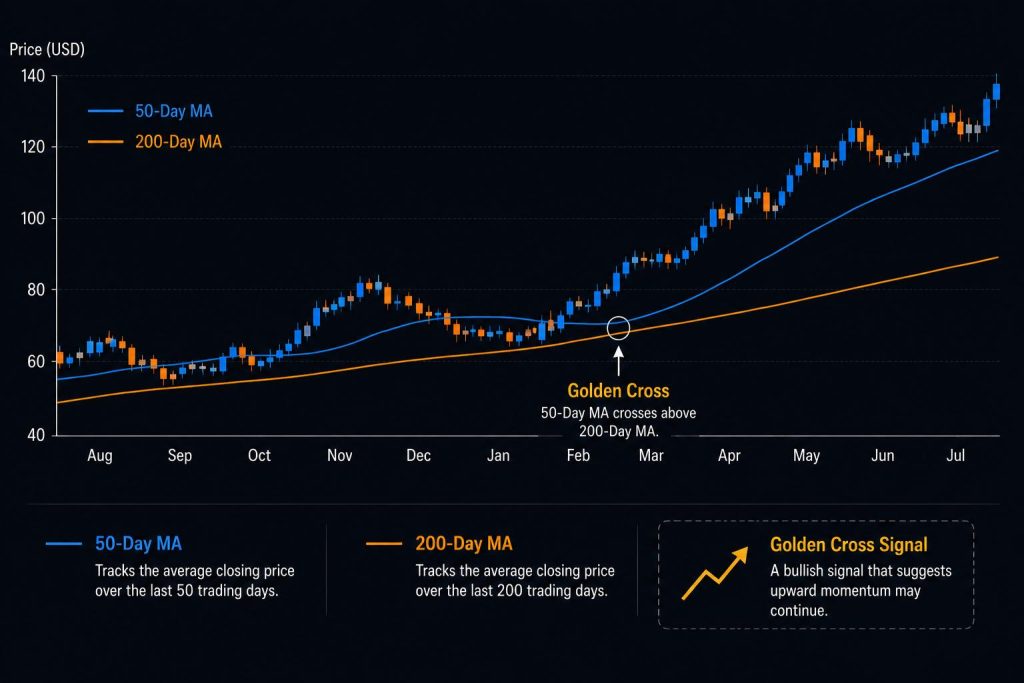
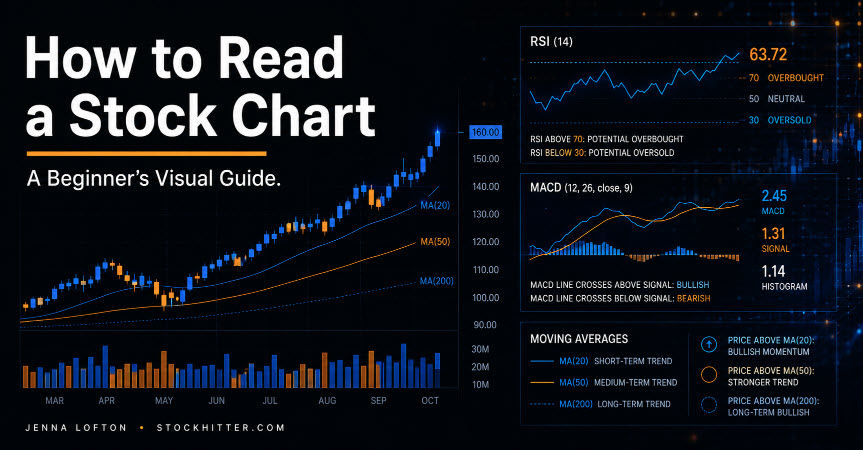
A moving average smooths out daily price noise by averaging closing prices over a set number of periods. The two most widely tracked are the 50-day moving average and the 200-day moving average. These are not arbitrary numbers. They represent roughly one quarter and one full year of trading, and institutional investors watch them closely enough that the levels become self-fulfilling reference points.
A stock trading above its 200-day moving average is in a long-term uptrend. Below it, a long-term downtrend. The relationship between the 50-day and 200-day is also significant. When the 50-day crosses above the 200-day, that is called a golden cross, historically a bullish signal. When it crosses below, that is a death cross, a bearish one.
Moving averages also act as dynamic support and resistance. A stock in a strong uptrend will frequently pull back to its 50-day moving average before bouncing. That level is where institutional buyers tend to add to positions, because it represents a mathematically defined discount from recent price action.
The 20-day moving average is useful for shorter-term traders tracking near-term momentum. The 200-week moving average appears often in long-term Bitcoin and macro analysis. But for most stock investors, the 50-day and 200-day daily charts cover 90 percent of what you need to know about trend context.
Support and Resistance: Where Price Has Memory
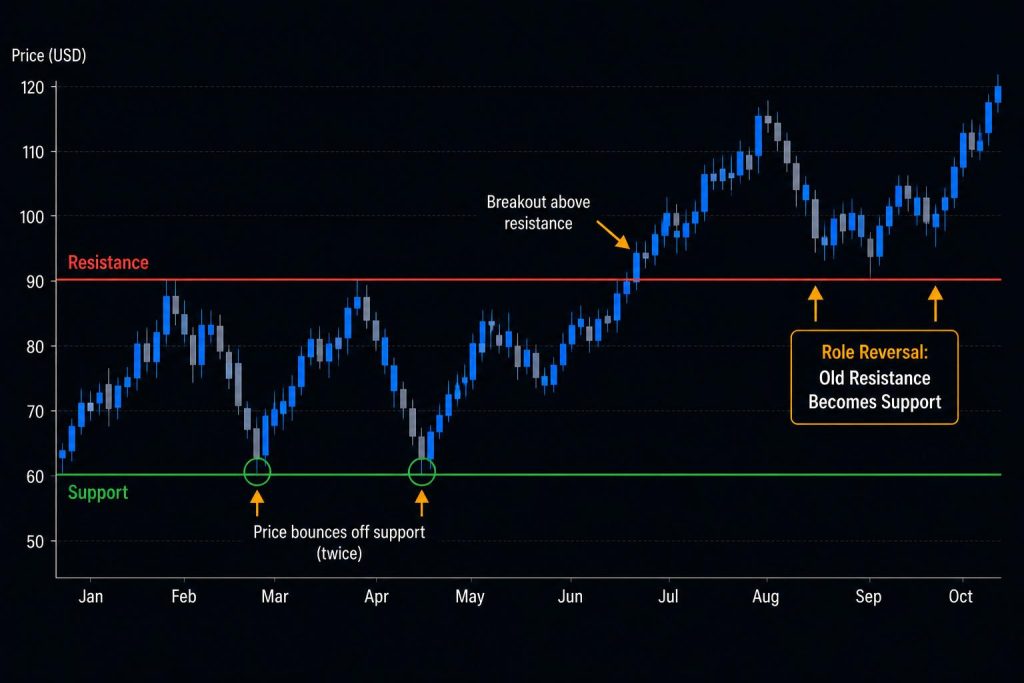
Support is a price level where a stock has repeatedly stopped falling and reversed upward. Resistance is a price level where it has repeatedly stopped rising and reversed downward. These levels exist because market participants have memory. A trader who bought a stock at $50, watched it fall to $40, and then saw it recover back to $50 is likely to sell at $50 to get out even. Multiply that psychology across thousands of participants and $50 becomes a ceiling.
When a stock breaks through a resistance level on high volume, that old resistance often becomes the new support. This concept is called a role reversal, and it is one of the more reliable patterns in technical analysis.
Round numbers act as psychological support and resistance more often than random prices. A stock approaching $100, $200, or $500 for the first time tends to stall there because options activity, price targets, and retail psychology all cluster around those levels.
Drawing support and resistance levels does not require sophisticated software. On most charting platforms including TradingView, which is free and used by professionals and retail investors alike, you can draw horizontal lines on a chart in seconds. Identify the two or three most significant levels where price has repeatedly reversed and those become your map for the stock’s near-term behavior.
The Relative Strength Index: One Momentum Indicator Worth Knowing
There are hundreds of technical indicators. Most of them repackage the same underlying price and volume data in slightly different ways. If you are going to learn one momentum indicator beyond moving averages, make it the Relative Strength Index (RSI).
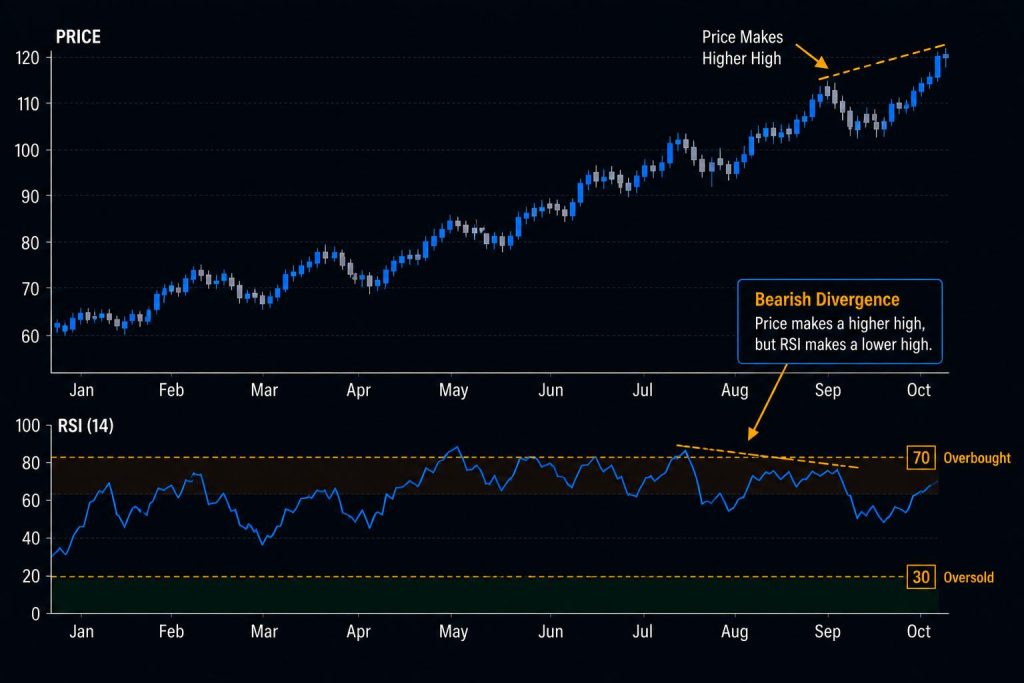
RSI is a number between 0 and 100 that measures how fast and how much a stock has moved recently relative to its own history. A reading above 70 is considered overbought. Below 30 is considered oversold. These are not automatic buy or sell signals. A stock can stay overbought for weeks in a strong uptrend. But an RSI pushing above 80 after a sharp run tells you the move is extended and a pause or pullback is increasingly likely.
The more useful RSI signal is divergence. When a stock makes a new price high but RSI makes a lower high, that divergence suggests the momentum behind the move is weakening even if price has not yet turned. The same logic applies in reverse at bottoms. Divergence does not predict exact turning points but it does flag situations worth watching more carefully.
Wall Street Reality Check
Technical analysis has a real problem at the retail level, and it is this: the same chart can be read to support almost any conclusion if you cherry-pick your indicators and time frames. Professional traders know this. They use charts to manage risk and timing around positions they have already convicted on fundamentally. They do not use charts as the primary reason to buy something. The investors who get into trouble with technical analysis are the ones who let a pattern override their judgment about whether a business is actually worth owning. Use the chart to improve your entry and exit. Do not use it as a substitute for doing the underlying work.
Putting It Together: A Simple Chart Review Process
When I look at a new stock chart, I follow the same sequence every time. Start zoomed out, then zoom in.
First, pull up the five-year weekly chart. What is the dominant trend over the full period? Is the stock making higher highs and higher lows, which is the definition of an uptrend? Or lower highs and lower lows? This single question filters out most of the noise before you look at anything else.
Second, switch to the one-year daily chart. Where is the stock relative to its 50-day and 200-day moving averages? Is it above both, below both, or somewhere between? Is volume confirming recent price moves or diverging from them?
Third, identify the two or three most significant support and resistance levels on the one-year chart. These become your reference points for thinking about where the stock might find buyers if it pulls back, or where sellers might emerge if it rallies.
Fourth, check RSI for obvious overbought or oversold conditions and look for divergence if the stock has made a significant recent move in either direction.
That four-step process takes about three minutes once you have done it enough times to make it automatic. It does not tell you whether to buy a stock. It tells you the context in which you would be buying, which is the part most investors skip.
For the fundamental side of stock evaluation, our guide to how the stock market works covers valuation metrics and what actually drives prices over the long term. Charts and fundamentals work best when you use both, not as competing frameworks but as complementary lenses on the same question.
If you want to see this kind of chart-aware analysis applied to specific stocks, the Hidden Alpha research service from Joel Litman combines forensic accounting fundamentals with institutional-level technical context. It is one of the cleaner examples of how professionals actually integrate both disciplines.
Bottom Line
Reading a stock chart is a skill that takes about an hour to learn at a basic level and years to apply with genuine judgment. Start with trend, add volume, layer in the 50-day and 200-day moving averages, identify support and resistance, and check RSI for extremes. Do that consistently and you will have more context for every investment decision than the majority of retail investors ever develop.
Further Reading
Disclaimer: This article is for informational and educational purposes only and does not constitute financial advice. StockHitter.com and Jenna Lofton are not registered investment advisors. All investing involves risk, including the potential loss of principal. Past performance does not guarantee future results. Always conduct your own due diligence and consult a licensed financial professional before making investment decisions. Some links on this page may be affiliate links, meaning StockHitter.com may receive compensation if you subscribe to a service at no additional cost to you. This does not influence our editorial opinions.