
Updated: May 2026 | By Jenna Lofton, StockHitter.com
Dollar Cost Averaging
Regular contributions. Fewer purchase-timing decisions. Investment risk remains.
Jenna’s Bottom Line
Dollar cost averaging gives your investing a schedule instead of a fresh timing decision every payday. It can make regular contributions easier to stick with, but it doesn’t prevent losses or guarantee better returns. If you’re investing from income as you earn it, that consistency can be useful without pretending the market comes with a safety net.
Key Takeaways
- Dollar cost averaging means investing a fixed dollar amount at regular intervals regardless of market conditions. You buy more shares when prices are low and fewer when prices are high.
- Investing an available lump sum immediately gives it more time in the market. Investing from each paycheck is a different decision: that future income is not available to invest today.
- A fixed schedule can reduce the temptation to time every purchase. You still need to choose suitable investments and review your plan.
- Automation can help you follow your contribution schedule. It does not guarantee that your investments or strategy will outperform.
- DCA can be paired with a diversified index fund, but diversification does not protect you from market-wide losses.
How Dollar Cost Averaging Actually Works
Hypothetical $500 monthly investment
- Month 1: $100 per share buys 5 shares.
- Month 2: $80 per share buys 6.25 shares.
- Month 3: $95 per share buys about 5.26 shares.
$1,500 invested ÷ approximately 16.5132 shares = approximately $90.84 per share. Fees excluded.
The mechanics are simple. You pick an asset, pick a fixed dollar amount, pick a frequency, and invest that amount on schedule regardless of what the market is doing.
When the price is high, your fixed amount buys fewer shares. When the price is low, it buys more. Your average cost depends on all the prices you pay and the number of shares bought at each price. It is not guaranteed to land in the middle of the price range or below the price available today.
Here is a hypothetical example, ignoring fees.
- You invest $500 per month into an index fund. In month one the price is $100 per share and you buy 5 shares.
- In month two the price drops to $80 and you buy 6.25 shares.
- In month three it recovers to $95 and you buy 5.26 shares.
Your average cost per share is roughly $91, below both the starting price and the recovery price. You benefited from the dip automatically without having to make a single decision during it.
DCA vs Lump Sum: The Honest Comparison
Lump sum: Invest available money immediately. More market exposure from day one, including exposure to an early decline.
Dollar cost averaging: Spread purchases over a schedule. Less initial exposure, but money waiting to be invested can miss gains.
Neither approach requires predicting the perfect entry price or guarantees a profit.
I want to be straight with you here: spreading out an available lump sum has a cost. Some money stays out of the investment while you wait, so you can miss gains if prices rise. You can also avoid some early losses if prices fall.
A February 2023 Vanguard study found lump-sum investing won roughly two-thirds of the time in its historical comparisons. One comparison used 1976–2022 MSCI World returns, a three-month investment schedule and wealth measured after one year. That is historical evidence, not a promise about your next investment.
So why use DCA at all? For money coming from your paycheck, a regular schedule fits the cash flow. For a lump sum already available, a short phased plan may feel more manageable than investing all at once. It can reduce the pressure around each purchase, even though it can’t switch off emotions or make a risky investment safe.
The useful question is whether the schedule fits your cash flow, goals and tolerance for losses. There isn’t one optimal answer for everyone.
What DCA Does During a Bear Market
When purchases occur below your existing average cost, they lower that average. That can help if the investment later recovers, but recovery is not guaranteed. Adding money also increases the amount exposed to further losses; a larger account balance is not necessarily a better investment return.
A schedule can help you keep contributing when buying feels uncomfortable. But check whether the investment still fits your plan and whether you can afford the contributions. Staying consistent should not mean ignoring a changed financial situation.
Investors who maintained consistent DCA contributions through the 2008 to 2009 bear market, buying every month as the S&P 500 fell toward its March 2009 low, accumulated shares at prices that looked extraordinary by 2012. They did not need to predict the bottom. They just needed to keep buying on schedule.
How to Set Up a DCA Strategy
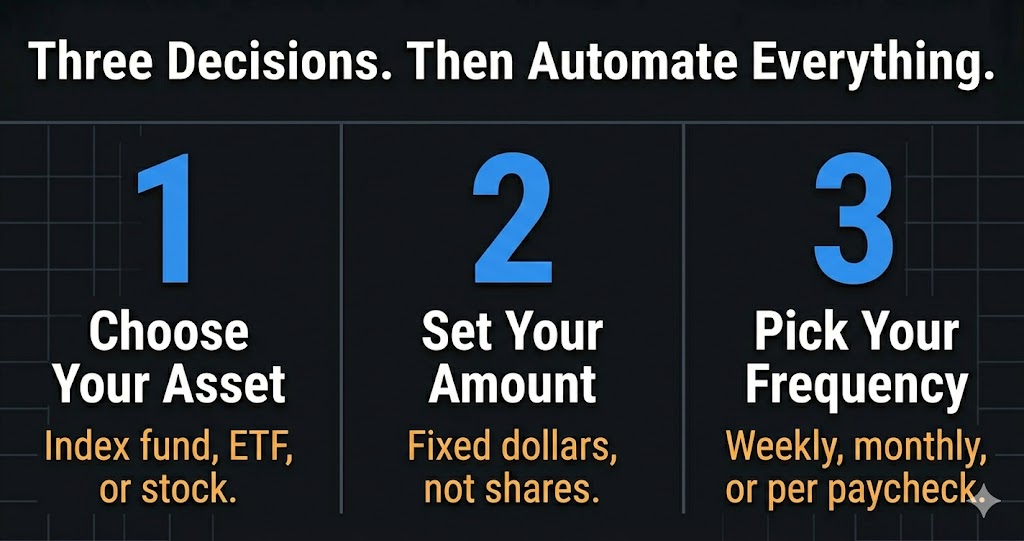
Automation can handle the recurring purchases, but this is not a zero-maintenance arrangement. Check that transactions execute and review the amount, investments and account limits when your circumstances change.
Three decisions to make upfront:
- Choose your asset. A broad market index fund is one option for spreading exposure across many companies. Individual stocks concentrate your purchases in fewer businesses. Diversification reduces that concentration, but it does not eliminate investment risk.
- Set your fixed dollar amount. Not a fixed number of shares. A fixed dollar amount. The share count varies with price, which is what creates the averaging benefit. Pick an amount you can sustain through a bear market without being tempted to pause contributions.
- Pick your frequency. Choose a schedule that fits when your money becomes available. Weekly purchases are not guaranteed to outperform monthly ones; the outcome depends on prices, fees and timing.
Once those three decisions are made, check the recurring-investment options at your brokerage and review the plan periodically. Most major brokers including Fidelity and Charles Schwab offer automatic investment scheduling at no cost. Automation helps with execution. It cannot compensate for an unsuitable investment or guarantee better returns.
DCA and Tax-Advantaged Accounts
DCA and tax-advantaged accounts are a natural combination that most investors underutilize. A 401(k) contribution from each paycheck is DCA by design. Every contribution goes in at whatever the market price is that day, automatically, without you making a decision. That is the entire structure working as intended.
For 2026, the IRS contribution limit across your traditional and Roth IRAs combined is $7,500, or $8,600 if you are age 50 or older, generally limited to your taxable compensation if that is lower. Roth eligibility also depends on income and filing status. If you qualify for the full $7,500 and make no other IRA contributions for that year, $625 each month for 12 months reaches that limit. Check your eligibility and existing contributions before automating the amount.
For a full breakdown of account types and contribution strategies, see our guide to how to start investing.
Experience Transparency
I ran my own DCA program through the 2022 bear market and it was genuinely uncomfortable to keep contributing as positions fell. There is a voice in your head that says wait until things stabilize, buy when it is clearer what is happening. I ignored it and kept contributing on schedule. By late 2023 those contributions made during the downturn were among the best-performing positions in the portfolio simply because of when they were made. Not because of any analytical insight on my part. Because I kept the schedule running when it felt wrong. That is the entire behavioral case for DCA in one real example.
DCA and AI Infrastructure Stocks
DCA is not just for index funds. It can also be used for individual stocks, but buying on a schedule does not remove the risk of a single business performing poorly.
For AI infrastructure names like Palantir Technologies (PLTR) and Arista Networks (ANET), which carry premium valuations and significant short-term volatility, a systematic DCA approach to building a position over 6 to 12 months reduces the risk of deploying a large amount at a local peak. You spread purchases across different price points, but the business thesis can still fail.
This is how I approach initiating positions in high-conviction but high-multiple growth stocks. Not a single entry point. A scheduled accumulation over time that lets the thesis play out without the pressure of a single large purchase decision.
For our full analysis of the AI infrastructure theme, see our guide to best AI infrastructure stocks to watch in 2026.
When DCA Is Not the Right Approach
DCA is not a universal solution. There are situations where it is the wrong tool.
- When you have a genuine lump sum and a long time horizon. An available lump sum deserves a different analysis from future paychecks. Consider your risk tolerance, cash needs and asset allocation, not just your time horizon. A phased approach can be reasonable for someone who would otherwise avoid investing altogether.
- When you are DCA-ing into a declining business. DCA works when the underlying asset recovers. Systematically buying into a company with deteriorating fundamentals accumulates more of a bad position at lower prices. Confidence alone is not enough; reassess the business and your exposure rather than assuming a lower price makes it a better investment.
- When transaction costs are significant. In most modern brokerage accounts with zero commissions this is not an issue. But in any account where each purchase carries a meaningful cost, frequent small purchases erode returns. Check your account structure before setting up a high-frequency DCA schedule.
For investors who want a research service to identify the right individual stocks to apply a DCA accumulation strategy to, Louis Navellier’s Growth Investor uses a quantitative screening process to identify stocks with the strongest earnings growth momentum, which are precisely the kind of high-conviction positions where a systematic DCA accumulation approach makes the most sense.
Wall Street Reality Check
Wall Street does not make money from investors who automate their contributions and never touch them. It makes money from activity: trades, product switches, advisory conversations triggered by market volatility. DCA’s greatest strength from a wealth preservation standpoint is also its greatest liability from the industry’s revenue standpoint. An investor running automated monthly contributions into a low-cost index fund is generating almost no revenue for anyone. That is not a coincidence. It is a feature. The strategies that are most profitable for you are almost never the ones the industry promotes most aggressively.
Bottom Line
Dollar cost averaging is not glamorous. It does not require analytical skill, market timing ability, or financial sophistication. It requires choosing an appropriate investment, setting an affordable amount and following a schedule, with periodic checks that the plan still fits. That routine can make investing easier to maintain, but the outcome still depends on what you own, its costs and market performance. Keep the schedule useful, not sacred.
Further Reading
Disclaimer: This article is for informational and educational purposes only and does not constitute financial advice. StockHitter.com and Jenna Lofton are not registered investment advisors. All investing involves risk, including the potential loss of principal. Past performance does not guarantee future results. Always conduct your own due diligence and consult a licensed financial professional before making investment decisions. Jenna Lofton holds a position in PLTR. Some links on this page may be affiliate links, meaning StockHitter.com may receive compensation if you subscribe to a service at no additional cost to you. This does not influence our editorial opinions.