


By Jenna Lofton, StockHitter.com
Jenna’s Bottom Line
Broadcom combines rapid AI semiconductor growth with cash generation and a quarterly dividend. That makes AVGO worth studying for investors who want growth and some income in the same position. It does not make the shares a bond substitute, or a bargain at any price. The custom-chip relationships are attractive; the concentration, execution, and valuation risks come along for the ride.
Key Takeaways
- Broadcom’s latest reported results are Q3 fiscal 2026, released September 2: revenue of $29.591 billion, up 86 percent, and AI semiconductor revenue of $16.7 billion, up 221 percent year over year.
- Customer relationships need careful labeling. Broadcom develops Google TPUs; Anthropic’s announced arrangement involves access to TPU compute capacity. A chip-design customer and an end user of computing capacity are not automatically separate bespoke-chip programs.
- The quarterly dividend remains $0.65 per share, equivalent to $2.60 annualized if that rate is maintained. Future dividends depend on board declarations; this is a current rate, not a promised growth rate.
- Q3 free cash flow was $13.665 billion, approximately 46.2 percent of that quarter’s revenue. That is a quarterly measure, not a trailing-twelve-month margin or a like-for-like peer comparison.
- A major risk is customer concentration. A reduction or delay in spending from a large AI customer can have an outsized effect on results; custom design relationships do not eliminate that exposure.
What Broadcom Actually Does
Broadcom is a semiconductor and infrastructure software company. That description covers two very different businesses that happen to sit inside the same company.
The semiconductor side designs custom AI accelerators, networking chips, and storage solutions. The AI story includes both accelerators and the networking that connects them. Co-designing a chip around a customer’s requirements can create a durable relationship, although no design win guarantees the next generation.
The software side includes VMware, whose acquisition closed on November 22, 2023. VMware supplies virtualization and cloud infrastructure software. Software cash flow can support investment elsewhere in the company, but it does not remove debt, customer-retention, or integration risk.
Broadcom’s Latest Results: Q3 2026, With Q1 Context
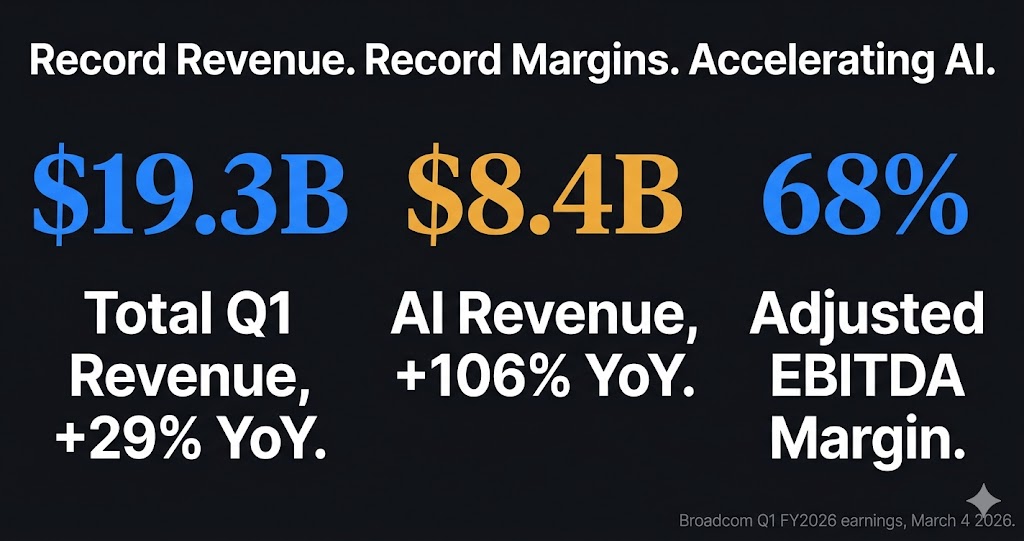
The September 2 Q3 fiscal 2026 release is the current operating baseline as of October 20. Revenue reached $29.591 billion; GAAP diluted EPS was $2.68 and non-GAAP diluted EPS was $3.32. The adjusted figure excludes items including stock-based compensation and acquisition-related amortization, so it should not be treated as the GAAP result.
AI semiconductor revenue was $16.7 billion, up 221 percent year over year and 54 percent sequentially. For Q4, management projected approximately $34.8 billion in total revenue and $21.7 billion in AI semiconductor revenue. Those are forecasts for the quarter ending November 1, 2026, not already-reported sales.
For historical context, the March 4 Q1 release reported $19.311 billion of revenue, $8.4 billion of AI revenue, and $13.128 billion of adjusted EBITDA. Q1 non-GAAP diluted EPS was $2.05, up 28 percent, not $2.10 as the original article stated. The Q1 image above is retained as a dated snapshot.
The progression from Q1 to Q3 supports the growth thesis. The next test is whether shipments, margins, and cash collection keep pace with the larger revenue base. Expectations can rise almost as quickly as the business does, which is where the stock-market fun usually becomes less fun.
The Custom Silicon Advantage
The important distinction is how each company designs and sells its AI computing products. Broadcom’s customer-specific development model deserves its own analysis.
Nvidia sells a broad programmable GPU platform. Broadcom works with customers on custom silicon and supplies networking components. Its April 6, 2026 Form 8-K describes agreements to develop and supply future Google TPUs and networking and other rack components through up to 2031. That is the documented arrangement, rather than a claim that every named AI company has a separate Broadcom-designed chip.
That customization can create substantial switching costs. A customer that co-designs multiple generations has engineering, software, and supply-chain work tied to the relationship. Moving away would require time and investment, but customers can still diversify suppliers, shift workloads, or change future designs.
It is important not to count an unnamed customer as a named one, or confuse a capacity user with a chip-design program. This update does not rely on a six-name customer tally or an unsupported customer-by-customer revenue forecast. The reported AI growth is strong enough to analyze without filling the missing boxes ourselves.
For Anthropic, the April 6 filing describes access through Broadcom to approximately 3.5 gigawatts of next-generation TPU-based compute beginning in 2027. It explicitly makes consumption dependent on Anthropic’s continued commercial success. Anthropic’s announcement also describes Google TPU capacity, not a separate proprietary Anthropic XPU. Gigawatts measure capacity; they are not Broadcom revenue.
Experience Transparency
I have held AVGO for several years through multiple business cycles and the VMware acquisition period when the stock was under pressure from integration concerns. What kept me holding was simple: Hock Tan has one of the best capital allocation track records in technology. He acquires businesses at disciplined prices, integrates them efficiently, and converts them into cash flow machines. The VMware acquisition looked expensive when it closed. Twelve months later the cash flow numbers told a very different story.
The Dividend Growth Story
The dividend adds a different ingredient to the AI growth story. Just do not mistake a cash distribution for a protective helmet around the share price.
The Q3 release kept the quarterly dividend at $0.65 per share. Multiplying by four gives a $2.60 annualized rate, not a guaranteed full-year payment. Historically, Q1 fiscal 2026 capital returns totaled $10.9 billion, comprising approximately $3.1 billion in dividends and $7.8 billion in repurchases.
On March 4, Broadcom announced an additional $10 billion repurchase authorization through December 31, 2026. An authorization permits purchases; it is not a commitment to spend the entire amount. The Q3 cash-flow statement reported no program repurchases in that quarter, while dividends continued.
Broadcom’s cash generation gives it choices: reinvest, repay debt, pay dividends, or repurchase shares. Those uses compete for the same cash. The ability to fund several priorities is attractive, but future dividend increases and buybacks still depend on business performance and board decisions.
For the basics of evaluating a sustainable payout, see our guide to dividend investing. Our Oxford Income Letter review discusses an optional paid dividend-research service. A newsletter is not necessary to calculate payout coverage, and its recommendations are not a guarantee of dividend safety.
VMware: The Business Nobody Talks About Anymore
The VMware transaction closed in November 2023. By Q1 fiscal 2026, more than two years had passed, not twelve months. Integration, pricing, and customer retention remain worth following alongside the reported financial contribution.
Infrastructure software revenue was $6.796 billion in Q1 fiscal 2026 and $8.752 billion in Q3. These are the reported software-segment totals, not VMware-only revenue or bookings. Keeping those labels straight matters when assessing the acquisition’s contribution.
The strategic logic is understandable: software can complement the more cyclical semiconductor business. But software customers can push back on commercial changes, and acquisition-related debt still needs servicing. A useful investment thesis leaves room for those costs instead of declaring integration risk permanently solved.
Free Cash Flow: The Number That Matters Most
Using the Q3 financial reconciliation, operating cash flow of $14.197 billion minus $532 million of capital expenditure equals $13.665 billion of free cash flow. Divide by $29.591 billion of revenue and the margin is approximately 46.2 percent. This is one quarter; it replaces, rather than updates on the same basis, the original article’s unverified TTM and peer-median figures.
For comparison, Q1 capital expenditure was $250 million on $19.311 billion of revenue. An outsourced manufacturing model keeps factory spending off Broadcom’s own capex line, but it does not make capacity, inventory, packaging, or research free. Free cash flow can also fluctuate with working capital, so revenue growth does not automatically mean a rising cash-flow margin.
Long-term agreements can improve planning visibility, but capacity arrangements and management forecasts should not be relabeled guaranteed backlog. Track the commercial conditions, delivery timetable, and actual revenue recognition. Broadcom itself cautions that its free-cash-flow measure does not represent all cash freely available for discretionary spending.
The Risk Case
Customer concentration is a primary risk, and I want to be direct about it. Large AI programs depend on relatively few relationships. A customer’s spending reduction, delayed deployment, or decision to use another design can have a material effect. The timing of that impact depends on contract terms and project schedules, rather than being automatically immediate.
The hyperscalers building custom silicon are also potential competitors in a narrow sense. A hyperscaler that develops enough in-house chip design capability could theoretically reduce its reliance on Broadcom over time. Google’s internal TPU team is the clearest example of this dynamic. The relationship remains deeply collaborative rather than competitive, but the long-term trajectory of hyperscaler silicon independence is worth monitoring.
Geopolitical and supply-chain risk is the second concern. Broadcom depends on contract manufacturing and a limited supplier base. Fabrication, advanced packaging, trade restrictions, and component availability can constrain delivery even when demand is strong.
For a different macroeconomic perspective, our Jim Rickards’ Strategic Intelligence review is an optional further read. Treat a paid service as opinion and research, not as a reliable way to predict trade policy or the stock price. Verify current terms with the publisher before subscribing.
Wall Street Reality Check
Broadcom is easier to evaluate when the semiconductor and software businesses are considered together, without assuming either makes the other risk-free. Strong operating results and a shareholder-friendly reputation do not settle what the shares are worth.
Capital allocation matters through market cycles, but a CEO’s track record is not collateral for a forecast. At Q3 end, Broadcom reported about $59.4 billion of short- and long-term debt and $24.0 billion of cash. That balance sheet belongs in the analysis right alongside the cash generation.
Broadcom vs. Nvidia: Different Bets, Both Worth Understanding
The most common question I get about Broadcom is how it compares to Nvidia as an AI infrastructure holding. The honest answer is that they are solving different problems for different customers.
Nvidia sells a broad GPU computing platform supported by CUDA. Its flexibility and software ecosystem appeal to many customers, while in-house accelerators and other vendors remain alternatives. Nvidia does not capture every AI workload.
Broadcom co-designs custom chips and supplies networking silicon. Those relationships can be sticky, but neither deeper switching costs than Nvidia nor a guaranteed five-to-ten-year customer lock-in can be assumed. They need to be evaluated program by program.
Owning both provides different business exposures, but not independent risks: both are sensitive to AI infrastructure spending and large customers. For the other side of the comparison, see our dedicated Nvidia stock analysis.
Who Should Own Broadcom
Broadcom may suit investors researching AI growth alongside dividend income, but it remains an equity exposed to large drawdowns. Its business model differs from Palantir and Vertiv; that does not establish that AVGO will always be less volatile.
Income investors should calculate yield from the current share price and the declared dividend, then assess coverage and competing cash demands. A $2.60 annualized distribution can be useful, but the amount of income earned per dollar invested depends on the entry price.
Growth investors should compare a current earnings or free-cash-flow valuation with slower-growth scenarios. Cash generation supports flexibility; it does not ensure the shares will hold up in a risk-off market. Customer concentration, debt, and valuation remain part of the same decision.
For readers comparing paid research tools, our Louis Navellier’s Growth Investor review explains a fundamental and quantitative screening approach. This article does not verify that AVGO is currently recommended by the service. Research subscriptions are optional, their picks can lose money, and renewal and cancellation terms deserve a look before checkout.
Bottom Line
Broadcom is an AI infrastructure business that also pays a dividend. The latest results show strong AI growth and cash generation, while the Google and Anthropic agreements illustrate the opportunity and its conditions. The next questions are execution, cash conversion, customer concentration, and valuation. A quarterly dividend is nice company on the journey; it does not promise a smooth ride.
Further Reading
Disclaimer: This article is for informational and educational purposes only and does not constitute financial advice. StockHitter.com and Jenna Lofton are not registered investment advisors. All investing involves risk, including the potential loss of principal. Past performance does not guarantee future results. Always conduct your own due diligence and consult a licensed financial professional before making investment decisions. Jenna Lofton holds a position in PLTR. Some links on this page may be affiliate links, meaning StockHitter.com may receive compensation if you subscribe to a service at no additional cost to you. This does not influence our editorial opinions.