


Is Stock Rover worth paying for?
Stock Rover is worth considering if you repeatedly compare businesses, investigate financial history, and organize research around a portfolio. Its biggest appeal is putting those jobs in one workspace. Its biggest buying trap is choosing a plan before checking which historical, screening, and export capabilities you actually need.
For an occasional stock lookup, a paid subscription may be unnecessary. For an investor maintaining a detailed research process, the current Premium or Premium Plus plans deserve a closer look. The difference should be a recurring task you can name, not a vague feeling that more data must be better.
This Stock Rover review examines current official features, prices, and limitations. It is a documentation-based assessment, not a claim of personal paid-account testing. Some published plan details conflict, and those deserve attention before anyone reaches for a credit card.
What Stock Rover actually does
Stock Rover is a browser-based investment-research platform. Its advertised functions span stock and fund research, screening, company comparisons, charts, watchlists, and portfolio analysis. Its coverage description focuses on North American equities, alongside ETFs and mutual funds. Check the listings you need before choosing a tier.
Think of the intended workflow as a chain: narrow a research universe, investigate the candidates, compare the numbers, save your reasoning, and revisit the businesses you own or follow.
The attraction is reducing the amount of context you rebuild every time you research a company. A good research record should answer why a stock made the list, which figures mattered, and what would change the conclusion. Otherwise, six months later you are left staring at a ticker and trying to remember whether it represented a serious thesis or a very persuasive Tuesday.
The platform does not take responsibility for your investment decisions. Stock Rover’s official FAQ also says trades cannot currently be executed through it. Brokerage-linked research is different from an order-entry platform.
Current Stock Rover pricing
The current pricing page, checked October 19, 2026, lists four paid plans. Older reviews that center on the former Essentials plan should not be used as today’s shopping guide.
| Plan | Monthly billing | Annual upfront bill | Two-year upfront bill |
|---|---|---|---|
| Premium | $34 | $348 | $576 |
| Premium Plus | $70 | $588 | $1,008 |
| Ultimate | $99 | $948 | $1,656 |
| Ultimate Pro | $199 | $1,788 | $3,096 |
Prices are in U.S. dollars before applicable taxes. The annual Premium bill works out to $29 per month, but you pay $348 for the year. The two-year version works out to $24 per month, with $576 committed for two years.
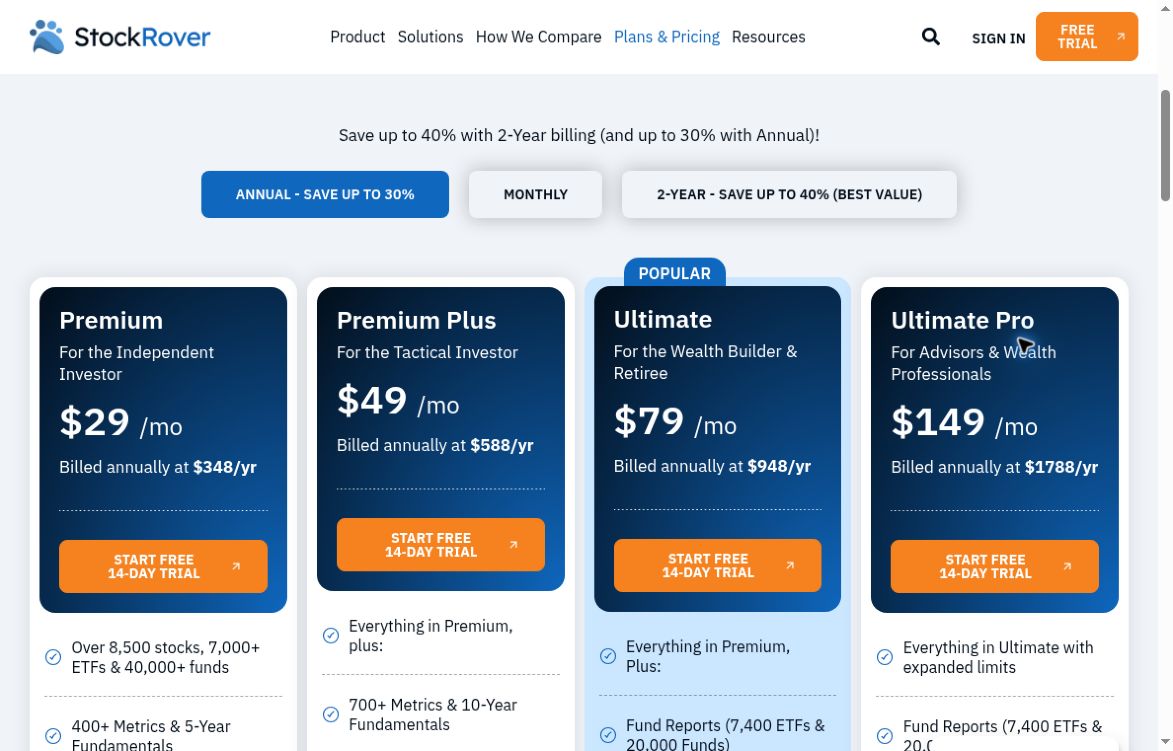
Those are three different purchasing decisions. A lower monthly equivalent is not automatically a better deal if you are still figuring out whether the product belongs in your routine.
The ongoing Free plan supports basic individual-stock research and market monitoring. It is different from the temporary Ultimate trial that new Free accounts receive, according to the official FAQ. A feature visible during the trial may not remain available on Free; identify the required paid tier before subscribing.
Premium versus Premium Plus is the first useful decision
For an individual investor, the initial question is usually whether ordinary fundamental research is enough or whether you need to express more detailed conditions across historical data.
Premium advertises five years of fundamentals, research and comparison tools, portfolio functions, and standard stock screening. Premium Plus adds ten-year fundamentals and historical/equation screening, among other capabilities.
The distinction between seeing history and screening on history matters. You might be able to inspect a company’s earlier results but still need a higher tier to ask the screener to find companies that meet a particular condition over several periods.
Examples of questions worth testing include:
- Has profitability improved over a defined historical period?
- Which candidates meet two financial conditions at the same time?
- Can I create a metric that reflects the way I compare these businesses?
- Can I save the result and recover the assumptions later?
These are research questions, not validated stock-picking strategies. If your process does not use historical or custom screening, the extra tier may provide little practical value.
On annual billing, Premium Plus costs $240 more than Premium. That is a $20 monthly equivalent difference. Decide whether the specific extra capability justifies that recurring expense. “It seemed more complete” is a very flexible answer, which is why subscription companies enjoy it so much.
What the higher tiers are for
Ultimate advertises a longer fundamental history, fund reports, larger working limits, and additional data categories. Ultimate Pro is positioned toward professional and higher-volume use.
Those tiers may be relevant when a specific requirement exceeds the lower plans: a larger research universe, more portfolio work, additional historical depth, or considerably more exports.
They are not automatic upgrades for someone who wants to become a better investor. Sophisticated tools can help answer sophisticated questions. They can also help you ask a simple question in a magnificently complicated way.
Some higher-tier capacity numbers differ across the vendor’s current pages, which is a reason to verify your requirement before paying. The specific conflicts are listed below.
The limits you should check before subscribing
The plan comparison lists the following limits for the first three paid tiers:
| Limit | Premium | Premium Plus | Ultimate |
|---|---|---|---|
| Table rows | 250 | 500 | 1,000 |
| Data exports per month | 10 | 90 | 500 |
| Custom metrics | 0 | 30 | Unlimited |
| Screeners | 15 | 30 | 120 |
Translate those numbers into your own work. If you save a few long-lived screens and export once a week, your needs differ from someone generating several daily versions of a large research table.
Also distinguish the type of export. Stock Rover says historical price data cannot be exported because of licensing restrictions. Paid subscriptions can export statement and table-metric data. “Has exports” should not be read as “can download every historical dataset.”
That matters if your real objective is building an outside spreadsheet model, database, or research pipeline. Check the required fields and permitted use rather than assuming a CSV button solves every data problem.
A useful fundamental-research task to try
A trial is most informative when it has an assignment. Try this comparison before deciding whether to subscribe.
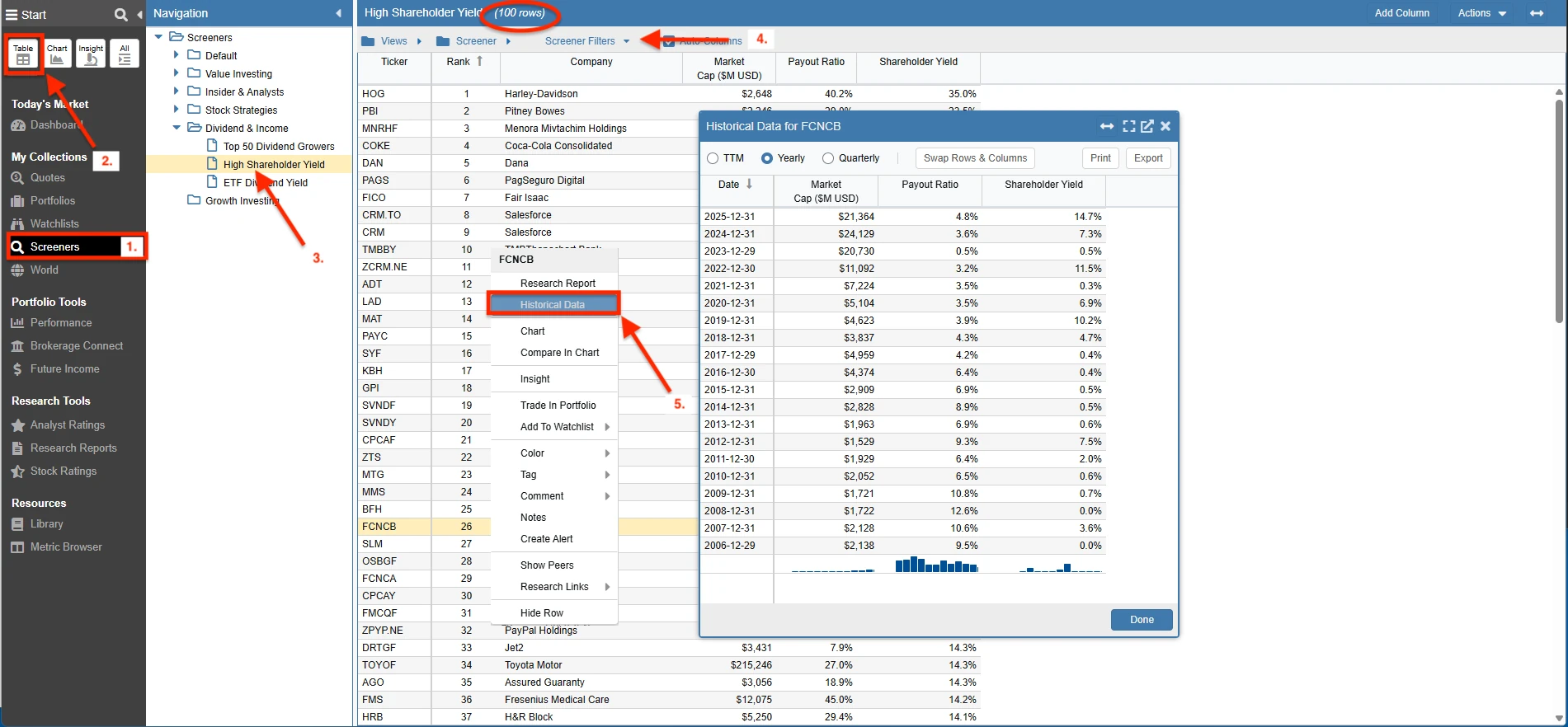
Choose three businesses from the same industry that you already want to understand. You are comparing research tools, so there is no need to manufacture a brilliant new investing strategy before lunch.
- Define the comparison. Write down the reporting period and the financial questions. Revenue growth, margins, debt, and valuation may be relevant, depending on the businesses.
- Check the data definitions. Annual figures, quarterly figures, and trailing-twelve-month figures should not quietly trade places in the table.
- Inspect the history. Identify whether the period you need is available on the selected tier and whether a missing value is actually missing rather than zero.
- Verify one important figure. Compare it with the company’s filing and investigate adjustments, restatements, or timing differences.
- Save a short thesis and a concern. Record what deserves further work and what might make you reject the idea.
- Test the next step. Can you recover the comparison later, express the intended screen, and use the output in your actual research process?
The output should be a clearer comparison and a record of limitations. Do not judge the trial by how many columns you can squeeze onto the screen.
The earnings-report guide provides a checklist for checking revenue, EPS, cash flow and management guidance against the source documents.
Portfolio tools help only when the inputs are right
Stock Rover distinguishes a portfolio, which stores holdings and purchase information, from a watchlist, which primarily tracks tickers. That difference affects what conclusions you can draw from the displayed analysis.
A hypothetical portfolio is useful for learning the system without assuming that an imported account is complete or accurate. If you later connect a brokerage, verify holdings, cash, transaction history, corporate actions, and the relevant dates before relying on performance calculations.
A missing cash movement or an incorrect share count can change the result. A professional-looking report is still a report built from inputs.
After the inputs reconcile, the portfolio rebalancing guide shows how to compare actual weights with your target allocation.
Stock Rover describes third-party aggregation for brokerage connections. This review does not independently audit that connection’s security, reliability, or institution coverage. Read the permissions and decide whether linking an account is necessary for the research task you want to perform.
Three published details need clarification
Stock Rover’s published plan pages disagree on three details that could affect your purchase.
- Ultimate Pro capacity: The plan summary advertises 300-plus screeners and 30 brokerage connections, while the comparison table lists 1,000 screeners and 60 connections. Confirm the exact limits if they influence your purchase.
- Premium screening: The plan description explicitly advertises stock screening, while the combined stock-and-ETF screening row in the comparison table is marked differently. The FAQ says ETF screening is available across paid plans. Verify the distinction between standard and advanced ETF capabilities.
- Real-time quotes: The FAQ describes real-time quotes generally, while the plan comparison places the real-time feature in higher tiers. Check the selected plan and the particular instrument rather than assuming every subscription has identical data timing.
These conflicts do not prove the platform cannot do the work. They mean a precise plan recommendation should be based on confirmed access, especially when the subscription is nonrefundable under the vendor’s published policy.
Historical screens do not prove a strategy worked
Stock Rover’s backtesting support answer says it does not have a dedicated backtesting feature. Its historical-screening workaround is limited by available historical metrics and does not account for survivorship bias.
There is also an important difference between charting today’s qualifying stocks backward and recreating a strategy that selected stocks using only the information available at each historical date.
If the exercise begins with companies that survived and uses data later revised or restated, it may make the past look easier to navigate than it really was. Historical research can be helpful without being a complete, investable simulation.
Similarly, a rating or fair-value estimate is an analytical input. It is not a promise that a stock will reach a particular price or beat a benchmark.
Trial, renewal, and refund terms
Stock Rover says its 14-day trial requires no credit card and reverts to Free when it ends. You can change trial tiers to inspect different capabilities.
The trial is not unrestricted. Table CSV exports are unavailable, and the pricing FAQ identifies limits on research and ratings reports. If exporting is the reason you would subscribe, record that it remains untested during a standard trial.
Paid subscriptions renew automatically unless cancelled. The vendor’s published policy says it does not issue refunds; cancelling stops the next renewal while current-term access continues. Check the active subscription and any separate add-on before assuming one cancellation covers everything.
That makes the no-card trial valuable, but only if you use it to investigate the plan you would actually buy.
Who should consider Stock Rover?
- Consider it if you repeatedly research individual businesses and want a more organized comparison and portfolio-analysis process.
- Inspect Premium Plus if historical or equation-based screening is a central requirement.
- Stay with free or existing tools if you mainly check occasional quotes, read a few filings, or do not yet have a recurring research task. Our Finviz screener walkthrough shows a simple starting exercise, with the limits of each filter explained.
- Look elsewhere for execution if your main need is entering and managing trades.
- Get explicit confirmation first if you depend on disputed capacity, data timing, or a particular export.
Stock Rover’s potential value is a research process you can repeat and understand. Start with the question, test the necessary tools, and buy the smallest plan that genuinely does the job.
Review basis: Official pricing, plan comparisons, FAQs and screening documentation checked October 19–20, 2026.