

Updated: August 1, 2026 | By Jenna Lofton, StockHitter.com
Jenna’s Bottom Line
Let’s talk about the stock you spent three weeks researching, agonized over, and finally bought at exactly the wrong moment. Cute. It doesn’t matter nearly as much as you think it does. The most famous statistic in portfolio management, the one that claims asset allocation explains 93.6 percent of your returns, is also one of the most confidently misquoted numbers in all of finance. Half the industry has been repeating it wrong for forty years. Here’s what it actually means, and why the real lesson buried underneath the bad math still holds up anyway.
Key Takeaways
- The famous 93.6 percent stat is widely misquoted: the 1986 Brinson, Hood, and Beebower study measured what explains a portfolio’s quarter-to-quarter return swings over time, not “93.6 percent of your total return comes from allocation instead of stock picking.” Even the study’s own author has publicly corrected this misuse.
- The Rule of 110 is the 2026 default: subtract your age from 110 to get your target stock percentage. A 35-year-old lands at 75 percent stocks, 25 percent bonds and cash.
- The old “100 minus age” rule is officially outdated. People are living longer, bonds yield less than they used to, and most advisors now use 110 or even 120 minus age instead.
- JPMorgan’s own 2026 forecasts project a 6.4 percent expected return for a standard 60/40 portfolio, rising to 6.9 percent when you add a modest alternatives allocation. Small tweaks, real money, over enough years.
- Your risk tolerance beats any formula. If a 40 percent portfolio drop would send you into a full spiral, no age-based rule matters more than being honest with yourself about that.
The Study That Ruins Everyone’s Fun (And Also Everyone’s Facts)
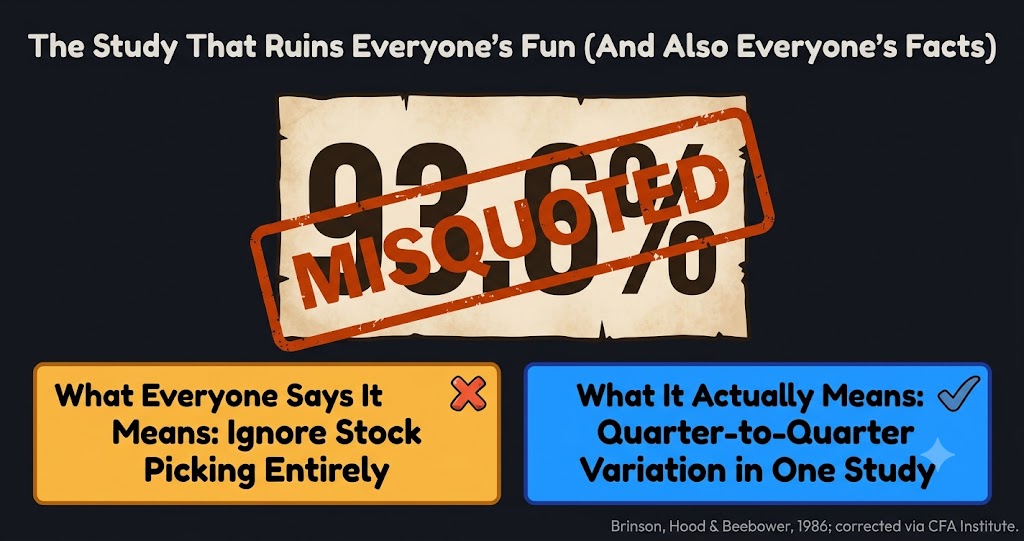
Let’s rip the band-aid off immediately, and then rip off a second, more accurate band-aid right after, because apparently one wound wasn’t enough today. In 1986, three researchers named Gary Brinson, Randolph Hood, and Gilbert Beebower published a study in the Financial Analysts Journal that every stock picker on earth has heard misquoted at least once, usually in a slide deck from someone trying to sell them something they don’t need.
The famous claim: asset allocation explains 93.6 percent of your portfolio’s returns. The actual finding, per Brinson’s own regression analysis of 91 pension funds: allocation policy explains 93.6 percent of the quarter-to-quarter variation in a given portfolio’s returns over time, not 93.6 percent of the total return level, and definitely not “ignore stock selection entirely.” Brinson himself has publicly corrected the marketing-department version of his own study more than once.
Here’s the part that survives the correction, though, and it’s still a genuinely big deal. Even the more careful academic re-reads of BHB’s work, and the follow-up studies that replicated it with cleaner data, consistently find that the structural mix of stocks, bonds, and cash drives the overwhelming majority of a portfolio’s volatility and long-run trajectory. Security selection and market timing still matter. They just matter meaningfully less than most people, myself included at 24, assumed.
So no, allocation isn’t literally 93.6 percent of your returns in some magic universal sense. But structure still beats swagger, on average, over time. That part of the myth happens to be true.
The Rule of 110 (And Its Cooler, Riskier Cousins)
Okay, so if allocation is the whole ballgame, how do you actually pick one? Enter the age-based rule of thumb, which is exactly as simple as it sounds and somehow still gets ignored by roughly everyone I’ve ever met.
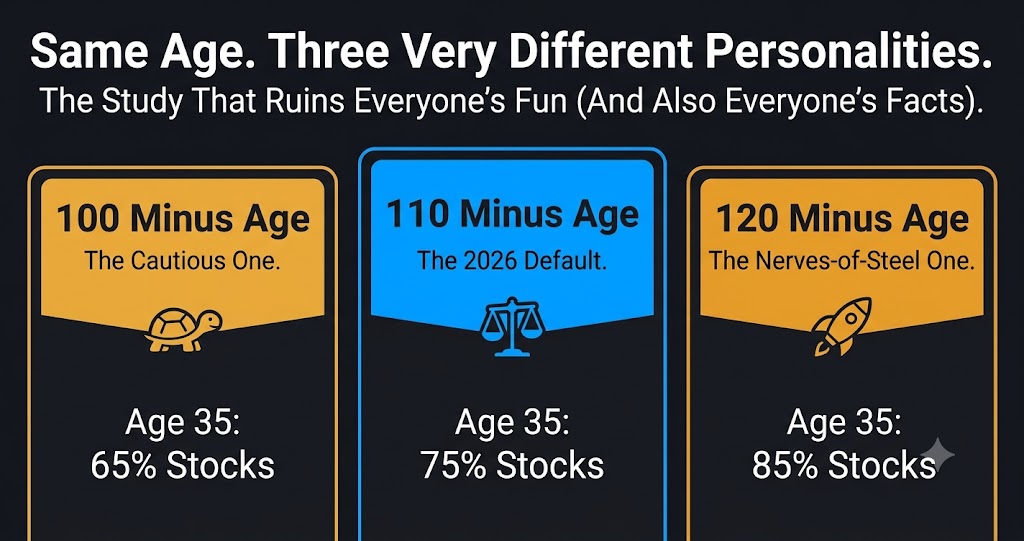
Take 110. Subtract your age. That’s your target stock percentage. The rest goes to bonds and cash. A 35-year-old lands at 75 percent stocks, 25 percent everything else. A 55-year-old lands at 55/45. Simple, defensible, and it actually adjusts as your life circumstances change instead of staying frozen forever like a college nickname you never asked for.
Here’s where it gets interesting. The classic version of this rule used 100 instead of 110, and that version is now considered, and I’m quoting the industry consensus here, an “oversimplification.” People are living longer. Bond yields have gotten less generous. So most advisors in 2026 have shifted to 110 minus age as the default, with a more aggressive 120-minus-age variant for people with a genuinely long horizon and the stomach to match.
- 100 minus age: the cautious grandparent of the group. Age 35 gets you 65 percent stocks.
- 110 minus age: the 2026 default, and the one I’d point most people toward. Age 35 gets you 75 percent stocks.
- 120 minus age: the “I have decades and nerves of steel” version. Age 35 gets you 85 percent stocks.
None of these are gospel. They’re starting points, not commandments carved into a stone tablet somewhere in a Vanguard basement. Adjust based on your actual risk tolerance, not the version that sounds coolest at a party.
What This Actually Looks Like in a Real Portfolio
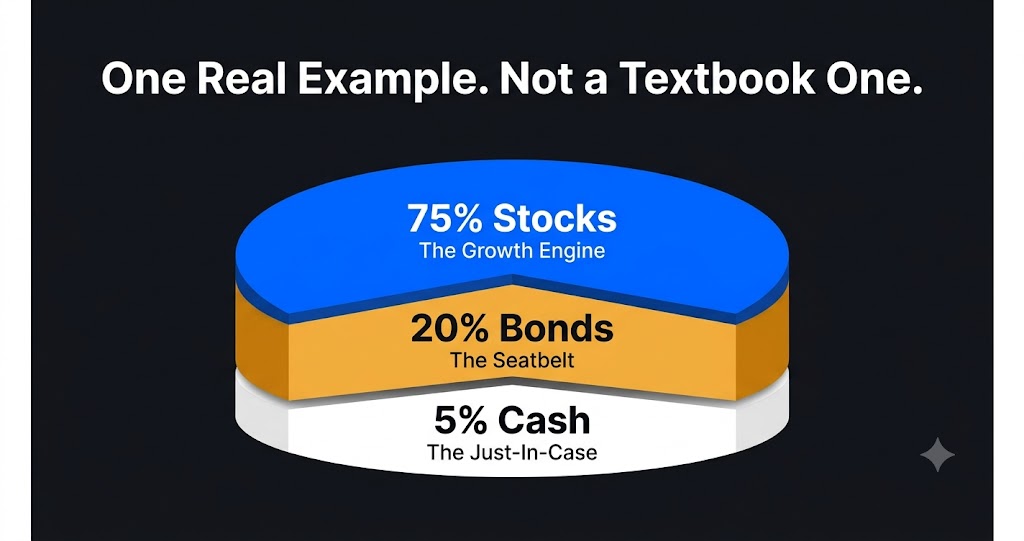
Formulas are nice. Formulas you can actually picture are better. Let’s say you’re 35 and using the Rule of 110. Your 75 percent stock allocation isn’t just “stocks, whatever, big pile of stocks.” It should include U.S. large-cap holdings as the foundation, some small-cap and international exposure for diversification, and if you want a satellite of individual conviction picks like Palantir (PLTR) or Nvidia (NVDA), that’s the corner of the portfolio where it lives.
Your remaining 25 percent isn’t just one boring bond fund either. A reasonable split might run 20 percent bonds, blending Treasuries and investment-grade corporates, and 5 percent cash sitting there for emergencies and opportunities, because “I saw a great buying opportunity but had zero liquidity” is a genuinely tragic sentence to say out loud.
This is not financial advice tailored to you specifically, obviously, but it’s a real, tangible shape instead of a Greek-letter equation. For the full picture on how index funds fit into that stock allocation, see our guide to index funds vs. individual stocks.
Why Your Bonds Aren’t Just “The Boring Part”
People treat the bond portion of their portfolio like the vegetables on a plate. You know you’re supposed to have some. You don’t particularly want to think about it. That’s a mistake, and here’s the accurate, slightly annoying truth: bonds are not one asset class, they’re several wearing a trench coat pretending to be one.
Treasuries are the safest of the bunch, and the ones that actually cushion your portfolio hardest when stocks fall off a cliff. Investment-grade corporate bonds pay a bit more for a bit more risk. High-yield bonds behave more like stocks in disguise, which sort of defeats the entire purpose of holding them for stability in the first place. If inflation stays sticky, a small TIPS allocation, Treasury Inflation-Protected Securities for anyone who just heard that acronym for the first time, adds real protection that plain vanilla bonds don’t.
Lumping all of that into “the bond part” is like calling every vegetable “salad.” Technically not wrong. Extremely unhelpful.
Experience Transparency
For the first several years of my investing life, my “allocation strategy” was basically vibes. I bought stocks I liked, ignored bonds because they felt like admitting defeat, and called it a portfolio. Then 2022 happened, and my extremely stock-heavy, bond-light setup got humbled in a way that felt personal. I rebuilt everything around an actual age-based target after that, and the weird part is my returns didn’t get worse. They got calmer, which, it turns out, is exactly what lets you stay invested through the scary parts instead of panic-selling at the bottom like a rookie. Structure isn’t the fun part of investing. It’s the part that keeps you in the game long enough for the fun part to matter.
The 2026 Numbers Worth Actually Knowing
Since we’re already deep in nerd territory, here’s a number that made me sit up: JPMorgan’s own 2026 Long-Term Capital Market Assumptions project a 6.4 percent expected annual return for a standard 60/40 global stock-bond portfolio over the next 10 to 15 years. Add a modest 30 percent alternatives sleeve, real estate, private equity, that sort of thing, and that expected return climbs to 6.9 percent with a meaningfully better Sharpe ratio to boot.
A half a point doesn’t sound thrilling in a sentence. Compounded over 25 years on a meaningful account balance, it’s a genuinely different retirement. Allocation tweaks are quiet. Their effects are not.
For a deeper dive into how the classic 60/40 framework is being reconsidered in 2026, including Vanguard’s own surprising shift, see our pillar guide to how to build an investment portfolio.
Rebalancing: The Part Everyone Conveniently Forgets
Here’s a fun fact nobody wants to hear: pick a perfect allocation today, do nothing else, and within a year it won’t be your allocation anymore. Stocks and bonds grow at different rates, so your carefully chosen 75/25 quietly drifts into something else entirely while you’re busy living your life and not checking your brokerage app every day like a well-adjusted person.
That’s what rebalancing is for, and we cover the full mechanics, including how often to actually do it, in our dedicated guide to portfolio rebalancing. The short version: it’s the unglamorous maintenance task that keeps your allocation from becoming an accident.
Wall Street Reality Check
Here’s my favorite piece of financial industry mischief: the same 93.6 percent statistic that gets used to argue “stop picking stocks, only allocation matters” was never actually saying that, and the guy who wrote the original study has spent years telling people so, largely to no avail. Brinson told Kiplinger directly that the number is an average across pension plans studied for one specific decade, not a universal law applying to your personal Robinhood account. Financial marketing departments ran with the flashy, oversimplified version anyway, because “93.6 percent!” sells better than “structural allocation is a meaningfully important but not singularly dominant factor in long-run portfolio outcomes, subject to caveats.” The corrected version is less quotable and still true enough to build a strategy around. That’s usually how it goes with statistics that sound too clean to be real.
Bottom Line
Asset allocation is not the fun part of investing. It’s also, according to decades of data, basically the entire game. Pick a target using the Rule of 110 as your 2026 starting point, build real diversification into both the stock and bond sides instead of treating them as monoliths, and rebalance on a schedule instead of by mood. Your stock picks can still be great. Just don’t confuse them for the thing that’s actually doing most of the heavy lifting.
Further Reading
Disclaimer: This article is for informational and educational purposes only and does not constitute financial advice. StockHitter.com and Jenna Lofton are not registered investment advisors. All investing involves risk, including the potential loss of principal. Past performance does not guarantee future results. Always conduct your own due diligence and consult a licensed financial professional before making investment decisions. Jenna Lofton holds positions in PLTR and NBIS. Some links on this page may be affiliate links, meaning StockHitter.com may receive compensation if you subscribe to a service at no additional cost to you. This does not influence our editorial opinions.