

By Jenna Lofton, StockHitter.com
Jenna’s Bottom Line
Nvidia remains a central company in the AI infrastructure cycle. The CUDA software ecosystem, Blackwell deployments, and the Vera Rubin production ramp make a strong business case. But a strong business and a good entry price are two separate homework assignments. Customer spending, competition, and the valuation still deserve a close look.
Key Takeaways
- Nvidia’s latest reported quarter is Q2 fiscal 2027: revenue of $96.2 billion, up 106 percent year over year, and Data Center revenue of $89.0 billion, up 117 percent. Results were released August 26, 2026.
- The CUDA software ecosystem is a major competitive advantage. Moving optimized applications, libraries, and engineering workflows to another platform can be costly, but the difficulty varies by workload and customer.
- Custom accelerators are a real competitive risk, not just a theoretical one. Google trained Gemini 1.0 on its own TPUs, and Anthropic uses several hardware platforms. This analysis does not rely on an unverified market-share percentage.
- At GTC in March 2026, Jensen Huang described visibility into at least $1 trillion of revenue over 2025–2027. That is a management expectation across three calendar years, not guaranteed future sales or a one-year forecast.
- For Q3 fiscal 2027, management guided revenue to $108 billion, plus or minus 2 percent. Guidance is a forecast; a current investment decision still needs a current share price and a consistently defined earnings estimate.
What Nvidia Actually Does
Nvidia designs graphics processing units and the software ecosystem that runs on them. That description undersells it significantly.
Nvidia GPUs are widely used to train and run AI models, but not every major model was primarily trained on Nvidia hardware. Google says Gemini 1.0 was trained on its TPUs v4 and v5e; Anthropic describes using AWS Trainium, Google TPUs, and Nvidia GPUs. Hardware diversity is already part of the competitive picture.
But the hardware is only half the story. Nvidia’s CUDA toolkit combines libraries, a compiler, runtime, and development tools for GPU-accelerated computing. Its long-established software ecosystem helps explain why a purchasing decision involves much more than the chip’s specification sheet.
Nvidia’s Revenue Growth: The Numbers
Start with the latest report: Q2 fiscal 2027 results, released August 26, 2026, for the quarter ended July 26. Revenue was $96.2 billion. GAAP diluted EPS was $2.46; non-GAAP diluted EPS was $2.22. Those are different accounting measures, not interchangeable versions of the same valuation input. The reconciliation also excludes equity-security gains from adjusted earnings; strong headline profit is not identical to recurring operating cash generation.
For historical context, Q1 fiscal 2027, reported May 20, produced $81.6 billion in revenue, up 85 percent, and $1.87 non-GAAP diluted EPS. The 85 percent figure describes revenue growth, not earnings growth.
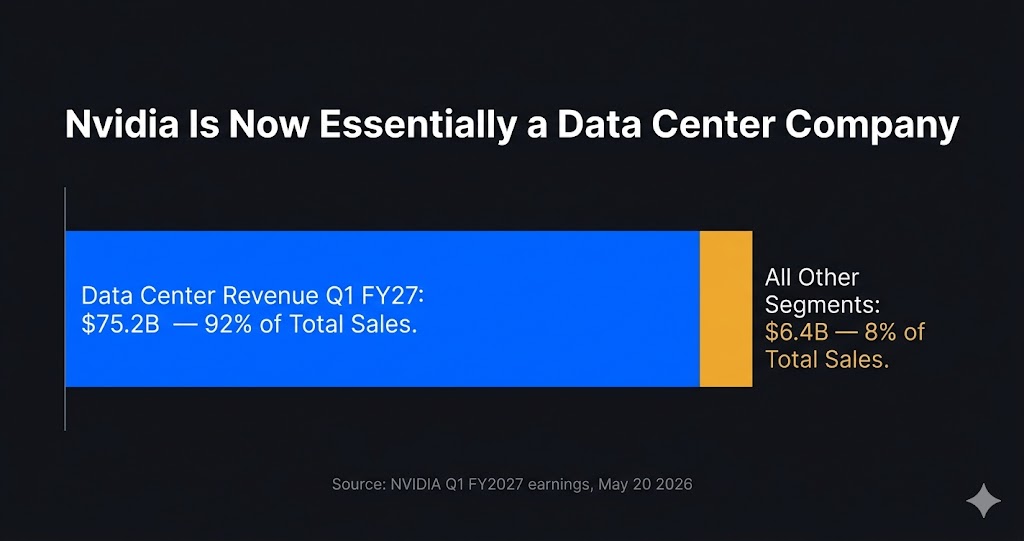
The original Q1 chart below remains a historical snapshot: Data Center contributed $75.2 billion, roughly 92 percent of sales. Q1 compute revenue was $60.4 billion and networking revenue was $14.8 billion. For Q2, total Data Center revenue reached $89.0 billion, also approximately 92 percent of company revenue.
For fiscal 2026 ended January 25, 2026, Nvidia generated $215.9 billion in revenue, up 65 percent. A useful accounting footnote: starting in Q1 fiscal 2027, Nvidia stopped excluding stock-based compensation from non-GAAP results and recast the comparisons it presents. Use that comparable series rather than mixing it with older adjusted EPS figures.
The CUDA Moat: Why Switching Is Hard
The most durable competitive advantage Nvidia holds is not its hardware. It is CUDA.
CUDA is the software platform that allows developers to use Nvidia GPUs for general-purpose computing. The accumulated code, tools, and developer familiarity can make an existing Nvidia installation easier to extend than to replace.
Switching away from CUDA is not simply a matter of buying different chips. It can mean adapting software libraries, retraining engineering teams, and validating performance and reliability. For a heavily optimized production system, that is a serious project. For a new workload built on portable frameworks, the hurdle may be lower.
That is the moat to watch: whether customers keep choosing Nvidia after comparing total deployment cost, software support, and performance on their own workloads. Vendor benchmark victories alone do not settle that question. A lovely slide is still not a production deployment.
Blackwell and Vera Rubin: What Has Changed
Blackwell succeeded Hopper and expanded Nvidia’s rack-scale approach, integrating Grace CPUs with GPU systems. It remains part of the installed-base story, but calling it the only current frontier while treating Rubin as a distant pipeline discussion is now out of date.
In its August 26 Q2 release, Nvidia said Vera Rubin was ramping into full production, with racks running at partners including CoreWeave, Google Cloud, Microsoft Azure, Oracle Cloud Infrastructure, and Nebius. That is a production-stage update, not merely a product-roadmap promise.
For investors, the important test is how that transition converts into shipped systems, recognized revenue, margins, and customer economics. Faster product cycles create upgrade opportunities, but they also bring execution risk and the possibility that customers wait for the next generation.
Experience Transparency
I started building a position in Nvidia in 2023 when the consensus view was that the post-ChatGPT enthusiasm would fade within two to three quarters. What changed my thinking was not the hype cycle. It was a conversation with an enterprise AI engineer who explained that migrating their production workloads off CUDA would take 18 months minimum and likely set back their AI roadmap by two years. That was not a product preference. That was a structural dependency. I have held and added through every correction since. The CUDA moat is the reason I sleep fine through the volatility.
Hyperscaler Capex: A Demand Driver, Not a Floor
Nvidia benefits from infrastructure investment by large cloud providers and AI developers. But their total capital expenditure is not the same thing as orders for Nvidia: it also pays for buildings, power, networking, custom silicon, and other equipment.
At the March 16, 2026 GTC keynote, summarized in Nvidia’s March 19 recap, Huang said he saw at least $1 trillion in revenue across 2025 through 2027. That longer period should not be compared directly with an older $500 billion figure covering 2025–2026. Neither statement should be read as audited backlog or a guarantee.
A useful demand checklist is simpler than the trillion-dollar headlines: are customers deploying capacity, earning an adequate return on it, and continuing to fund the next build? Delays in power availability, financing, or AI monetization can slow supplier revenue even when the long-term technology case remains appealing. In Q2, operating cash flow was $24.1 billion versus $59.7 billion of GAAP net income, with receivables and inventory absorbing cash. That gap is worth monitoring alongside revenue growth.
For our full analysis of the hyperscaler capex cycle and its downstream beneficiaries, see our guide to best AI stocks to buy in 2026.
The Risk Case
I want to be direct about the risks because a complete analysis requires acknowledging them honestly.
Custom silicon is a significant long-term threat. The Google and Anthropic examples above show that alternative accelerators already handle important workloads. Customers can mix platforms rather than make one all-or-nothing choice, so Nvidia can grow in dollars while still facing pressure on share or pricing.
The counterargument is that Nvidia offers a broad, programmable platform with a substantial software ecosystem. That versatility can be valuable as models and workloads change. It does not make competing systems incapable of training frontier models, and it does not guarantee that Nvidia will win every inference workload.
Export restrictions are the second material risk. Nvidia recorded a $4.5 billion H20-related charge in Q1 fiscal 2026 for excess inventory and purchase obligations. Its Q3 fiscal 2027 outlook assumes no Data Center compute revenue from China; that is narrower than excluding all China Data Center revenue. Export policy remains a source of uncertainty.
Valuation is the third. Do not carry a June forward-P/E estimate into an October purchase decision. Recalculate price divided by the same provider’s expected EPS for a clearly identified fiscal period, then test a slower-growth case. A good company can still deliver a poor stock return if the entry price assumes too much.
Wall Street Reality Check
The bear case deserves more than an eye roll, and the bull case deserves more than a chart that goes up and to the right. CUDA and the scale of AI spending are meaningful advantages. Customer concentration, competing accelerators, product transitions, and valuation are meaningful risks. A software-enabled infrastructure platform can still be exposed to a capital-spending cycle. Both things can be true.
Nvidia vs. AMD: The Competitive Reality
AMD is an important hardware and software competitor. Its July 23, 2026 announcement introduced Instinct MI400-series GPUs and Helios rack-scale systems, supported by ROCm software. An analysis that stops at MI300 misses the current product cycle.
The honest competitive picture is that customers evaluate complete systems: chips, networking, software, power consumption, availability, and engineering effort. Nvidia’s ecosystem is a substantial advantage, but AMD is also investing in a full stack rather than competing on chip price alone.
A hyperscaler evaluating GPU purchases is not just buying hardware performance per dollar. It is evaluating software compatibility, developer tooling, supply reliability, and switching costs. Compare results for the actual model and deployment configuration; do not treat either vendor’s best-case benchmark as a universal ranking.
Valuation Framework
The right starting point is a current price and a consistent earnings basis, not an old multiple repeated until it sounds permanent. Compare GAAP with GAAP, or adjusted with adjusted, and understand what each removes.
The relevant valuation question is whether the earnings trajectory justifies the price. Q1’s 85 percent revenue growth was not an earnings-growth rate: the company reported 140 percent comparable non-GAAP EPS growth and 214 percent GAAP EPS growth. Those unusually strong comparisons are historical results, not a sensible perpetual-growth assumption.
The framework I use is simple. Test several outcomes for revenue growth, margins, and the exit multiple. If customer spending slows, earnings estimates and the multiple can both fall. If growth stays strong, investors still need to ask how much of that success is already priced in. The spreadsheet needs a downside column, not just a party hat.
For readers comparing research tools, our Louis Navellier’s Growth Investor review discusses a paid service built around fundamental and quantitative stock screening. It is optional research, not evidence that NVDA is a bargain or a promise of superior returns. Check the publisher’s current subscription, renewal, and cancellation terms before paying.
Who Should Own Nvidia
For an investor who chooses to own it, Nvidia makes more sense as a risk-budgeted part of a diversified portfolio than as a substitute for diversification. An AI thesis is not an emergency fund.
A multi-year time horizon helps, but it does not eliminate the possibility of a large or lasting loss. Size the position so a sharp drawdown would not force a sale to meet ordinary expenses. There is no rule that the next correction must resolve upward just because earlier ones did.
Investors who need stability or near-term income should not assume an AI fund solves those needs either. Broader funds can reduce single-company concentration while still carrying substantial market and sector risk. For a framework on sizing growth positions, see our guide to investing strategies and our discussion of growth investing.
Bottom Line
Nvidia is a major toll booth on the AI highway, but it does not own every road. CUDA, strong reported growth, and the Rubin ramp support the business case. Competition, export restrictions, customer spending, and the price paid determine how much of that case reaches shareholders. The company deserves serious research; the stock still has to earn its place at the valuation available when you buy.
Further Reading
Disclaimer: This article is for informational and educational purposes only and does not constitute financial advice. StockHitter.com and Jenna Lofton are not registered investment advisors. All investing involves risk, including the potential loss of principal. Past performance does not guarantee future results. Always conduct your own due diligence and consult a licensed financial professional before making investment decisions. Jenna Lofton holds a position in PLTR. Some links on this page may be affiliate links, meaning StockHitter.com may receive compensation if you subscribe to a service at no additional cost to you. This does not influence our editorial opinions.