

Last Updated 09/07/2026

Hey! So this is kind of a weird one to review because I wasn’t even planning to look at Retirement Millionaire. My dad subscribed and kept forwarding me emails from “Doc” that I honestly just deleted for about six months.
But then around Thanksgiving 2021 he wouldn’t stop talking about his portfolio gains and how this newsletter is “the real deal” and I should write about it. So fine, Dad. Here’s your review, and here’s the update he’s been asking about since I mentioned the portfolio grew again.
I’ve had access to his account since November 2021, nearing five years now, which is longer than most of my friendships have lasted. What you’re reading below is based on an actual portfolio export dated September 7, 2026 showing all 34 open positions with real returns. Not marketing claims. Not “based on research.” Data straight from the Stansberry Research members area.
Short version: Dr. Eifrig’s Retirement Millionaire portfolio now shows 30 of 34 open positions in the green, an 88.2% win rate, up from 85% back in February. The top position is up over 1,500%.
One honest wrinkle since my last update: a nuclear technology position got stopped out at -25% after entering in January, a fast loss that shows even Doc’s conservative system occasionally cuts one quickly rather than letting it bleed.
At $79 promotional pricing with a 30-day guarantee, this remains one of the more transparent conservative newsletters I track.
The Skinny (Because You’re Probably Skimming)
- Win rate improved since February. 88.2% of open positions are now profitable, up from 85%, even though the total position count shrank from 39 to 34.
- The top holding is up over 1,500%. Same 2010 software pick from before, it just kept climbing.
- A new loser got cut fast. A nuclear technology stock entered in January was stopped out at -25% by September, proof the “Strong Buy” label doesn’t mean untouchable.
- The Chaos Hedges are still perfect. All four precious metals positions remain in the green, including a brand new silver miner already up 43% in three months.
- My dad’s still not following every pick, and he’s still doing fine anyway.
Retirement Millionaire Review: Is Dr. David Eifrig’s Newsletter Legit? (September 2026 Update)

Quick Specs: Retirement Millionaire at a Glance
| Metric | Retirement Millionaire (As of Sep 7, 2026) |
|---|---|
| Access Since | November 2021 (nearing 5 years via dad’s subscription) |
| Total Open Positions | 34 active recommendations across 4 categories |
| Best Performer | +1,537% (Major software company, held since Nov 2010) |
| Second Best | +795% (Conglomerate, held since Apr 2009) |
| Worst Current Position | -25% (Nuclear technology company, stopped out) |
| Positions in the Green | 30 of 34 (88.2%) |
| Positions in the Red | 4 of 34 (11.8%) |
| Oldest Open Position | September 2008 (18 years and counting) |
| Recent Profit-Taking | Silver trust sold half at +82.2% (Feb 2026), bought back a second tranche (Jun 2026) |
| Portfolio Categories | Chaos Hedges, Fixed Income, Hybrid Stocks, Stocks |
| Price | $79 promo / $199 renewal |
| Refund | 30 days |
Best for: Retirees, pre-retirees, conservative dividend investors, long-term holders | Not for: Day traders, aggressive growth chasers, anyone who can’t hold positions for years
What Is Retirement Millionaire?
I joined, so I can show you!
David Eifrig’s Retirement Millionaire is a monthly investment newsletter published by Stansberry Research that’s been around since 2008. It comes out on the second Wednesday of each month with stock picks, investment ideas, and market analysis designed to help retirees grow and protect their wealth.
The whole focus is conservative, low-risk investment strategies mixed with health and wellness advice. Doc calls it the “millionaire lifestyle” approach. Which is why my dad loves it. He’s been anxious about having enough money for retirement for years, and Doc’s approach is designed for exactly that mindset.
Price is normally $199 per year but they run promotions constantly. Right now it’s $79 with bonus reports tied to whatever macro theme Stansberry is currently pushing. Classic Stansberry Research sales funnel stuff (Porter Stansberry built the company on aggressive marketing), but the core newsletter behind it is one service where the actual content is legit.
Is Dr. David Eifrig from Stansberry Research Legit?

Yeah, David Eifrig is legit. He worked at Goldman Sachs on Wall Street as a derivatives trader, then randomly became a doctor. Like actually went to med school at University of North Carolina at Chapel Hill. Has an MBA from Northwestern University’s Kellogg School of Management too. He’s basically that overachiever who makes everyone else feel bad about their life choices at Thanksgiving, the guy who traded derivatives AND delivers babies, presumably not on the same day.
What convinced me more than any bio was the actual portfolio data. When I exported the model portfolio on September 7, 2026, it showed 30 out of 34 positions in the green (88.2% win rate on open positions). The longest-held position has been running since September 2008. That’s 18 years on a single recommendation. You don’t maintain a portfolio like that if you don’t know what you’re doing.
His track record shows both winners and losers, which I appreciate. The transparency is better than most investment advisory services that only highlight their best picks.
How I’ve Been Tracking This: My Methodology
My dad subscribed before November 2021. I’ve had access to his account since then and have been following the portfolio, reading the monthly issues, and watching positions develop for nearly five years.
The portfolio data below comes from an official Stansberry Research export dated September 7, 2026. Every ticker, every return percentage, every entry date is directly from their tracking system.
Since Stansberry keeps the full portfolio visible to subscribers (unlike some services that hide closed trades), I have a complete picture of all 34 open positions. I’ll use sector descriptions to protect the subscription value, same approach as always.
Performance results shown are from the Retirement Millionaire model portfolio as exported from Stansberry Research. Past performance does not guarantee future results. This is not investment advice.
The Model Portfolio: What 18 Years of Picks Actually Looks Like
This is the part Stock Gumshoe’s 400+ user reviews can’t show you. Not opinions about the newsletter. Actual positions with actual returns. Let’s break it down by category.
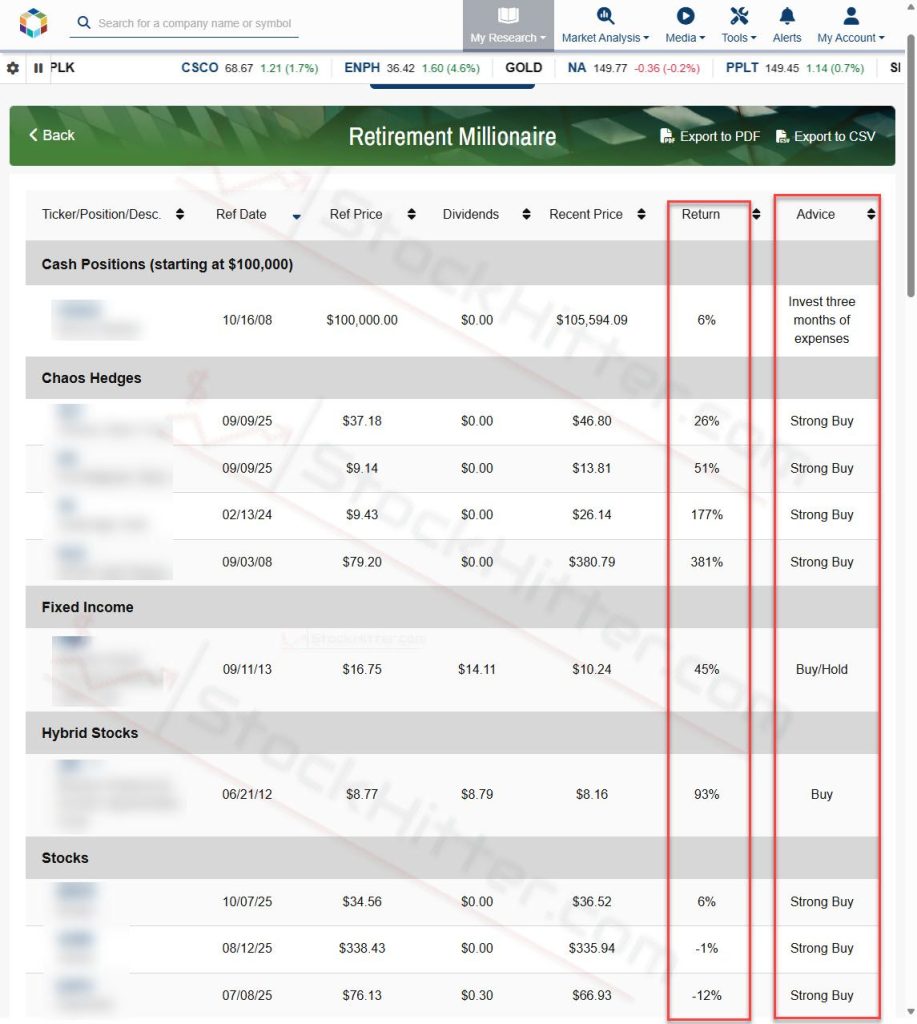
The Legacy Blue-Chip Holdings (The Big Winners)
These positions have been in the portfolio for years, some for nearly two decades. They demonstrate what conservative, long-term investing actually delivers when you have the patience to hold:
| Description | Recommended | Total Return | Status |
|---|---|---|---|
| Major software company | Nov 2010 | +1,537% | Strong Buy |
| Famous conglomerate/holding company | Apr 2009 | +795% | Strong Buy |
| Big Tech / search and AI giant | Dec 2016 | +735% | Strong Buy |
| Major e-commerce / cloud company | May 2017 | +443% | Strong Buy |
| Gold ETF (SPDR) | Sep 2008 | +414% | Strong Buy |
| Medical tech and devices fund (Fidelity) | Sep 2008 | +385% | Buy |
| Industrial distribution giant | Nov 2020 | +239% | Strong Buy |
Read that table again. These aren’t speculative bets. They’re blue-chip stocks, gold ETFs, and income funds. The kind of boring, conservative picks that retirees should be holding. The top position alone grew from +1,344% in February to +1,537% now, in about seven months, on a position that’s already 15 years old. That’s what compounding looks like when you stop checking the price every day and just let the poor thing cook for a decade and a half.
The Chaos Hedges (Precious Metals Protection)
Doc maintains “Chaos Hedges” designed to protect against market volatility and inflation. Every single one is still in the green, and there’s a new addition since February:
| Description | Recommended | Total Return | Status |
|---|---|---|---|
| Gold ETF | Sep 2008 | +414% | Strong Buy |
| Silver trust ETF (two tranches, combined) | Sep 2025 / Jun 2026 | +40% | Strong Buy |
| Silver mining stock | Jun 2026 | +43% | Strong Buy |
| Gold mining stock + spinoff (combined) | May-Jun 2026 | +17% | Strong Buy |
The silver mining pick is brand new, entered in June 2026, and it’s already up 43% in about three months. Doc also went back for a second helping of the silver trust in June after taking profits on the first half in February, buy, sell half, buy more, the same disciplined loop that’s kept this category perfect since 2008.
There’s also a small, slightly chaotic spinoff situation in this category: a gold mining stock recommended in May 2026 spun off a second company in June, and the combined position is being tracked together at +17%. It’s a little messy on paper, the kind of spreadsheet situation that makes you squint, but it’s the same kind of active management that turned a Danaher spinoff into a clean win in past years.
The Income Plays (Fixed Income and Hybrid Stocks)
For retirees who need cash flow, Doc includes dividend funds and preferred stock positions:
| Description | Recommended | Total Return | Status |
|---|---|---|---|
| Preferred & income opportunities fund | Jun 2012 | +100% | Buy |
| Emerging markets debt fund | Sep 2013 | +53% | Buy/Hold |
These won’t make headlines. But a retiree who needs steady quarterly income? A preferred income fund that’s doubled since 2012 is exactly what that portfolio needs.
Recent Picks and the Honest Losers
Now the reality check. Not everything works, and I’d be lying if I hid the red:
| Description | Recommended | Total Return | Status |
|---|---|---|---|
| Emerging markets ex-China fund | May 2021 | +83% | Strong Buy |
| Networking/telecom giant | Feb 2025 | +79% | Strong Buy |
| Internet domain registry | Aug 2024 | +70% | Strong Buy |
| Online dating platform | Dec 2017 | +66% | Strong Buy |
| Professional tools manufacturer | Jul 2024 | +57% | Strong Buy |
| Genomics/biotech company | Jun 2025 | +148% | Strong Buy |
| High yield equity dividend fund | Apr 2016 | +128% | Strong Buy |
| Welding/electrical equipment maker | May 2025 | +43% | Strong Buy |
| Financial data/software provider | Apr 2026 | +34% | Strong Buy |
| Enterprise software/CRM company | Aug 2026 | +31% | Strong Buy |
| Industrial filtration company | Mar 2024 | +31% | Strong Buy |
| Engineering/construction services | May 2026 | +29% | Strong Buy |
| Construction/engineering services | Dec 2025 | +21% | Strong Buy |
| Electrical components manufacturer | May 2025 | +21% | Strong Buy |
| Water utilities | Jan 2025 | +21% | Strong Buy |
| Farmland REIT | Jun 2024 | +16% | Strong Buy |
| Industrial equipment manufacturer | Jul 2026 | +4% | Strong Buy |
| Consumer beverage company | Apr 2025 | +4% | Strong Buy |
And now, the losers:
| Description | Recommended | Total Return | Status |
|---|---|---|---|
| Manufactured housing REIT | Feb 2026 | -4% | Strong Buy |
| Life sciences company + spinoff (combined) | Sep 2022 | -13% | Strong Buy |
| Timber REIT | Jun 2024 | -15% | Strong Buy |
| Nuclear technology company | Jan 2026 | -25% | STOPPED OUT |
That last one is the most honest thing in this whole update. The nuclear technology position was recommended in January 2026 and got stopped out by September at -25%, less than eight months from pick to exit. That’s not a slow bleed, that’s a fast, clean cut once the thesis broke, the financial equivalent of ripping off a Band-Aid instead of peeling it for six months. I’d rather see that than watching a “Strong Buy” label sit on a sinking position out of pure stubbornness, hoping nobody notices.
Funny enough, back in February the worst open position was also sitting at -25%, but that was a totally different pick (the life sciences one, now recovered to just -13%). Same number, completely different story, which is a good reminder that a single percentage doesn’t tell you what’s actually happening underneath it.
But here’s the honest math: 30 winners vs. 4 losers. An 88.2% hit rate on open positions, actually better than February’s 85%. And the scale of the winners (multiple positions up 200% to over 1,500%) dwarfs the losses (worst at -25%, and already closed). That asymmetry is what makes long-term conservative investing work.
What My Dad’s Portfolio Actually Looks Like
My dad still follows maybe 15 of these positions, same as before. He’s up somewhere in the 20-30% range overall since he started subscribing. Not amazing compared to the model portfolio’s home runs, but he got into the big tech giants too late and stayed too nervous on precious metals for years.
That’s the honest truth about any newsletter: the model portfolio assumes you bought every pick at the recommended price on the recommended date. Real subscribers cherry-pick, hesitate, and enter late. Your personal investment results will vary based on your own investment decisions. But even with his selective approach, he’s still sleeping way better than when he was trying to pick growth stocks himself off vibes and CNBC.
What You Get With a Retirement Millionaire Subscription
Monthly Newsletter and Stock Picks

The monthly newsletter includes new investment recommendations with detailed analysis. Each of the newsletter issues explains the investment thesis, business model, competitive advantages, and risks. Not just “buy this ticker symbol.”
Recent issues covered healthcare companies, dividend-paying stocks, defensive positions against inflation, and international equities that most American investors completely ignore. Doc’s writing is easy to follow and well-researched. My dad can understand it and he barely knows what a P/E ratio is.
Each recommendation includes the ticker symbol, buy-up-to price, and actionable, step-by-step supporting research with practical advice on position sizing. The quality is well above free newsletters.
Special Reports and Bonuses

New subscribers get several special reports with the current promotion, plus one evergreen bonus:
- The Big Book of Retirement Secrets (672-page comprehensive guide)
- Several themed reports tied to whatever macro story Stansberry is currently pushing
The Big Book of Retirement Secrets is actually useful. It covers healthcare planning, investment strategies, and practical retirement advice. Haven’t read all 672 pages (who would?) but the parts I skimmed seemed solid.
The themed bonus reports feel more promotional, understandably, since they exist to sell the subscription. They’re fine for understanding Doc’s current thesis, but take those upside projections with a grain of salt.
Health and Wealth Bulletin
Doc sends a daily Health and Wealth Bulletin with market commentary, health tips, and financial advice for retirees. The “living well” angle covers topics from reducing medical costs to improving sleep quality and overall quality of life. Some of it’s random (there was one about something in your closet that supposedly prevents flu, and four years later I have made zero progress toward understanding what he meant, and at this point I’ve stopped trying).
My dad deletes most of these daily emails. If you want the holistic health and wealth approach, the bulletin adds value. If you just want stock picks, it becomes inbox clutter.
Portfolio Updates Throughout the Month
Doc sends updates when positions hit targets, need adjustments, or should be closed. The portfolio is updated every Monday with current prices and status. These updates matter, since the nuclear technology stop-out happened between monthly issues, not on the usual publishing schedule.
The Retirement Millionaire Track Record: An Honest Assessment
What the numbers show: The newsletter’s 34 open positions break down to 30 winners (88.2%) and 4 losers (11.8%). Top performers include gains of 1,537%, 795%, 735%, 443%, and 414% on major U.S. stocks and ETFs. These are positions held for years to decades. The worst current position, a stopped-out nuclear technology stock, closed at -25%.
The active management keeps showing up: selling half the silver trust at +82.2% in February, buying back a second tranche in June, and a clean stop-out on the nuclear pick rather than letting it ride. Doc doesn’t just set and forget.
The conservative approach avoided 2022 pain: While growth-focused newsletters got destroyed during the 2022 market downturn, Doc’s emphasis on value, dividends, and precious metals hedges limited the damage.
Time horizon is still everything: Doc’s best picks took years to pay off. The top performer has been held since 2010 (16 years). If you need quick gains, this isn’t it.
My dad’s real-world result: Following roughly 15 positions, he’s up somewhere in the 20-30% range. Not the model portfolio’s theoretical returns, but better than he was doing on his own. And he’s still not losing sleep.
Is Retirement Millionaire Worth the Cost? (Pricing, Refund, and Fine Print)
At $199 per year normally, this sits mid-range for investment newsletters. The promotional pricing at $79 makes it easy to try. That’s under $7 monthly for the newsletter, model portfolio access, special reports, and daily bulletin.
One decent pick could easily cover the annual cost several times over. The gold ETF alone, held since 2008, is up 414%. A $1,000 position there is worth over $5,100 today. At $79 per year, the math isn’t complicated.
Here’s the catch and the fine print most reviews skip: the subscription automatically renews at $199 per year after the first year. Set a calendar reminder or you’ll get charged the higher rate.
One thing the Retirement Millionaire newsletter still doesn’t publish openly is closed recommendations. The portfolio shows all 34 open positions, but positions that were stopped out or sold entirely get removed, which is part of why this update shows 34 instead of February’s 39. I’d prefer full transparency on closed trades too, but what’s visible is still more than most newsletter services show.
If you’re young and focused on aggressive growth stocks or day trading, your money is better spent elsewhere. Retirement Millionaire is specifically designed for its target audience.
They offer a 30-day refund policy. If you’re unhappy for any reason, contact customer service within 30 days for a full refund.
Retirement Millionaire Pros and Cons
What Works
 88.2% of open positions in the green (30 of 34), up from 85% in February
Multiple positions up 200-1,537% for patient long-term holders
Disciplined risk management, the nuclear technology position got stopped out cleanly instead of being left to bleed
“Chaos Hedges” precious metals category: still a 100% win rate, now including a brand new silver miner already up 43%
Conservative approach protected against 2022 downturn