

Disclosure: This review contains affiliate links. If you purchase through these links, StockHitter may earn a commission at no additional cost to you. Our reviews are based on real subscriber access and independent analysis.
Hey all, Jenna Lofton here – thank you for stopping by to read my review of Louis Navellier’s Growth Investor newsletter.
I’ve been a paying subscriber since October 2022, so I’ve had over three years to test Louis Navellier’s stock recommendations, track the portfolios, and see how his system performs in a real stock market – not just on a backtested spreadsheet. This isn’t a sales page review. I’m showing you what you actually get as a member.
The current pitch is built around what Louis is calling the “AI Reset of 2026” – a thesis about a new category of AI computing technology being assembled by the U.S. Department of Energy that he believes will make today’s AI systems look primitive by comparison.
I’ll get into whether that thesis holds up. But the more important question for anyone considering Growth Investor is whether the underlying newsletter delivers – and that’s what three-plus years of real money will tell you.
If you came here specifically looking for info on the Project Apex campaign, that review is here – it covers a different Growth Investor campaign angle. This review covers the full service.
Short version: Growth Investor is a legitimate stock-picking newsletter from one of Wall Street’s most data-driven quantitative analysts. The Stock Grader tool alone is worth the $49 entry price. The portfolio has delivered real 100%+ closed positions over my three years as a subscriber – alongside real losers. If you’re a buy-and-hold growth investor with a 2-3 year time horizon, this service is worth evaluating. If you need fast flips or can’t stomach a losing position sitting in your account for 12+ months, it’ll frustrate you.
Growth Investor Quick Stats
| Metric | Growth Investor (2026) |
|---|---|
| Publisher | InvestorPlace Media |
| Editor | Louis Navellier – quantitative analyst, $1.1B family office, Forbes “King of Quants” |
| Member Since | October 2022 (3+ years) |
| Current Pitch | “AI Reset of 2026” – Golden Dawn mega computer thesis |
| Promotional First Year Price | $49 |
| Auto-Renewal Price (Year 2+) | $199/year |
| Regular Annual Price | $499 |
| Guarantee | 90-day full refund, keep all bonus reports |
| Best Closed Position | +206% (AI infrastructure play, held 2+ years) |
| Worst Closed Position | -34% (AI software miss) |
| Typical Hold Time | 2-3+ years |
✓ Best For
- Buy-and-hold growth investors
- 2-3 year time horizon investors
- Investors who want a quantitative stock filter
- Anyone comfortable holding through volatility
✗ Not For
- Short-term traders or flip investors
- Conservative dividend-only investors
- Anyone who panic sells at -15%
- Investors expecting results in 30 days
Who Is Louis Navellier?

Louis Navellier is one of Wall Street’s most recognized quantitative analysts – and not just because InvestorPlace says so. Forbes called him the “King of Quants.” The New York Times called him “an icon among growth stock investors.” The Wall Street Journal has covered his methodology extensively. He appears regularly on CNBC, Fox Business, Bloomberg, and MarketWatch.
He’s been publishing stock analysis since 1980 – longer than most of his competitors have been alive. Through Navellier and Associates, he manages billions in mutual funds and institutional accounts. That matters because he’s not just a newsletter writer selling picks. He has real skin in the game through his fund management business, and Louis Navellier’s net worth is estimated in the hundreds of millions – worth mentioning because it means he’s not just selling stock picks, he has real skin in the game.
His public track record includes recommending Nvidia at $2.51 split-adjusted before its 44,000% run, Intel at $2.25 before a 3,228% gain, and Qualcomm at $2.05 before a 6,235% rise. These are long-term maximum gains – not every subscriber captured the full move, and past performance doesn’t guarantee future results. But the pattern of identifying technology companies early is consistent and documented.
Below you’ll find my honest assessment, what’s included in the current offer, closed positions I’ve traded (both winners and losers), and whether Growth Investor is worth the money in 2026.
What Is Growth Investor All About?
Growth Investor is Louis Navellier’s flagship stock-picking newsletter, published through InvestorPlace Media. The core methodology hasn’t changed in 40+ years: use quantitative analysis to identify stocks with the strongest combination of fundamental momentum and earnings growth – with the explicit goal of helping investors beat the market, not just keep pace with it – then hold them long enough for the thesis to play out.
The current marketing pitch is built around the “AI Reset of 2026” thesis. Louis is calling attention to a new category of AI computing being assembled by the U.S. Department of Energy – a networked system of FP64 supercomputers he’s calling “Golden Dawn” that he believes will solve what he calls the “Precision Problem” in current AI models. The free stock pick in the current presentation is AMD, which he says is building the first of nine new AI supercomputers that will power this system.
Whether the Golden Dawn thesis plays out exactly as described, the underlying framework – using Louis Navellier’s stock grader to find quantitatively superior growth stocks before the mainstream catches on – is what I’ve been testing for over three years. That’s what this review covers.
What’s Included When You Join Growth Investor in 2026?
I got it, so I can show you!
Here’s everything included in the current offer:
- Monthly issues – Louis Navellier’s flagship stock recommendations each month, with full fundamental analysis and Stock Grader rating breakdown
- Two model portfolios – the High-Growth Investments model portfolio and the Elite Dividend Payers model portfolio, each broken into three risk tiers
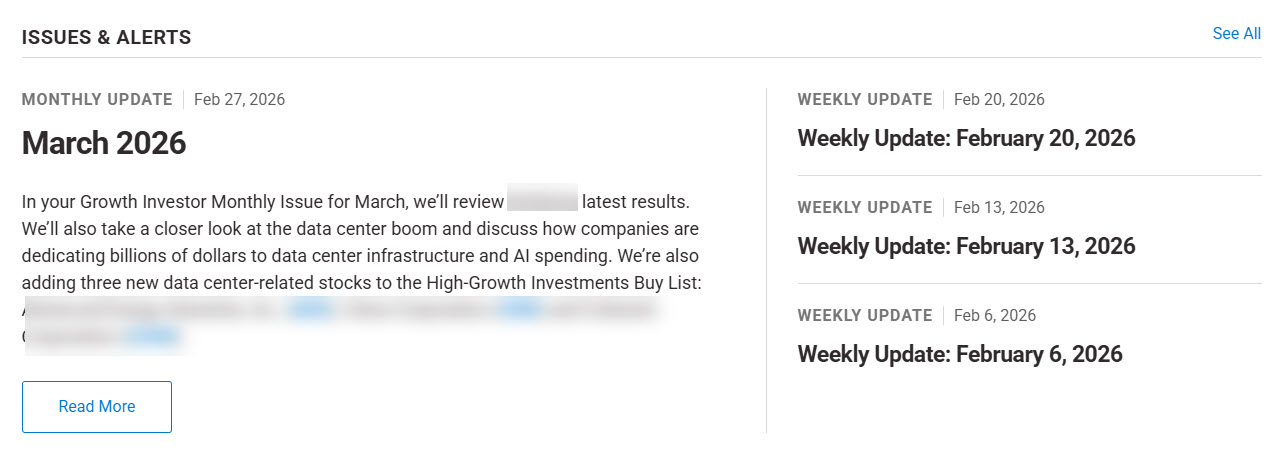
- Weekly market updates – one of my genuine compliments about the service. You’re never left wondering what’s happening with open positions for weeks at a time. The team curates what’s actually worth knowing vs. just filling your inbox
- Flash alerts – time-sensitive buy and sell recommendations sent between monthly issues
- Louis Navellier Stock Grader access – type any ticker and get an instant letter grade based on quantitative criteria. More on this below
- TradeStops integration – syncs with your brokerage, helps size positions based on risk tolerance, uses a volatility quotient (VQ) system to set rational exit points. Solid addition that wasn’t included when I first subscribed
- Full report archive – all previous special reports and research. Louis’s older work on 5G, cybersecurity, and energy transitions still holds up as context for understanding his current thesis
Bonus Reports Included With Current Offer:
- Bonus Report #1: “The Next Tech Giant: The Hidden Winner of Elon’s AI Supercomputer” ($199 value) – Louis’s top AI hardware pick, which he’s comparing to his early calls on Adobe (1990), IBM (1992), and Amazon (2004)
- Bonus Report #2: “Trump and Elon’s Preferred AI Partner: Inside the Tech Defending America’s Future” ($199 value)
- Bonus Report #3: “The Perfect AI Energy: Make 10X Gains on This AI Lifeblood” ($199 value)
- Bonus Report #4: “Sell These Stocks ASAP: Ten Ticking Timebombs That Could Blow Up Your Portfolio in 2026” ($299 value) – ten widely held stocks Louis believes are at serious risk. Worth running against your existing holdings regardless of whether you follow his buy recommendations
- Bonus Report #5: “Create Your Own Million Dollar Retirement Plan” ($99 value)
The Two Portfolios: How Growth Investor Is Actually Structured
One thing most Growth Investor reviews skip over: the service runs two distinct portfolios, not one. Understanding the difference matters.
The High-Growth Investments Portfolio is where Louis tries to identify the best stocks in the market right now – large-cap growth plays with consistently growing sales and earnings quarter over quarter. Dividends aren’t the point here. This is the portfolio where the biggest wins and biggest misses live.
The Elite Dividend Payers Portfolio covers dividend stocks with strong yields, reliable payout histories, and cash flow to sustain them. Lower volatility, more income-focused. Good for investors who want growth exposure without having everything in high-beta tech.
Both portfolios break into three risk tiers:
| Risk Tier | Portfolio Allocation | What to Expect |
|---|---|---|
| Conservative | 60% | Lower volatility, steady growth, higher-probability plays |
| Moderately Aggressive | 30% | Higher growth potential, more price swings, longer hold times |
| Aggressive | 10% | Swing-for-the-fences picks with more risk – this is where the -34% losers live |
The aggressive bucket is where you need realistic expectations. Those picks can sit underwater for a long time. But they’re also where the 200%+ winners come from.
The Louis Navellier Stock Grader: A Closer Look
I already covered this above, but it deserves its own section because it’s genuinely one of the better tools included with any newsletter I’ve subscribed to.
The Louis Navellier Stock Grader lets you type any ticker and instantly get a letter grade based on his quantitative criteria: earnings growth, sales growth, revenue growth, return on equity, and institutional buying pressure. It’s a genuinely data-driven system – not vibes, not gut feel. Louis’s methodology combines fundamental analysis with momentum signals to rank stocks, and the output is as rigorous as you’ll find in a retail newsletter product.
Grade scale:
- A and B – strong fundamentals, serious consideration
- C – middle of the road, proceed with caution
- D and F – weak fundamentals, potentially poised to drop
One of Louis Navellier’s most cited claims is that this system has identified the top S&P 500 performer of the year for 12 consecutive years. I can’t independently verify that, but the selection process is transparent – you can see exactly which fundamental and momentum factors drive each grade.
Here’s how I actually use it in practice:
- Type in any ticker before I invest – takes about 10 seconds
- If it’s an A, I look more seriously even if I wasn’t already watching it
- If it’s a C or below, I think twice before adding a position
- I’ve used it to evaluate stocks completely outside of Louis’s own recommendations
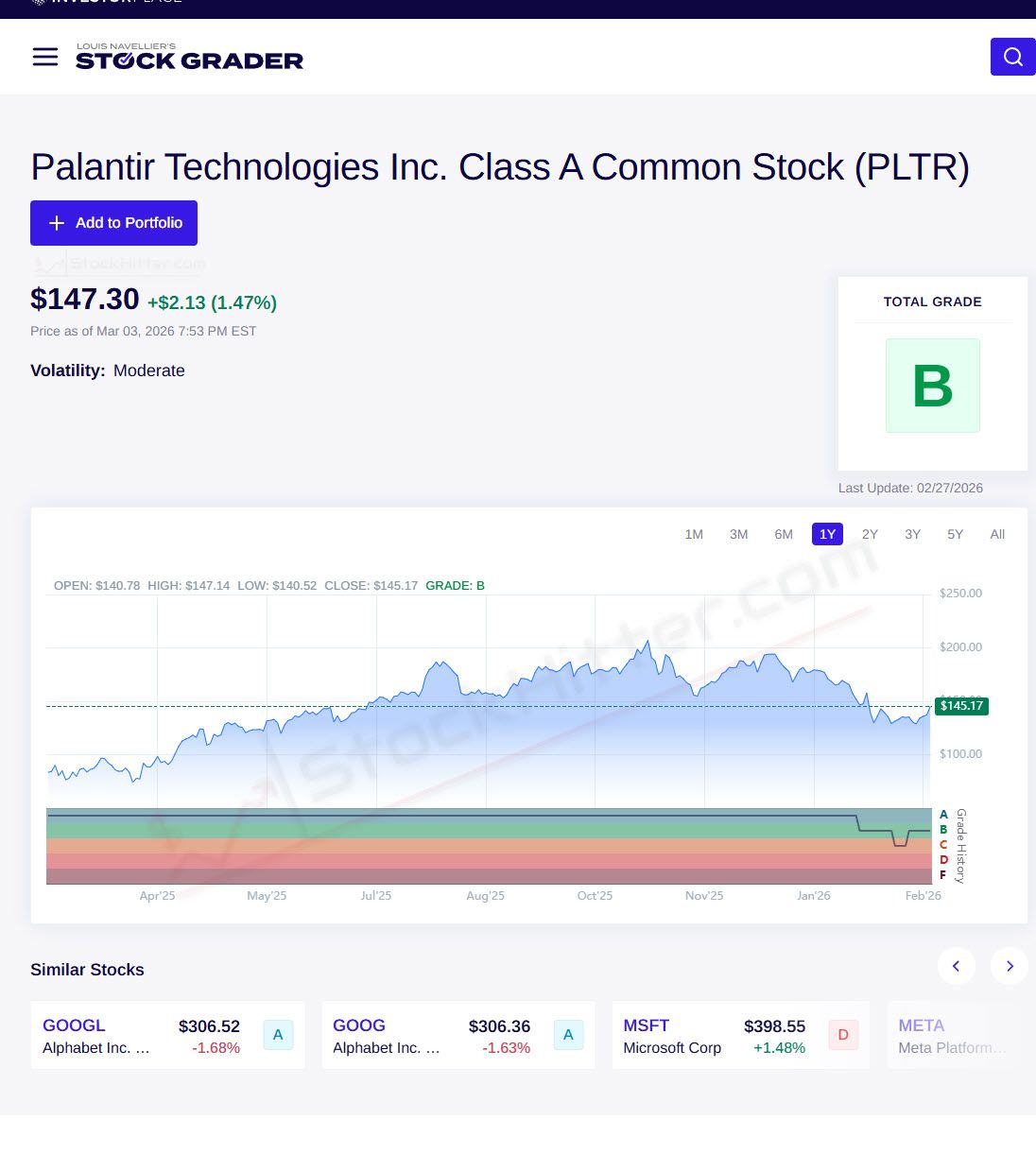
I ran Palantir (PLTR) through it last night just out of curiosity – it’s basically the stock everyone won’t shut up about right now. It came back a B, which means Louis thinks it’s still a buy but not his top conviction pick. What I found more interesting was the grade history: PLTR was an A for most of mid-2025. It’s been quietly downgraded as the price ran up and the fundamentals stopped keeping pace with the valuation. That’s exactly the kind of signal you’d never pick up just watching CNBC.
It won’t make you rich on its own. But as a first-pass filter to save research time in a noisy stock market, it’s genuinely useful. The letter grade system is simple enough that you don’t need to understand all the underlying math to act on it.
Stock Grader access is included with your $49 membership.
Grade any ticker in 10 seconds. 90-day money-back guarantee.
My Real Experience: Closed Positions I’ve Traded
Since joining in October 2022, here are actual positions I’ve closed out – winners and losers both. I’m not going to show current open picks (that’s not fair to paying subscribers), but the closed positions tell the real story of how this service performs over time.
The Winners
| Position Type | Recommended | Entry | Exit | Sold | Return |
|---|---|---|---|---|---|
| AI infrastructure play | – | – | – | – | +206% |
| Industrial company | Nov 2023 | $68 | $156 | Jan 2026 | +129% |
| Gold miner | Jun 2024 | $19 | $38 | Feb 2026 | +100% |
| Elite dividend payer | Mar 2023 | $42 | $71 + dividends | Dec 2025 | +69% + ~8% dividends |
The Losers
| Position Type | Recommended | Entry | Exit | Sold | Return |
|---|---|---|---|---|---|
| AI software miss | – | – | – | – | -34% |
| Biotech stock | Jan 2024 | $89 | $67 | Aug 2025 | -25% |
| Tech hardware play | Apr 2024 | $178 | $151 | Jan 2026 | -15% |
The honest math: I’m up overall across these closed positions. The 206% and 129% winners absorb the three losers combined with room to spare. That’s growth investing working as designed – you need the home runs to cover the strikeouts, and you need enough stock picks to generate those home runs, and you need the patience to let those home runs fully develop.
The 206% AI infrastructure winner took over two years to fully develop. If I’d sold at 80% because it felt “good enough,” I’d have left most of the gain on the table. That’s the discipline this service teaches – and also the thing that makes it genuinely hard to hold through.
The “AI Reset of 2026” – What’s Louis Actually Saying?
The current Growth Investor pitch centers on a thesis Louis is calling the “AI Reset of 2026.” The core argument: every major AI model today – ChatGPT, Gemini, Grok, Claude – runs on FP16 hardware, which Louis calls “half-precision” chips. Fast, but fundamentally limited when it comes to real scientific precision.
The U.S. Department of Energy, he argues, is assembling a networked system of FP64 supercomputers – including Frontier at Oak Ridge National Lab, El Capitan at Lawrence Livermore, and Aurora near Chicago – into what he’s calling “Golden Dawn.” FP64 chips can handle 18 quintillion calculations at once versus 65,000 for FP16. The math on the precision advantage is real, even if the “283 trillion times more powerful” framing is characteristically aggressive Navellier marketing.
AMD is the free stock pick in the current presentation – they’re building the Lux supercomputer at Oak Ridge using their MI355X Instinct Accelerator chip. The paid reports reveal six additional companies Louis believes are positioned to profit from the Golden Dawn buildout.
Is this exactly what will happen? I’ve followed Louis long enough to know his big-picture thesis calls tend to identify real trends early – even when the specific timeline and magnitude get oversold in the marketing. The AI infrastructure buildout is real. The FP64 vs FP16 distinction is real. Whether Golden Dawn becomes the “atom bomb of AI” as described, I genuinely don’t know. What I do know is that his Stock Grader has consistently found strong performers in the sectors he’s been bullish on.
How Much Does Growth Investor Cost?
| Pricing Detail | Amount |
|---|---|
| Promotional First Year Price | $49 |
| Auto-Renewal Price (Year 2+) | $199/year |
| Regular Annual Price | $499 |
| Guarantee | 90-day full refund, keep all bonus reports |
The jump from $49 to $199 at renewal catches people off guard. Set a calendar reminder before your first year is up if you’re still testing the service. All bonus reports are yours to keep regardless of whether you cancel within the 90-day window.
With stock picks across two portfolios and three risk tiers, the 90-day money-back guarantee is one of the stronger refund policies in this category – three months is enough time to follow several picks and get a real feel for the service. Just make sure you actually evaluate it during those 90 days rather than letting it auto-renew.
If you want more from the service, InvestorPlace does offer an upgrade path to the Platinum Growth Club, which bundles Growth Investor with Breakthrough Stocks and Accelerated Profits. I haven’t gone that route, but it exists if you want a more comprehensive package after testing the base service.
90-Day Money-Back Guarantee — Strongest in This Category
Most competing newsletters offer 30 days. Growth Investor gives you 90 — enough time to follow several monthly issues, track real positions, and make an informed decision. Keep all bonus reports regardless of whether you cancel.
From $49 your first year. 90 days to decide.
Keep all bonus reports even if you request a full refund.
Growth Investor Pros and Cons
What Actually Works:
- The Stock Grader tool is legitimately useful. This alone has made me a more disciplined buyer. It adds a real gut-check before pulling the trigger on any position. The data-driven grade system means you’re not just following someone’s opinion – you can see exactly why a stock ranks where it does.
- Real track record with transparency. Wins and losses both stay in the portfolio. You’re not looking at cherry-picked results. The 206% and 129% winners are real, and so are the -34% and -25% losers.
- The big winners are genuinely big. Multiple 100%+ closed positions over 2-3 years isn’t unusual here. One stock returning 200%+ covers the cost of the entire year’s subscription many times over. The math on that isn’t complicated.
- Two distinct portfolios. The High-Growth and Elite Dividend Payers split gives you genuine flexibility depending on your goals and risk tolerance. Most newsletter services give you one portfolio and call it a day.
- Frequent communication. Weekly updates mean you’re never left wondering what’s happening with open positions for weeks at a time.
- Solid 90-day money-back guarantee. Full refund within 90 days for any reason, and you keep all the bonus reports you downloaded. Three months is enough time to follow several picks and get a real feel for the service.
What’s Annoying:
- InvestorPlace marketing is relentless. Daily “urgent” subject lines, constant upsells. The actual newsletter content is far more measured than the promotional emails suggest. Expect your inbox to get busy.
- Hold times are long. My best winner took over two years to fully develop. This is not a trading service. If you want quick 30-day flips, you’ll be frustrated waiting two years for a thesis to play out.
- Losers are real. The aggressive bucket (10% of picks) will produce misses. If a -34% on your screen causes panic selling, this service will stress you out.
- The $49 to $199 renewal jump. It’s in the fine print. You’ve been warned – set that calendar reminder.
- Customer service is slow. Had a billing question and waited nearly a week for a response. Functional, not fast.
Still on the fence? The 90-day guarantee makes it low-risk.
Keep all bonus reports even if you request a full refund.
Growth Investor vs. The Competition
| Service | Focus | Guarantee | Entry Price | Key Tool |
|---|---|---|---|---|
| Growth Investor | Quantitative growth stocks, AI infrastructure | 90 days | $49/year | Stock Grader |
| Fry’s Investment Report | Macro growth, international markets | 90 days | $49/year | Sell This Buy That framework |
| Altucher’s Investment Network | Contrarian growth, crypto, AI | 90 days | $49/year | Three-portfolio structure |
| Hidden Alpha (Altimetry) | Forensic accounting, undervalued stocks | 30 days | $79/year | Altimeter Database |
| Stansberry Investment Advisory | AI-assisted, broad equities | 30 days | $149/year | StansberryGPT |
Growth Investor is the most affordable entry point in this comparison and has the strongest guarantee at 90 days. If you want forensic accounting depth, Hidden Alpha goes deeper. If you want broader research tools, Stansberry covers more ground. For pure quantitative growth stock picking from a 40-year track record, Growth Investor is the strongest option at this price point.
Is Growth Investor Worth It in 2026?
Most Growth Investor reviews you’ll find focus on the marketing pitch of the moment. But the actual service underneath has been consistent for years. In an uncertain stock market where AI hype is everywhere, having a data-driven quantitative system doing the filtering is genuinely useful.
Louis Navellier has a legitimate 40+ year track record. The portfolio structure is sound. The Louis Navellier Stock Grader adds real value beyond just following his picks. The two-portfolio setup gives you flexibility most newsletters don’t offer. It’s one of the more comprehensive packages in the newsletter space at this price point.
But be clear-eyed about what you’re signing up for. If you want quick 30-day flips, you’ll be frustrated. If you can’t stomach a -34% loser sitting in your account while you wait for a bounce, the aggressive bucket will drive you crazy. If you hate promotional emails, your inbox is going to be a problem.
If you’re a buy-and-hold growth investor who can hold through volatility and let winners run, Growth Investor delivers. The 206% winner that took two years to develop is exactly how this service is designed to work – and exactly the patience it requires.
Bottom line: Worth it at $49 with clear eyes on the time horizon. The Stock Grader alone justifies the entry price for serious investors. One 100%+ winner covers the subscription cost many times over. Just set that $199 renewal reminder and don’t expect overnight results.
Frequently Asked Questions
Is Growth Investor worth your time and money?
For buy-and-hold growth investors with patience, yes. Three years of real-money testing shows the service delivers genuine 100%+ winners alongside real losers. The 90-day money-back guarantee makes it low-risk to evaluate yourself.
What is Louis Navellier’s net worth?
Louis Navellier’s net worth is estimated in the hundreds of millions, built primarily through Navellier and Associates, his institutional fund management firm that oversees over $1 billion in assets. He’s not just a newsletter writer – he manages real money alongside his Growth Investor subscribers.
What is the Growth Investor refund policy?
Full refund within 90 days for any reason. You keep all bonus reports you downloaded. Contact InvestorPlace member services to request your refund.
What is the Louis Navellier Stock Grader?
A quantitative stock rating system that grades any ticker from A to F based on earnings growth, sales growth, revenue growth, return on equity, and institutional buying pressure. It’s a fast way to filter out stocks unlikely to outperform without spending hours on market analysis yourself.
What is the Platinum Growth Club?
An upgrade path that bundles Growth Investor with Breakthrough Stocks and Accelerated Profits for a more comprehensive package. Worth considering after you’ve tested the base Growth Investor service.
How often does Growth Investor send alerts?
Monthly issues with new stock recommendations, plus weekly market updates. Flash alerts go out between issues for time-sensitive buy and sell recommendations. Communication is frequent – sometimes too frequent if you’re inbox-sensitive.
What is the typical hold time for Growth Investor picks?
2-3+ years for the biggest winners. This is not a trading service. Short-term traders will be frustrated. Long-term buy-and-hold investors who let winners run are who this service is designed for.
What is the “AI Reset of 2026” thesis?
Louis Navellier’s current investment thesis arguing that FP64 supercomputers being networked by the U.S. Department of Energy will create a new category of AI computing power that makes current FP16-based AI models look primitive by comparison. AMD is the free stock pick. The paid reports reveal six additional companies Louis believes are positioned to benefit.
Affiliate Disclosure: This article contains affiliate links. If you purchase through these links, we may receive a commission at no additional cost to you. Review updated May 12, 2026.
Disclaimer
The information in this review is for educational purposes only and should not be considered financial or investment advice. I am not a licensed financial advisor, and nothing I write on StockHitter.com should be taken as a recommendation to buy or sell any security. All investing involves risk, including the potential loss of principal. Past performance of any investment or newsletter service is not indicative of future results. The closed positions and returns mentioned in this review reflect my personal experience and may not be typical of all subscribers. Always do your own due diligence and consider consulting a licensed financial professional before making any investment decisions.
Thanks for reading! Any questions about my three-plus years with Growth Investor? Drop them in the comments.
Other Recommendations
If you’re comparing growth-focused investment newsletters, I also recommend checking out Fry’s Investment Report and Altucher’s Investment Network — both cover contrarian and macro growth angles at the same $49 price point.
For a quantitative research approach with deeper forensic analysis, Hidden Alpha by Altimetry is worth serious consideration. Also worth looking at: The Skousen Report and The Near Future Report.