
One Ticker Trader Review 2026: Larry Benedict’s “Final Phase of Elon’s Master Plan”
Last Reviewed September 30, 2026Disclosure: This review contains affiliate links. If you purchase through these links, StockHitter may earn a commission at no additional cost to you. Our reviews are based on real subscriber access and independent analysis.
Hey All, Jenna Lofton here. I first reviewed One Ticker Trader back in 2023 and honestly, at the time I thought it was solid but niche — mostly for people who already knew their way around options. Coming back to it now in 2026 is a different story.
Larry Benedict has rebuilt the pitch around something real and time-sensitive: the SpaceX IPO and what happens after it. That IPO has now actually happened — SpaceX went public in June 2026. If you are weighing the stock itself, our guide to buying SpaceX stock after the IPO covers the SPCX ticker and the main risks. I pulled Larry’s official closed-position track record fresh from the members dashboard on September 30, 2026, went back through the materials, the reports, and the current positioning. Here’s what I think.
I got access, so I can show you!
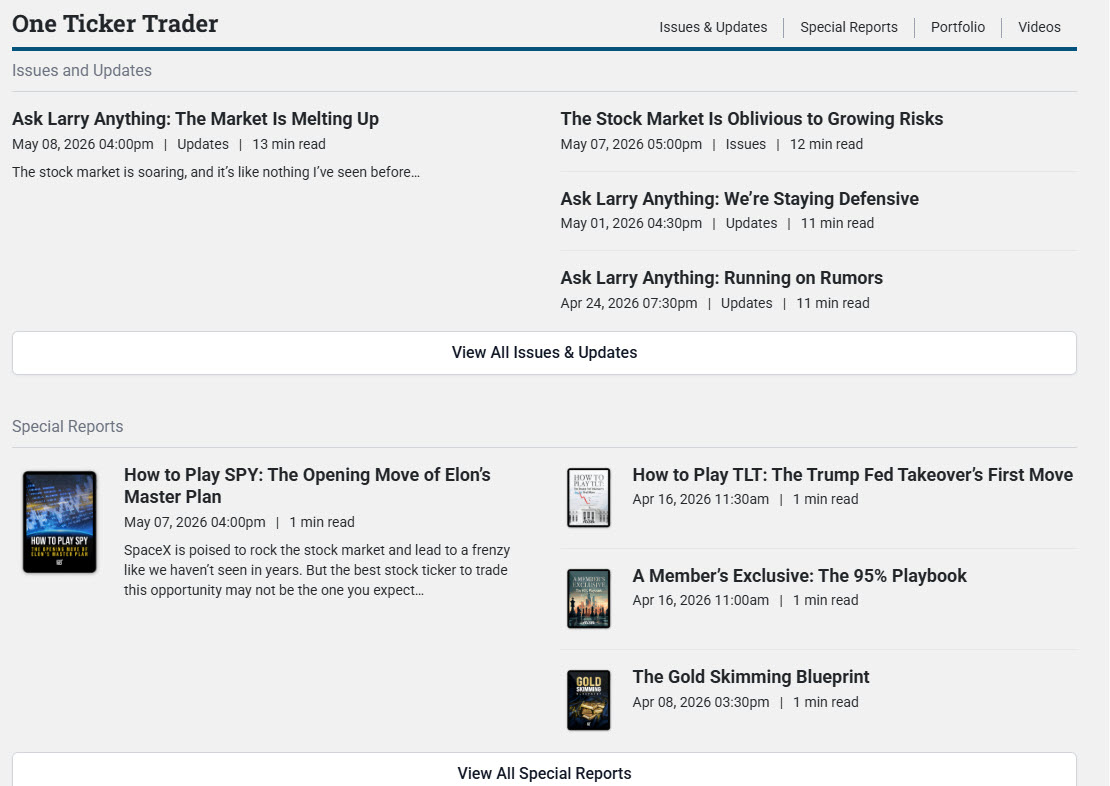
Short version: Larry Benedict is the real deal — a 20-year unbroken winning streak, $274 million made for hedge fund clients, featured in Market Wizards alongside Ray Dalio. The current pitch centers on SpaceX’s real June 2026 IPO and the S&P 500 inclusion question that follows it — one of the more concrete market setups he’s built a service around. The official closed-trade record, pulled fresh from the dashboard, shows 99 closed trades since 2022 with an 81% win rate, including 35 closed trades in 2025 alone at an 86% win rate. At $19 for a full year, the price is almost absurdly low for what you’re getting. The question is whether you can trade options — and whether you’re willing to act fast when alerts come in.
One Ticker Trader at a Glance
| Metric | One Ticker Trader (2026) |
|---|---|
| Publisher | Brownstone Research / The Opportunistic Trader |
| Trader | Larry Benedict — hedge fund legend, 20 consecutive winning years, Market Wizards featured |
| Current Angle | “The Final Phase of Elon’s Master Plan” — SpaceX IPO and S&P 500 inclusion thesis |
| Free Pick Revealed | SPY — the S&P 500 ETF, traded with options |
| Core Strategy | One Ticker Trading — options on a single ticker, both directions |
| Price | $19/year (discounted from $199) |
| Guarantee | 30-day full money-back |
| 2025 Closed-Trade Record | 35 closed trades, 86% win rate, +23.3% average gain per trade |
| Track Record Since 2022 | 99 closed trades, 81% win rate, +18.3% average gain per trade |
| Original Review | April 2023 — Updated September 2026 |
✓ Best For
- Options traders or those willing to learn
- Anyone wanting to trade around the SpaceX IPO
- Active investors who can act on alerts quickly
- Anyone looking for short-term catalyst-driven trades
✗ Not For
- Buy-and-hold investors
- Complete beginners with no interest in learning options
- Anyone who can’t act quickly on trade alerts
- Investors wanting long-term equity portfolios
Who Is Larry Benedict? The Most Credentialed Trader You’ve Probably Never Heard Of
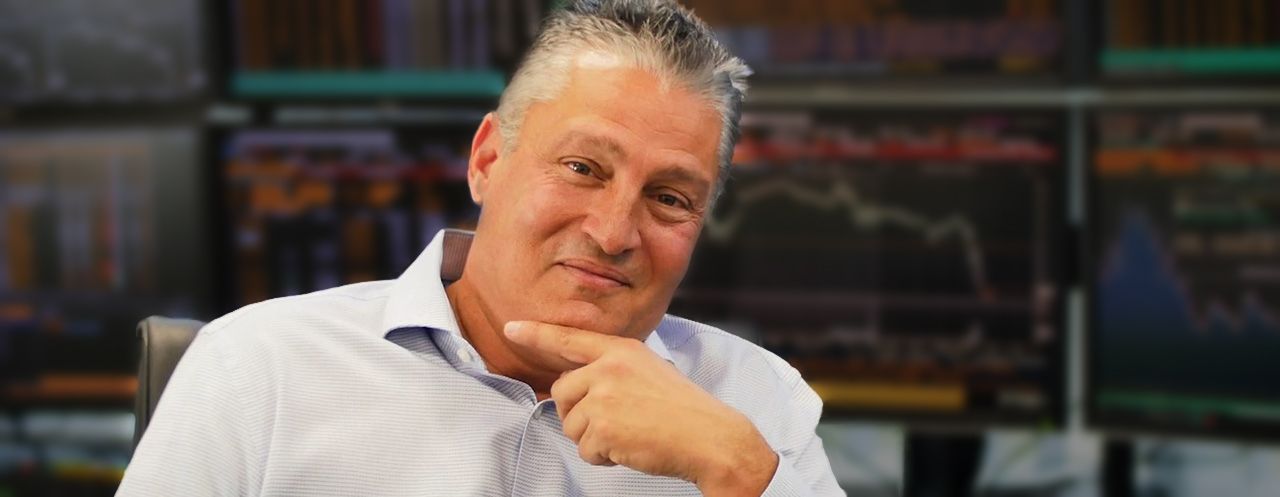
Before getting into the current pitch — I want to spend a minute on Larry’s background because it’s the reason I take this service seriously at all. A lot of newsletter traders have impressive-sounding bios. Larry’s is different.
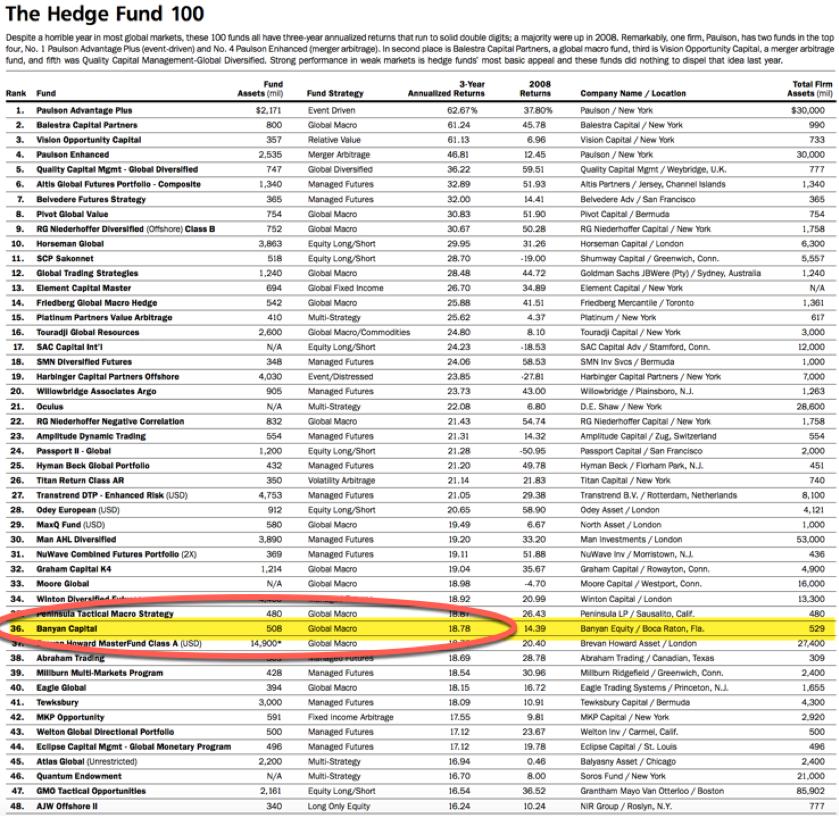
He ran Banyan Capital, a hedge fund that Barron’s ranked in the top 100 hedge funds in the world multiple times — #36 in 2008, #74 in 2010, #84 in 2011. With roughly 10,000 hedge funds globally, that puts him in the top 1%. His clients were the kind of people who could afford to be selective — royalty, billionaires, the highest tier of wealth management.
From 1990 to 2010, he never had a single losing year. Twenty consecutive winning years. That includes the dot-com crash, the 2008 financial crisis, and everything in between.
In 2008 — while the S&P 500 fell 37% — Larry and his partners made $95 million in profit. A legal audit by a San Francisco firm confirmed that from 2004 to 2012, his firm generated $274,572,167 in net profit. That’s not a marketing number — it’s audited.
He’s featured in Jack Schwager’s Hedge Fund Market Wizards — Chapter 3, right after Ray Dalio. If you know that book, you understand the weight of that.
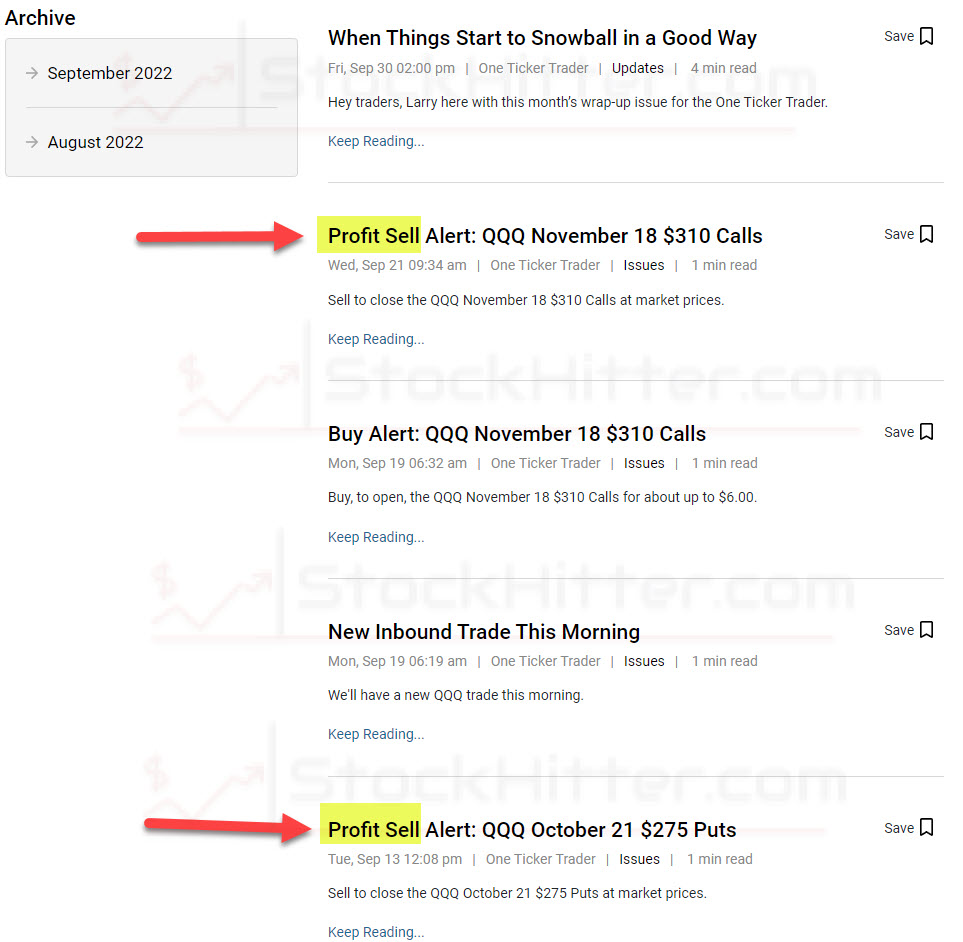
In 2025, running One Ticker Trader, Larry closed 35 trades with an 86% win rate, averaging +23.3% per trade, per the official closed-position export pulled fresh from the members dashboard. During Trump’s Liberation Day tariffs in April 2025, while the market was in freefall, his readers had the opportunity to make nearly 59% on QQQ — then went back to the same ticker for another 29%.
He went 13-for-13 on trades tied to Trump’s market moves after the election.
Larry Benedict — The Numbers That Matter
- 20 consecutive winning years — including the dot-com crash and 2008 financial crisis
- $274,572,167 in audited net profit for clients (2004-2012)
- Barron’s Top 100 Hedge Funds — #36 in 2008
- Market Wizards Chapter 3 — alongside Ray Dalio
- 35 closed trades in 2025, 86% win rate, +23.3% average gain per trade
- 13-for-13 on Trump trade calls post-election
What Is “The Final Phase of Elon’s Master Plan”?
The current One Ticker Trader pitch is built around what Larry calls “The Final Phase of Elon’s Master Plan” — and the core thesis is actually straightforward once you strip away the marketing language.
SpaceX went public. Reuters reported in April 2026 that SpaceX had laid out its IPO details and was targeting an early June roadshow, and the IPO itself went on to actually happen in June 2026, at a reported valuation of roughly $1.75 trillion. That part of the thesis is no longer a forecast — it’s confirmed history.
At that size, SpaceX became one of the largest companies in America overnight — bigger than Meta, bigger than Tesla. Larry’s pitch has always been that a company that size eventually gets added to the S&P 500. As of this update, I have not been able to independently confirm that S&P Dow Jones Indices has added SpaceX to the index, or set a date to do so — that decision sits with the index committee, not with SpaceX or with Larry.
Here’s the part most people gloss over: roughly $20 trillion in assets are linked to the S&P 500 index. When a new company joins, every fund tracking that index is effectively forced to buy shares to stay aligned. That’s forced buying at scale.
When Tesla entered the S&P 500 in 2020, index funds were required to absorb roughly $85 to $90 billion in Tesla shares almost overnight. SpaceX would be significantly larger.
But here’s the part most investors are missing: Larry’s argument is that the obvious play — buying SpaceX itself — is the wrong play. SpaceX’s gains were already priced into a $1.75 trillion valuation before a single retail share traded. The real opportunity, in his view, is what forced buying would trigger across the broader market if and when inclusion happens.
Larry’s thesis has been that the S&P could move to include SpaceX within days of the IPO rather than the usual months-long waiting period. That inclusion has not been confirmed as of this update, so treat the timing as his own projection, not a scheduled event.
And that’s where Larry’s free pick comes in: SPY — the SPDR S&P 500 ETF. Not SpaceX. The fund that tracks every company in the index, that moves every time the market moves, and that creates options trading opportunities in both directions if and when an inclusion-driven move materializes.
Why SPY and Not SpaceX? The Forced Buying Argument Explained
When Tesla joined the S&P 500 in 2020, index funds were forced to absorb $85-90 billion in Tesla shares almost overnight. SpaceX at $1.75 trillion would be significantly larger if and when it’s added. Larry’s argument is that this forced buying would flow through SPY — the ETF that tracks the entire index — and that’s where the options opportunity would live. Buying SpaceX itself means buying at the peak of the hype. Trading SPY around a potential inclusion event means positioning around a documented market mechanic, even though the inclusion itself isn’t confirmed yet.
Why Larry Avoids SpaceX and Recommends SPY Instead
This is the part of the pitch I find genuinely interesting, and it’s not just marketing. Larry makes a specific case worth understanding.
SpaceX at $1.75 trillion before the IPO means the life-changing money was made by private investors years ago. By the time retail buyers can purchase shares, the best returns are already priced in.
On top of that, SpaceX will have one of the smallest public floats of any major company in history — a tiny fraction of total shares available to trade publicly. That means extreme volatility. A single Elon statement could move it 20-30% in either direction. That’s not an investment — that’s a speculation on whatever Elon says next.
SPY, on the other hand, is something Larry has traded for years. He knows exactly how it behaves around major market shocks. When SpaceX’s inclusion forces billions of dollars through the index, SPY is where that energy flows. And because he trades it with options, he can position for gains whether the move is up or down.
His track record with SPY-style trades includes a 188% gain in a single day (when SPY fell 2%), a 37% gain around Liberation Day, and a 30% gain during a 2% SPY rise over a week.
SpaceX’s IPO is done. The S&P 500 decision is still pending.
Larry’s SPY playbook is included with your $19 membership.
What Is One Ticker Trading?
The underlying strategy behind the service is worth understanding before you decide whether it’s right for you.
Larry calls his approach “One Ticker Trading.” The idea is deliberately simple: instead of spreading attention across dozens of positions, he identifies the single ticker at the center of a major market event — and then trades it multiple times as that event develops.
When Musk’s admission about juggling DOGE and Tesla sent the Nasdaq down 4% in March 2025, Larry didn’t scramble across multiple stocks. He zeroed in on one ticker and traded it twice in four days — 28% the first time, 31% the second. Same ticker. One Elon move. Two winning trades.
This is options-based. He trades calls and puts on a single underlying asset — usually an ETF like SPY or QQQ — using options to define his risk and amplify his exposure without putting full stock-price capital at risk.
The key point: with options, your maximum loss is what you paid for the contract. If you spend $500 on an option instead of $18,000 buying 100 shares, and you’re wrong, you lose $500. That’s the tradeoff — defined risk, potential for significant percentage gains.
What’s Included With a One Ticker Trader Membership
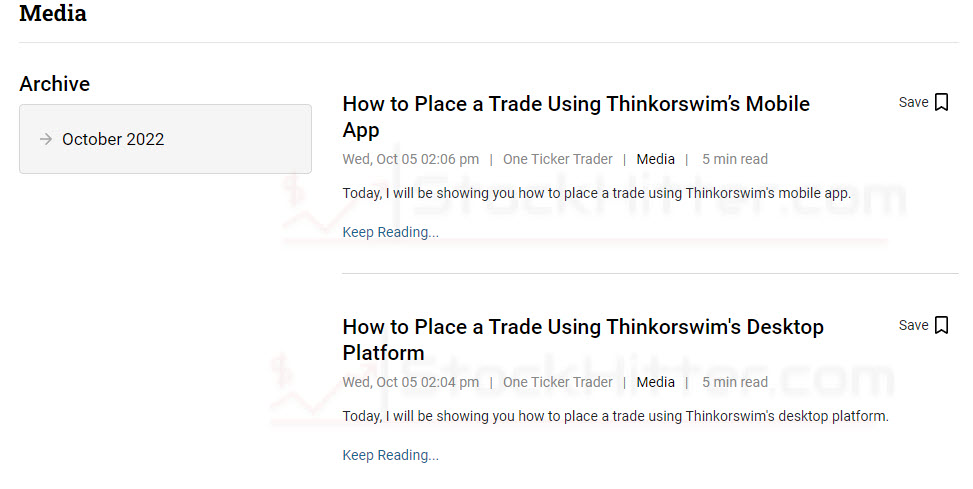
Everything above for $19. 30 days to decide.
Both special reports are yours to keep even if you cancel.
How Much Does One Ticker Trader Cost?
| Plan | Price | Guarantee |
|---|---|---|
| Annual Membership | $19 (discounted from $199) | 30-day full money-back |
Nineteen dollars. I keep coming back to that number and it still feels weird to type.
I’ve reviewed newsletters at $49, $79, $149 a year. Larry’s service — from someone with a verifiable 20-year unbroken winning streak and $274 million in audited client profits — is $19. Larry’s stated reason is that he wants regular investors positioned before the wealth transfer, not just the wealthy clients who could afford his hedge fund minimums.
The 30-day window is short — you’ll need to actually read the reports and evaluate a trade or two during that period to properly assess the service. Don’t sign up and forget about it.
30-Day Guarantee — Both Special Reports Yours to Keep Either Way
If the service doesn’t meet your expectations within 30 days, contact customer service for a full refund. Both special reports — the SPY playbook and the options guide — are yours to keep regardless of whether you cancel.
One Ticker Trader Pros and Cons
What Actually Works:
- Larry Benedict’s track record is the real thing. Twenty consecutive winning years. $274 million in audited net profits. Barron’s top 100. Market Wizards alongside Ray Dalio. I went looking for the catch and I didn’t find one.
- The 2025 performance data is compelling. 35 closed trades, an 86% win rate, averaging +23.3% per trade, straight from the official dashboard export. 13-for-13 on Trump trade calls. These are recent and specific enough to evaluate seriously.
- The SpaceX thesis is grounded in real market mechanics, even though inclusion itself isn’t confirmed. The forced-buying argument isn’t manufactured hype — it’s how S&P 500 index inclusion actually works when it happens. Tesla’s $85-90 billion in forced buying when it joined the index is documented history. Whether and when SpaceX gets added is still the index committee’s call.
- The free SPY pick is actually the honest play. Telling people to skip the SpaceX IPO and focus on SPY options is more sophisticated and credible than pitching a speculative SpaceX derivative play.
- The price eliminates the risk objection entirely. At $19 with a 30-day guarantee, there is essentially no financial argument against evaluating it.
- The options guide removes the learning barrier. Larry’s beginner report covers everything needed to start from zero and execute a basic options trade.
What’s Actually Annoying:
- This is an active trading service, not passive investing. You need to act on alerts when they come. If you miss a trade alert because you weren’t watching your phone, you may miss the opportunity entirely.
- Options have a real learning curve — I’m not going to pretend otherwise. Larry’s guide is genuinely good for beginners, but the first time you’re staring at an options chain at 9am deciding whether to execute a trade, it can feel overwhelming. Build in some time to paper trade first before risking real money.
- The SpaceX S&P 500 inclusion hasn’t happened yet. The IPO itself is done, but whether and when SpaceX gets added to the index is still a decision for the index committee. If inclusion doesn’t happen, or happens on a very different timeline, the specific catalyst trade this pitch is built around may never show up.
- The sales presentation is intense. The “wealth transfer” and “Final Phase” framing is dramatic. The underlying thesis is real — the packaging is aggressive.
- 30-day guarantee only. Given alerts don’t come on a fixed schedule, you may only see one or two trade opportunities in that window.
One Ticker Trader vs. Similar Services
For a broader view of the work involved, compare our active trading service reviews. The collection separates stock forecasts from options alerts and explains why their timing and risks differ.
| Service | Focus | Guarantee | Entry Price | Key Differentiator |
|---|---|---|---|---|
| One Ticker Trader | Single-ticker options strategy | 30 days | $19/year | SPY options, 20-year unbroken winning streak |
| Near Future Report | AI, semiconductors, biotech | 30 days | $179/year | 5 portfolios, Silicon Valley insider background |
| Altucher’s Investment Network | Contrarian growth, |