

Is Danelfin useful for researching stocks?
Danelfin is worth a look if you want an AI-generated shortlist to investigate. It becomes much less useful if you expect a score out of ten to do the investing for you. A neat number can organize a messy research process. It still can’t tell you how much of your savings belongs in one stock, whether you can stomach a loss, or what happens when next quarter refuses to resemble the training data.
The strongest reason to consider Danelfin is its combination of stock rankings and explanations behind those rankings. The biggest reason for caution is how easily a forecast can start feeling like a fact once it arrives wearing a confident little badge. This review separates the product’s documented features, current subscription costs and performance evidence so you can decide whether it deserves a place in your research routine.
Review scope: Official documentation, public stock-report content and published methodology reviewed as of October 19, 2026, with pricing and AI Audit disclosures refreshed November 14, 2026. This is a documentation-based review. We did not subscribe, connect a brokerage account, place trades or independently reproduce Danelfin’s model results.
The short verdict
Start with Free if you’re curious. Consider a paid tier only when you can name the feature you need. Unlimited reports might solve a genuine research bottleneck. Paying for a larger dose of certainty won’t, because certainty isn’t on the menu.
| Your goal | Potential fit | The catch |
|---|---|---|
| Find stocks to investigate | Rankings and model explanations can help narrow a universe | A high score is the start of due diligence |
| Monitor a selected watchlist | Scores, component signals and portfolio views provide structured checks | A changed score alone doesn’t establish a reason to trade |
| Make a five-year business-quality judgment | One additional input | The AI Score’s primary horizon is three months |
| Delegate portfolio decisions | Poor fit for that expectation | Ratings aren’t a personalized allocation or risk-management plan |
What the AI Score means
Danelfin’s core AI Score runs from 1 to 10 and expresses the model’s assessment of a security’s probability of beating its benchmark over the next three months. For U.S. stocks, its methodology uses the S&P 500 Total Return benchmark. It also provides fundamental, technical and sentiment subscores. The overall score is not simply their arithmetic average.
That distinction matters. A stock can have attractive fundamentals and weak near-term price behavior. The categories describe different inputs; they aren’t three judges whose cards you add together. Danelfin’s methodology explanation describes how those inputs feed its analysis.
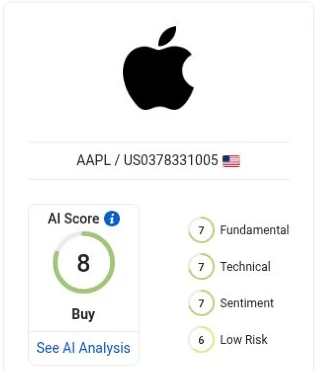
The dated public Apple report below makes the distinction concrete: the overall AI Score was 8 while the fundamental, technical and sentiment subscores were each 7. This illustrates how the interface separates its outputs; it does not establish that Apple was a suitable investment.
A 10/10 score does not mean a 100% chance of success or a forecast 10% return. Nor does beating a benchmark require making money. In a hypothetical quarter, a stock falling 5% while its benchmark falls 10% has outperformed by five percentage points. Your account still went backward.
The separate Low Risk score uses historical downside fluctuations. A high reading describes that history; it isn’t a maximum-loss limit, insurance or protection against a future earnings surprise.
If you are comparing rating systems, our Power Gauge Report review explains a separate Bullish, Neutral and Bearish framework; those labels are not interchangeable with Danelfin’s AI Score.
What you can investigate beyond the headline number
The public report format includes alpha-signal explanations, component analysis, score history and forecast views. In this context, an alpha signal is a feature the model associates with relative performance. Seeing which inputs contribute is more useful than receiving an unexplained buy label, but it doesn’t prove that a particular input caused a stock’s return.
Danelfin’s getting-started guidance also distinguishes its three-month AI Score baseline from additional one-, six- and twelve-month forecast and track-record views. Check which horizon you’re looking at before comparing two figures. A one-year forecast and a three-month rating aren’t interchangeable just because they share a ticker.
A practical reading sequence is:
- Check the date and horizon. Make sure the report is timely enough for the decision.
- Inspect the explanation. Identify which fundamental, technical or sentiment inputs matter.
- Challenge the inputs. Compare important financial figures with the company’s reporting and investigate unusual values.
- Look for a reason the model could be wrong. Upcoming events, business changes and concentration deserve their own review.
- Decide whether any action is needed. A fresh score does not create an obligation to press a button.
Before paying, check the export formats and logged-in workflow you need. The public reports don’t show how those features will work with your account.
Danelfin pricing: the annual bill matters
The monthly and annual schedules list four tiers. The attractive monthly equivalent on the annual page is the yearly price divided by twelve, not a monthly billing commitment. Read the whole number before the checkout page makes it your problem.
| Plan | Monthly billing | Annual billing | Annual-plan monthly equivalent | Main reason to consider it |
|---|---|---|---|---|
| Free | $0 | $0 | $0 | Limited initial evaluation |
| Plus | $29 | $156 per year | $13 | Unlimited reports and rankings |
| Pro | $79 | $420 per year | $35 | CSV exports and deeper signal detail |
| Elite | $179 | $960 per year | $80 | API and historical-score access |
Check the official plan comparison and billing FAQ for current entitlements, the billing currency, applicable taxes and the final checkout amount. These annual offers apply to new subscriptions through November 30, 2026. The renewal discount continues only while the subscription stays active on the same plan and billing period. Compared with twelve payments at the listed monthly rates, these annual totals cost $192, $528 and $1,188 less, respectively. That saving only helps if you actually want the longer commitment.
Free includes ten stock or ETF reports per month and one portfolio containing five holdings. Plus adds unlimited reports and rankings, U.S. brokerage synchronization and three portfolios of up to 25 holdings each. Pro adds CSV exports and fuller fundamental, technical and sentiment signal access. Elite includes the API Expert allowance of 10,000 calls per month and historical daily AI Scores since 2017, available as CSV on request. API access does not grant unrestricted rights to republish the data.
Paid tiers advertise a 14-day trial. The FAQ says plans renew automatically, cancellation prevents the next renewal, and a 30-day money-back guarantee runs from the creation date of a new subscription. Those are different clocks. Confirm when your trial ends and when the refund window begins before paying; don’t assume cancellation automatically requests a refund.
How strong is the performance evidence?
Danelfin publishes more than one kind of performance analysis. They answer different questions, and blending them together would make the evidence sound stronger than it is.
The Best Stocks Strategy is a backtest
The published strategy uses 25 stocks across five sectors, with eligibility reviewed quarterly and equal weights restored annually. Its reported simulation period runs from March 29, 2017 through September 3, 2026.
The full strategy methodology and footnotes describe twelve Monte Carlo variations: each selects five stocks from ten high-scoring eligible candidates within each selected sector. The reported average comes from those simulations, with estimated transaction costs of 0.15% per trade. The page also says the simulations were rerun from the beginning after a strategy update.
This is a vendor-produced historical test, rather than a record of actual customer accounts. Random variations in stock selection can test sensitivity to that selection; they don’t by themselves remove model-selection bias, establish independent verification or settle real-world taxes and execution costs.
The AI Audit makes a separate point-in-time distinction
Danelfin’s AI Score Audit disclosures say scores before July 7, 2025 were recalculated walk-forward using the current model. Scores from that date onward are described as live, point-in-time scores.
That distinction deserves credit for being explicit. It also deserves careful reading. A score recorded at the time is different evidence from a reconstructed historical score, but neither automatically equals an investor’s realized, after-cost return.
The dashboard says its mechanical bias checks cannot detect look-ahead inside recalculated scores. Its score-to-alpha regression does purge overlapping forward-return horizons from training dates: each test date uses only training observations whose holding periods have already ended. That out-of-sample label applies to the regression, not the underlying historical scores or every analysis on the dashboard.
There’s another important gap: the score history omits companies that no longer trade, including acquired, delisted and bankrupt businesses. Danelfin says the size and direction of that survivorship bias cannot be determined here. Its small delisting-sensitivity differences aren’t evidence that the results are robust.
This is Danelfin’s own dashboard, not an external audit. We did not independently reproduce its calculations. The word “Audit” in a page title shouldn’t do that work for us.
For a buying decision, ask whether the specific evidence matches the strategy you would actually use: universe, holding period, turnover, position limits and costs. A favorable result for a diversified scoring experiment is not a promise about the one ticker catching your eye today.
Is a paid plan worth the cost?
It depends on the job you need it to perform and the size of your research budget. On a hypothetical $10,000 portfolio, the promotional annual subscriptions of $156, $420 and $960 equal 1.56%, 4.20% and 9.60% of that starting balance. Those are cost comparisons, not forecasts or a precise after-tax performance hurdle. They do show why an expensive research stack can overwhelm a small account.
Plus is the more natural paid candidate for someone who needs frequent reports. Pro deserves consideration when exports or deeper signal inspection support a repeatable process. Elite’s data access makes more sense for a defined research workflow than for a casual investor who simply wants the biggest plan. More features are only a bargain when they have somewhere useful to go.
If you mostly hold a diversified long-term portfolio and rarely research individual stocks, the free tier may answer your curiosity without adding another recurring bill. If you need financial planning, personalized allocation or trade execution, evaluate those needs separately.
A sensible evaluation before upgrading
Use the free allowance on securities you already understand, including a candidate you dislike. Write down the score, report date, horizon and your own thesis before seeing what happens next. Record disagreements as carefully as agreements. A tool that only confirms your favorite ideas can become a very polished yes-person.
The watchlist-building guide offers a way to keep those research reasons and review conditions beside each ticker.
Then ask whether the explanations uncovered a checkable fact or merely made your existing opinion feel more official. Confirm that your required securities and features are available, and test export formats or broker compatibility only if you actually need them. Compare future observations with an appropriate benchmark over the stated horizon, while recognizing that a tiny sample cannot establish predictive accuracy.
Bottom line: Danelfin offers a structured way to generate and challenge stock ideas. Its documented explanations and explicit performance caveats are worth reading. The useful purchase is research assistance that fits your process, with a subscription you can justify. A high score can earn a stock a closer look. It shouldn’t earn automatic custody of your money.
This review is educational and is not personalized investment advice. Investing involves risk, including loss of principal.