

Thomson Reuters beat its own revised third-quarter growth and margin forecasts, but the useful investor takeaway comes with a bookkeeping wrinkle: its print business has moved out of continuing operations. The quarter showed real growth in the remaining businesses, alongside softer margins and weaker quarterly cash generation. Reading all three together gives a much clearer picture than an earnings headline alone.
For the company behind legal, tax and business-information tools, this is an unusually good moment to check which version of the scorecard you’re holding. A majority sale changed the comparisons, and some benefits of the new arrangement won’t show up until the fourth quarter. The fine print has, rather appropriately, become part of the story.
The Q3 beat needs the October scorecard
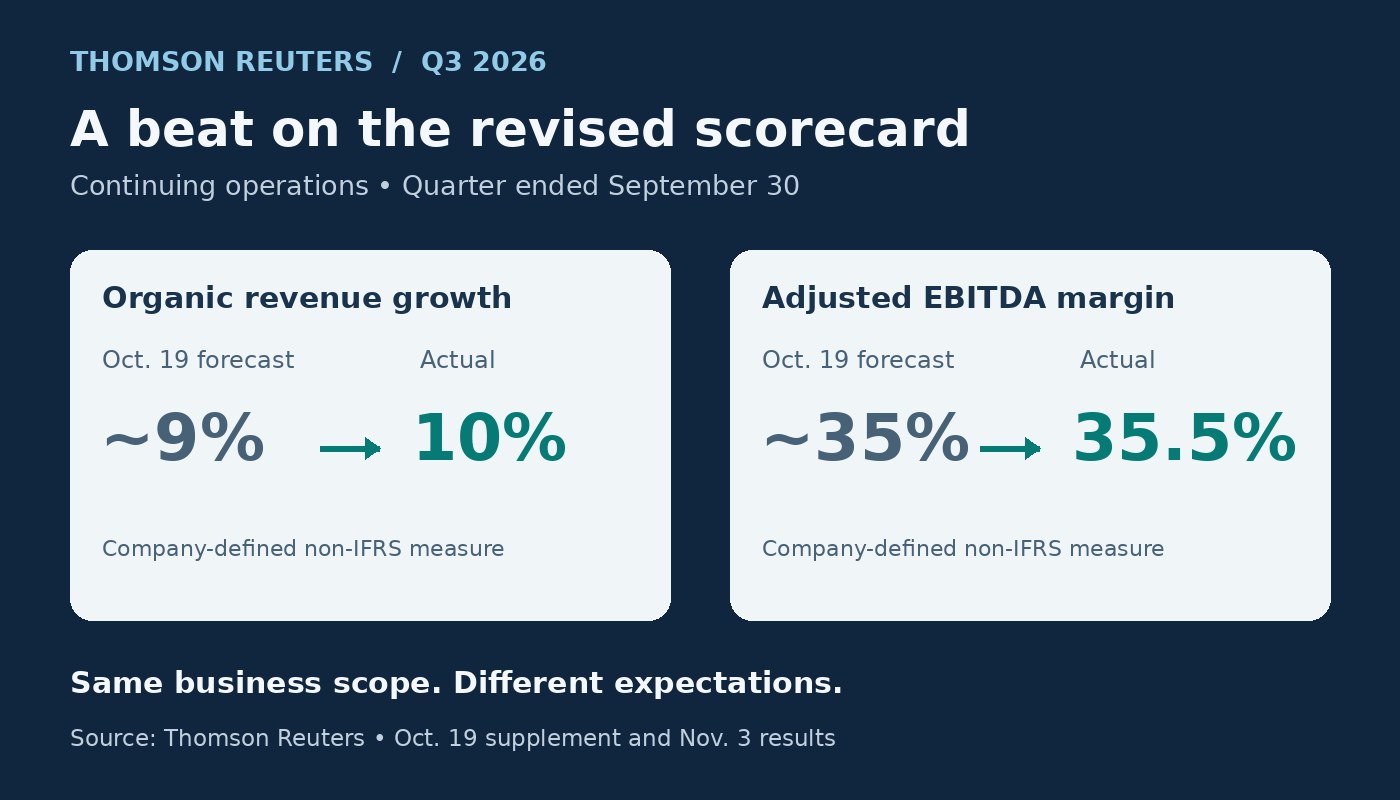
In its November 3 earnings release, Thomson Reuters reported 10% organic revenue growth and a 35.5% adjusted EBITDA margin for the quarter ended September 30, 2026. Both exclude the former Global Print business from continuing operations. All dollar amounts here are U.S. dollars.
Management’s October 19 restated outlook called for about 9% organic growth and a 35% adjusted EBITDA margin. These company-defined non-IFRS forecasts aren’t analyst consensus.
August’s targets included Print, so mixing those with today’s results would scramble the comparison. It’s a practical example of why reading an earnings report starts with matching the business, period and accounting basis.
Growth improved, but profitability needs context
The revenue mix offers something encouraging and something to watch. Recurring revenue grew 8% organically, while transaction revenue grew 23% organically. Reuters’ growth included generative-AI content licensing that the company describes as largely transactional. That matters: a licensing boost doesn’t automatically become the same dependable annual stream as a subscription.
Meanwhile, the 35.5% adjusted EBITDA margin was below the comparable prior-year 35.8%. Beating a forecast and losing some margin year over year can both be true.
Statutory operating profit also fell, to $402 million from $517 million. But the comparison includes a prior-year gain from selling the Elite minority interest. That one-off gain complicates the comparison.
The cash picture changes with the time frame
The earnings presentation’s cash-flow breakdown separates continuing and discontinued operations. Continuing-operations free cash flow fell to $356 million from $459 million in the quarter. Working capital and other operating items swung against cash generation, and capital spending increased.
Yet continuing-operations free cash flow for the first nine months rose to $1.30 billion from $1.173 billion. Free cash flow is a company-defined non-IFRS measure. Choosing whichever number looks friendliest would be a very short analysis.
The print deal leaves connections behind
Thomson Reuters completed the sale of 51% of Global Print on October 1, received approximately $500 million in gross proceeds and retained 49%. The business now operates as Westbridge Print. This was a majority sale, with an ongoing ownership stake and contractual ties.
Starting in Q4, Westbridge will pay royalties equal to 20% of its Professional revenues. That business represents roughly 85%–90% of Westbridge’s total revenue. Transition-services reimbursements add another connection. Management expects those receipts largely to cover costs left behind after the separation. They aren’t benefits earned in Q3.
That assumption deserves a spot beside the upbeat growth forecast. Receipts could fall short of the remaining costs, and Thomson Reuters has agreed to certain financial support designed to provide KKR a minimum return under certain circumstances.
What the next quarter needs to show
Management now forecasts full-year organic growth of 8.5%–9% and an adjusted EBITDA margin of about 39% on the continuing-operations basis. Its outlook for the three core professional-information segments is unchanged. The forecasts hold currency rates constant and exclude future acquisitions or disposals.
Next quarter, watch whether recurring growth holds up and the new receipts cover the costs left behind. The growth is encouraging; I’d keep the margin comparison and cash-flow trend beside it before giving the quarter a victory lap.