
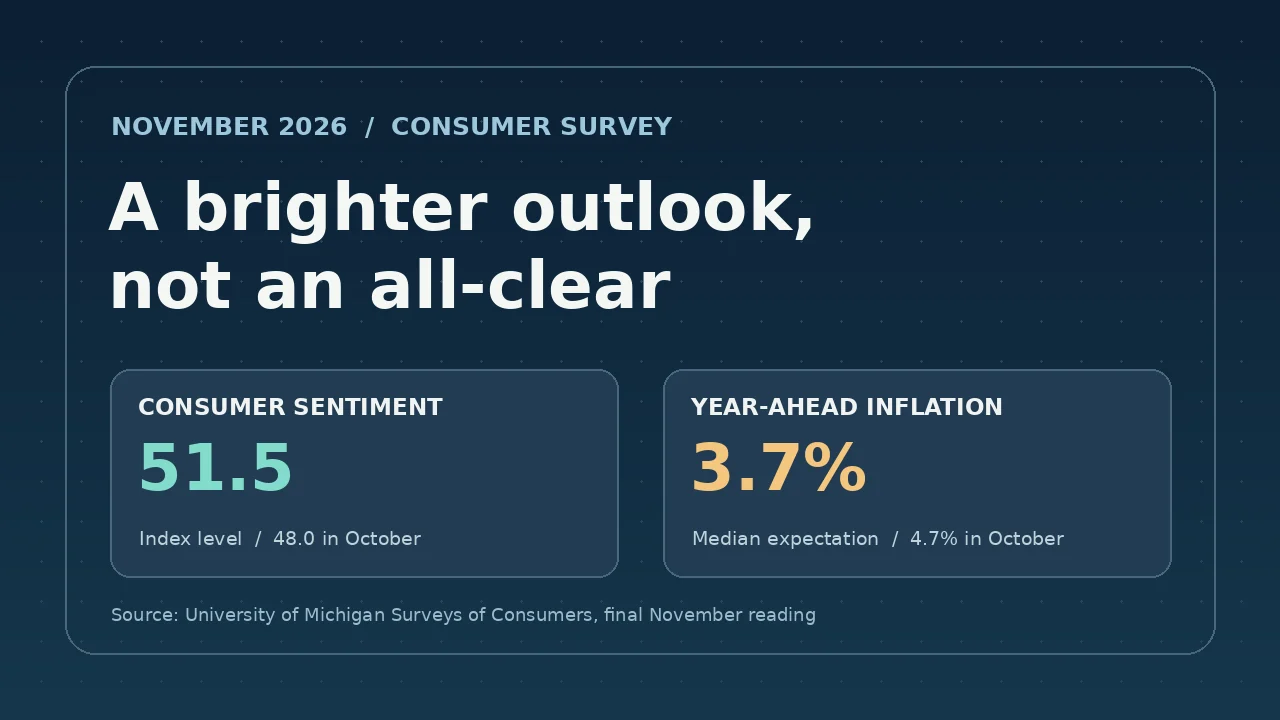
Shoppers sounded a little less gloomy in November. They didn’t suddenly say life was getting cheaper. The University of Michigan’s final consumer sentiment index rose to 51.5 from 48.0 in October, while the median expectation for inflation over the next year fell to 3.7% from 4.7%. That’s a brighter outlook, but the survey has more to say about what households think will happen than what they’re buying right now.
The final reading gave the outlook more of a lift
The headline finished half a point above the preliminary November reading of 51.0. The two pieces underneath it went in opposite directions between releases. Current conditions finished at 49.4, below the preliminary 51.0. Expectations finished at 52.9, above the preliminary 50.9. Both were still higher than in October. In other words, the final number didn’t get a lift because the assessment of today improved from the early read. It got a lift even though that part slipped.
Here’s another reason not to hang too much on the headline: the university’s November 20 release says the headline index needs a monthly move of 4.8 points for statistical significance at the 95% level. November’s gain was 3.5 points. The current-conditions and expectations indexes gained 2.7 and 4.1 points, respectively, also below the six-point threshold for each. Those thresholds apply to the October-to-November moves, not to the revisions from the preliminary survey. The readings are directionally better, but they don’t establish a broad rebound.
Michigan also found that roughly half of the improvement in expected business conditions came after Election Day. That’s a timing observation, not proof the election caused the change. And the overall sentiment index was still about 9% below February. A better month and a subdued level can both be true.
Cooling expectations don’t reverse past price increases
The one-percentage-point drop in the median year-ahead inflation expectation is the number I’d circle. Even after that drop, 3.7% was above February’s 3.4%. Longer-run expectations also eased, from 3.5% to 3.3%, but remained above the 2.8% to 3.2% range Michigan recorded in 2024. In its final survey commentary, Michigan said respondents still overwhelmingly viewed inflation, rather than unemployment, as the bigger source of hardship over the next year or two.
The household stories weren’t all headed the same way either. Survey director Joanne Hsu said people with less wealth generally described better personal finances than they had in October and noted some relief from lower gas prices. Respondents with the biggest stock holdings reported weaker personal finances. That’s useful context when a national average makes it sound like everybody had the same month.
Think of the difference between a receipt and a forecast. The survey asks people what they think prices will do. Even if they’re right that prices will rise more slowly, that doesn’t roll back the grocery bill or the rent increases they’ve already absorbed. And a median expectation isn’t an inflation reading or a prediction of what the Fed will do.
What would make this more convincing for retail investors?
I’d look for evidence that the better outlook is showing up in spending after inflation, then see whether that matches what retailers say about traffic and how much customers buy. A company can sell more in dollar terms because it sold more items, because prices rose, or because shoppers bought a different mix of things. Those explanations can look identical at the top of an earnings release and tell very different stories about demand. Traffic, units and average transaction size can help separate them when companies disclose those measures.
Our look at October retail sales makes the same point from the other direction: the Census numbers show dollar receipts, and the headline can conceal big differences across categories. On November 25, the Bureau of Economic Analysis is scheduled to release October spending and inflation data. Its inflation-adjusted spending figures cover goods and services, so they can add context the retail report can’t. The spending report covers October, and Michigan’s final survey includes interviews through November 16. So the spending figures offer a baseline, not a test of what people bought after their outlook improved. For now, the November report says the mood brightened. The checkout line hasn’t weighed in yet.