

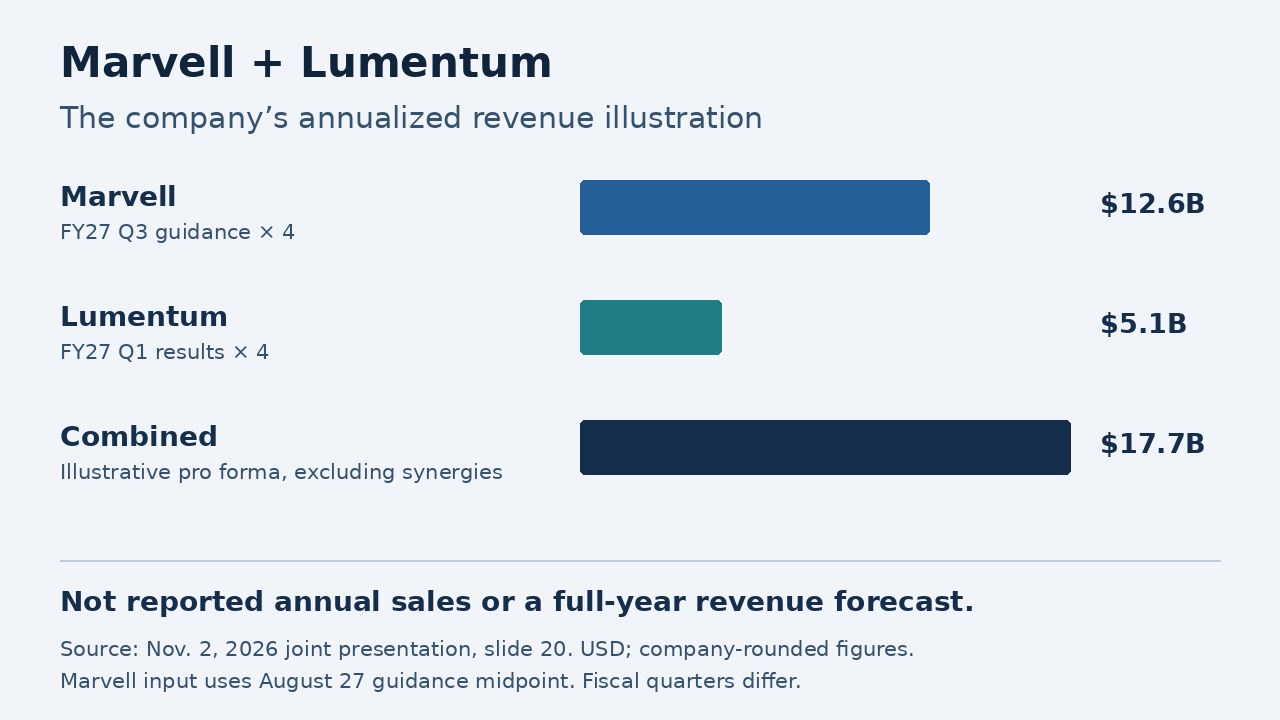
Marvell’s proposed acquisition of Lumentum would bring more of the hardware behind AI connections under one roof. But the companies’ $17.7 billion combined revenue illustration needs a little unpacking: it annualizes quarterly figures, mixes guidance with reported results, and does not describe a year of sales the combined business has already earned.
That distinction matters in a deal announced November 2 with an implied enterprise value of $115 billion for Lumentum. There’s a substantial business combination here, alongside a substantial collection of future expectations. The interesting part is figuring out which numbers belong in which column.
The revenue figure is a snapshot stretched into a year
In their joint investor presentation, the companies show $12.6 billion for Marvell and $5.1 billion for Lumentum, adding to $17.7 billion of pro-forma revenue. The small-print label is “MRQ Annualized”: most recent quarter, scaled to a full year.
Marvell’s portion uses the midpoint of fiscal third-quarter 2027 guidance issued August 27. Lumentum’s portion uses its fiscal first-quarter 2027 results. They’re different fiscal quarters, and one input began as an outlook rather than a completed earnings report. The illustration also excludes synergies.
Annualizing a quarter can help show the size of businesses growing quickly. It just doesn’t tell us what four actual quarters added up to, or guarantee that the next four will look like the latest one. The calendar hasn’t agreed to copy and paste.
Marvell did provide an update alongside the deal: preliminary fiscal third-quarter revenue remained consistent with its previous guidance midpoint. Those preliminary numbers are unaudited and subject to quarter-end closing procedures. That supports the scale illustration without turning it into audited annual revenue.
What Lumentum common shareholders would receive
The proposed exchange is fixed at 4.500 Marvell common shares for each Lumentum common share, with cash instead of fractional shares. It is not a fixed cash offer.
The announcement’s approximately $1,132-per-share equivalent and 23.9% premium use the companies’ unaffected October 28 closing prices. If Marvell’s share price changes, the market value of that share consideration changes too. The $115 billion headline is an implied enterprise value for Lumentum, not a cash payment promised to its shareholders.
After closing, existing Marvell shareholders would own approximately 67% of the combined company and Lumentum shareholders approximately 33%, on a fully diluted basis. Lumentum’s preferred stock has separate conversion and election provisions, so the common-share exchange should not be applied indiscriminately to every security.
The profit forecasts use adjusted numbers
Management expects the deal to add to Marvell’s non-GAAP earnings per share in the first year after closing, compared with Marvell on its own. It also identifies more than $1 billion in annual run-rate cost synergies, primarily in cost of goods sold. Both are expectations about the combined business, not savings already collected.
The accounting label deserves attention. Lumentum’s newly reported fiscal first quarter had a 42.3% non-GAAP operating margin, compared with 28.5% under GAAP. Its reconciliation includes stock-based compensation and related payroll taxes, amortization and other adjustments. Part of the compensation adjustment reflects an unusual equity-award modification associated with an executive retirement.
That historical example shows why adjusted and GAAP profits can differ substantially. It does not establish the precise exclusions in the future combined company’s EPS forecast. The deal release and presentation also do not quantify a merger integration-cost budget. Expected savings should therefore be read alongside execution costs and uncertainty, not treated as a clean addition to today’s profit.
Why combine these businesses now?
Marvell contributes electrical and optical interconnect technology, network switching and custom silicon. Lumentum contributes lasers, optical transceivers and optical circuit switching. The companies argue that designing more of those pieces together can improve performance, power efficiency and customers’ time to market as AI systems become more demanding.
That’s a more specific proposition than simply buying another company with AI exposure. My read: the useful test is whether joint engineering translates into products customers adopt and financial benefits that survive the cost of combining the operations.
There’s time between the announcement and that test. The companies expect closing in the first half of 2028, subject to both companies’ shareholder approvals, regulatory approvals and other conditions. Matt Murphy would remain chairman and CEO; three Lumentum directors would join Marvell’s board.
For investors following the deal, the most revealing updates will connect those stages: approval progress, actual quarterly performance, integration spending and evidence behind the synergy targets. The proposed scale is impressive. The next chapter is whether the businesses can turn that scale into the results management is projecting.