

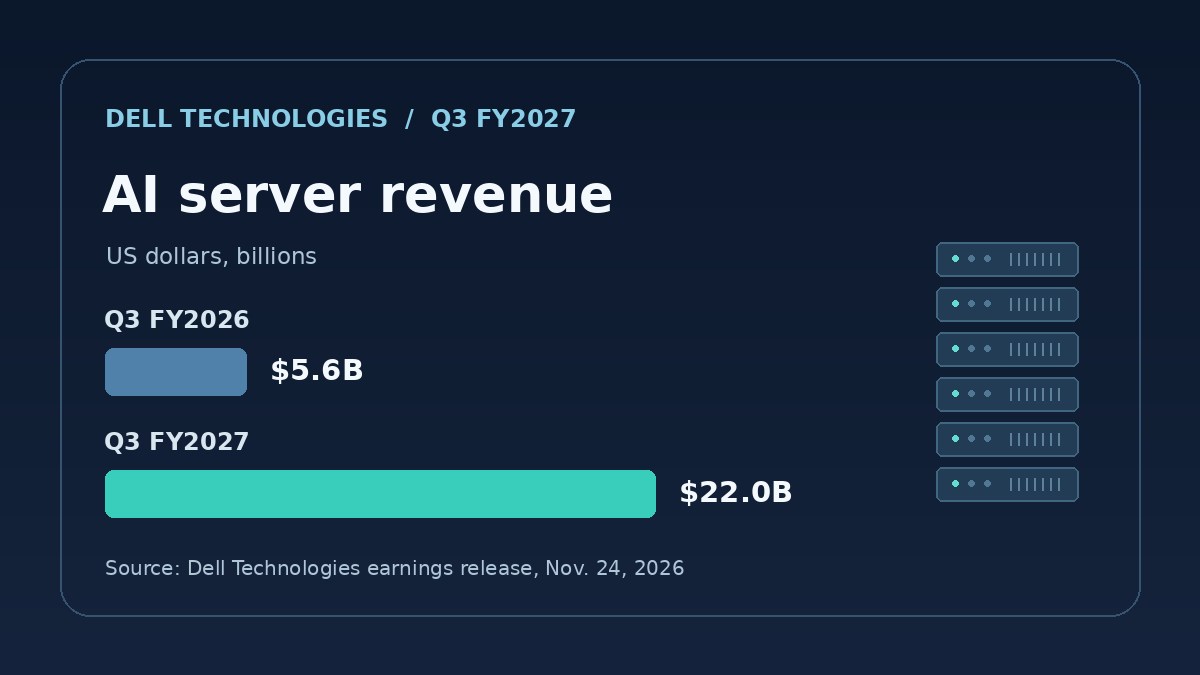
Dell Technologies (NYSE: DELL) booked $22 billion in AI server revenue in its fiscal third quarter, nearly four times what it recorded a year earlier. Its $132.3 billion AI server backlog is bigger and flashier, but it answers a different question. The first number tells us what Dell recognized as sales. The second tells us how much work is still lined up. Neither tells us how much cash came in.
The numbers that made me linger over Dell’s November 24 report were $4.46 billion in cash from operations and a 17% operating margin in its infrastructure segment. They show the benefit went beyond a fat order book. They also give us something concrete to compare next quarter, when Dell expects that segment’s margin to come down from its third-quarter level.
Orders, backlog and sales are three different numbers
In the quarter ended October 30, Dell booked $60.2 billion in new AI server orders. That was slightly below the $60.9 billion it reported in the previous quarter, even as ending backlog rose from $95 billion to $132.3 billion. Those figures don’t contradict each other. Orders track new business added during the quarter, backlog measures what’s outstanding at the end, and revenue is what Dell recognized in the quarter. Adding them together would make for a spectacular headline and a terrible calculator.
Management said in its prepared remarks it checks customers’ financial capacity and underlying end-user contracts when it takes an order and again before production starts. It also checks whether customers have access to land and power. That due diligence is worth knowing about: a data center without power can’t make much use of a new rack. It doesn’t make the backlog a delivery calendar or guarantee when Dell gets paid.
AI racks weren’t the whole profit story
AI servers accounted for about 40% of Dell’s $54.9 billion in total quarterly revenue. Traditional servers and networking brought in another $15.0 billion, more than triple the year-earlier figure, and storage added $4.9 billion. All three sit inside the Infrastructure Solutions Group, which earned $7.1 billion in operating income, up from $1.7 billion. Its operating margin rose to 17.0% from 12.4%. That’s a margin for the entire segment, not just the newer AI racks.
Dell cited scale and pricing discipline, and pointed to a contribution from its higher-margin own-brand storage. Management also expects the segment margin to ease from Q3 as a favorable North American sales mix normalizes. Meanwhile Client Solutions, Dell’s PC-focused segment, grew revenue 3% but earned 6% less operating income than a year earlier. Consumer revenue within the segment fell 15%, even as the commercial side grew.
What made it into cash?
Cash from operations climbed to $4.46 billion from $1.17 billion a year earlier. After net capital spending and capitalized software costs, Dell’s reported free cash flow was $3.47 billion. The $4.29 billion adjusted figure adds back effects from financing receivables and equipment under operating leases. I’d keep those lines side by side, especially when the company is helping some customers finance the equipment they order. Dell also approved another $25 billion in Class C share repurchases. That’s authorization for possible future purchases, not $25 billion already spent.
The balance sheet adds another clue. At October 30, inventories stood at $29.4 billion, up from $10.4 billion at the January fiscal year-end. Accounts payable rose over the same period, to $57.8 billion from $33.6 billion. Bigger inventories can help Dell fill orders, but they also mean more money tied up in equipment and parts. Watching inventory alongside payables and cash keeps me from reading the inventory number as if Dell had already paid for everything sitting on the shelf.
What the higher Dell forecast assumes
Dell raised its fiscal 2027 revenue outlook from $192 billion to $202 billion, while its AI server forecast rose from $74 billion to $78 billion. That’s $4 billion of the $10 billion increase, a useful reminder that this upgrade isn’t all about AI servers. Dell also forecast about $23.5 billion in AI server revenue for Q4. That number is management’s expectation, not sales already recognized.
So I’d frame the next report around a simple comparison: did Dell turn more of that order book into sales and cash, and how much profit did the infrastructure business keep on those sales as its mix shifted? The backlog can tell us how busy the kitchen is about to get. I’m more interested in what makes it out the door and gets paid for.