

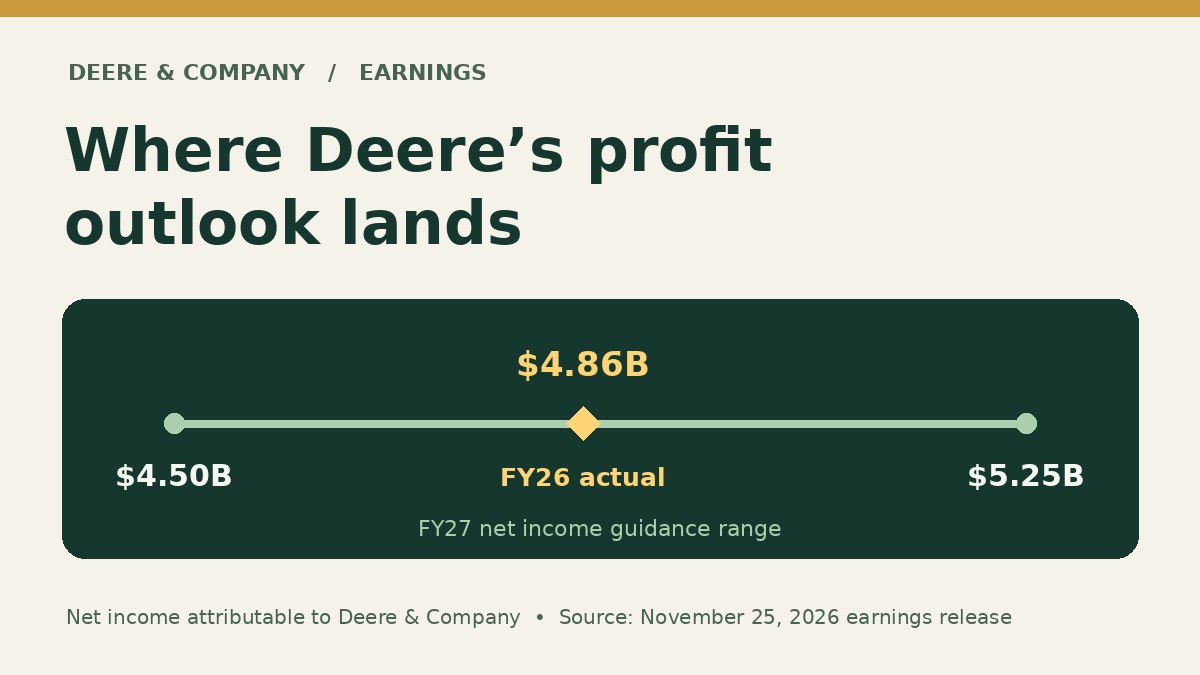
Deere sees early signs that demand for large farm equipment is improving in North America. Its profit forecast leaves plenty of room for a bumpier ride. The company expects fiscal 2027 net income attributable to Deere of $4.50 billion to $5.25 billion, a range that straddles the $4.86 billion it just earned in fiscal 2026.
That’s the part I’d circle. A better outlook for big farm machines gives Deere & Company (NYSE: DE) a way to earn more, but the low end of the forecast allows for another year of declining profit. And there’s an estimated pension charge tucked inside that range, alongside a tougher comparison on tariffs. Here’s what each piece tells us.
Deere’s biggest farm equipment business is coming off a weak quarter
In the Nov. 25 earnings release, Deere reported fourth-quarter worldwide net sales and revenues of $12.12 billion, down 2% from the year before. Net income attributable to Deere fell to $1.05 billion from $1.07 billion, and diluted earnings per share slipped to $3.89 from $3.93. The quarter ended Nov. 1.
The decline was much sharper in Production & Precision Agriculture, the segment that sells equipment such as large tractors and combines. Segment sales fell 15% to $4.02 billion as Deere shipped less equipment. Operating profit dropped 33% to $406 million, and operating margin fell from 12.7% to 10.1%. Management pointed to lower shipment volumes and the mix of sales as the main reasons for the profit decline.
Contrast that with Construction & Forestry, where sales rose 12% but operating profit fell 3%. Higher production, administrative and research costs weighed on profit. One company, two very different paths to lower operating profit. It’s why I’d keep the segment margins beside the sales numbers on the next report.
What Deere expects to improve in fiscal 2027
Deere’s earnings presentation puts expected U.S. and Canadian large agricultural equipment industry unit sales at 5% to 15% above fiscal 2026. Deere also forecasts 5% to 15% sales growth for its own Production & Precision Agriculture segment, with an operating margin of 12.5% to 14.5%, up from 11.3% for the full fiscal year just ended.
Same growth range, different yardsticks. The first is an industry forecast for how many units sell in two countries. The second is a dollar sales forecast for Deere’s segment, and it assumes about 3% favorable price realization and a negative currency effect. Deere expects the European agricultural equipment market to be flat to down 5% in units, so a North American pickup wouldn’t necessarily show up everywhere at once.
On the earnings call, Deere said North American early orders for spring-use products finished up by double digits. Combine orders were also up by double digits at the same point in a program that was still underway. That’s a reason to pay attention. Management said sustained combine orders and stronger confidence translating into regular tractor orders would help Deere reach the upper end of the segment’s sales forecast.
The Small Agriculture & Turf outlook gives investors another reason to look past the large-machine forecast. Deere expects roughly flat segment sales and a 12.5% to 13.5% operating margin, versus 15.1% in fiscal 2026. A healthier margin in one farm business can share a report with a weaker one in another.
The Association of Equipment Manufacturers expects stabilization to come before a broad recovery. Its November market update pointed to tight farm finances and pressure on grain and oilseed producers, who are key buyers of large machines. That’s useful context for Deere’s forecast: a rebound from a weak starting point can still leave the industry a long way from a boom.
The pension charge matters when you compare the profit numbers
The $4.50 billion to $5.25 billion companywide range works out to roughly 7% below to 8% above fiscal 2026 net income attributable to Deere. It includes an estimated one-time, noncash pension settlement charge of $250 million to $400 million after tax, linked to a voluntary lump-sum option for certain U.S. salaried retirees. I wouldn’t treat that accounting charge as a new operating cost of selling tractors or read an easy profit rebound into the high end of the range.
Tariffs complicate the comparison in a different way. Deere recorded $383 million in tariff recoveries in fiscal 2026 and doesn’t expect those refunds to recur. Management expects direct tariff costs before refunds to come down, but forecasts about $300 million more in net tariff expense in fiscal 2027. Those are different measures. I wouldn’t add the tariff figure straight to the after-tax pension charge and call it an adjusted profit forecast.
On the next earnings report, I’d start with orders, shipment volumes and the Production & Precision Agriculture margin. Deere has told investors where it expects improvement. If you’re following along with the next release, our guide to reading an earnings report explains how to compare margins and guidance without relying on the headline. The useful test for Deere is whether it ships more equipment and earns more per sales dollar in that business, even if the companywide headline is noisy.