

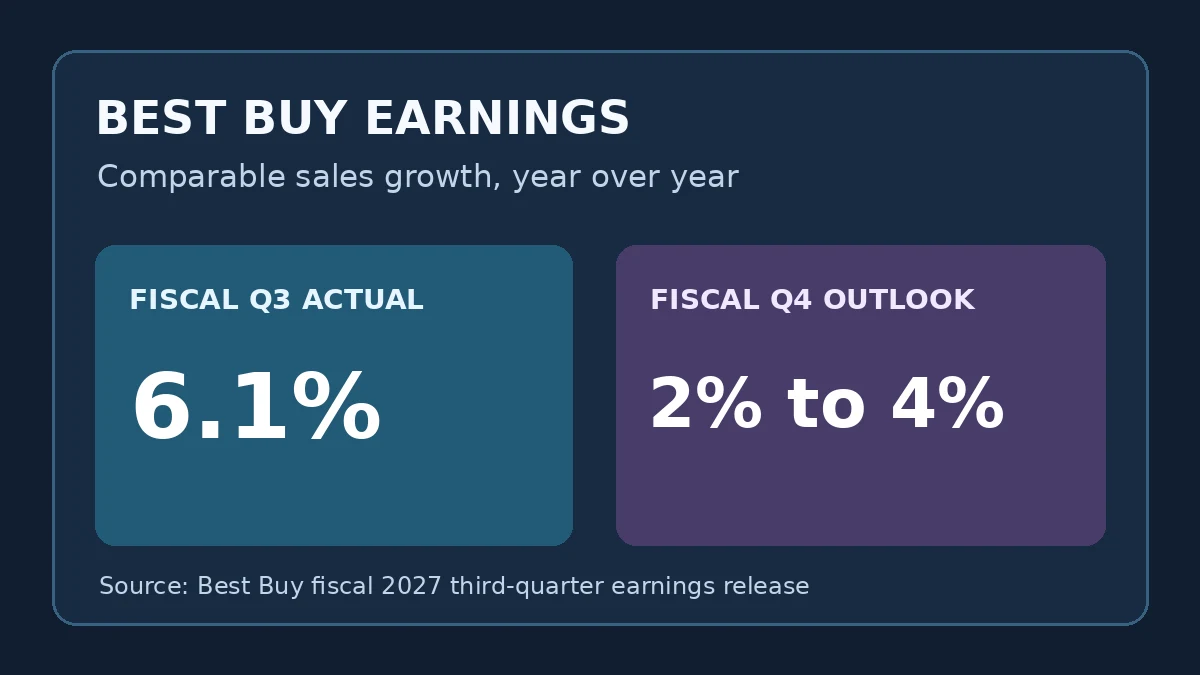
Best Buy (NYSE: BBY) just turned in its strongest comparable-sales growth in five years, according to the company. In its November 24 earnings release, the electronics retailer said comparable sales rose 6.1% in the 13 weeks ended October 31, 2026. For the holiday quarter, management expects growth of 2% to 4%. Both can be good news: Best Buy raised its full-year outlook, but it isn’t counting on another quarter like the one it just had.
What pushed Best Buy above its own forecast?
In August, Best Buy had forecast third-quarter comparable-sales growth of 1% to 3%. The actual 6.1% came in 3.1 percentage points above the top of that range. Total revenue rose to $10.24 billion from $9.67 billion in the same quarter a year earlier. Those are two different measures: Total revenue covers the whole business, while comparable sales measure changes in a comparable set of operations.
Domestically, Best Buy pointed to computing, mobile phones and a group of emerging categories that includes AI glasses and trading cards. Trading cards are the fun detail. Computing and phones are the part I’d underline. Together they represented 49% of domestic revenue, and comparable sales in that category rose 7.1%. Entertainment posted a much flashier 27.5% increase, but accounted for just 7% of domestic revenue. The biggest percentage isn’t necessarily the one doing the most work.
And in computing alone, the earnings call added a twist. CEO Jason Bonfig said the average selling price rose about 25%, while unit sales fell by a percentage in the mid-teens. He pointed to higher memory costs and a shift toward newer premium products. That pricing and unit breakdown is for computing, not for the combined computing-and-mobile category or the retailer as a whole.
Domestic online sales rose 10.8% on a comparable basis and made up 33.2% of domestic revenue, up from 31.8% a year earlier. That’s a useful second view of where the growth showed up. It doesn’t tell us how much came from more items, higher prices or a different mix of products. Our breakdown of October retail sales explains why the same distinction matters when looking at dollar sales across the economy.
A $41 million refund helped the margin
Best Buy’s domestic gross margin rose to 24.1% from 23.3%. The company credited a $41 million refund of tariffs imposed under the International Emergency Economic Powers Act, along with growth in its online Marketplace and advertising business. Lower product margins partly offset those benefits. The August report showed a similar mix: roughly $34 million of tariff refunds and lower product margins. So the domestic margin improved even though product margins fell. Marketplace and ads helped the gross margin, but Best Buy also spent more to build those businesses. Higher incentive pay added another operating expense.
The earnings comparison needs a little unpacking, too. Companywide reported diluted earnings per share rose to $1.66 from $0.66. Last year’s quarter included a $171 million goodwill and intangible-asset impairment tied to Best Buy Health, plus a separate long-lived asset impairment. On the company’s adjusted basis, diluted EPS rose to $1.62 from $1.40, about 16%. That comparison removes the prior-year impairments, but it still includes the benefit from the tariff refund. “Adjusted” isn’t a magic button that strips out every unusual item.
Outside the domestic business, international comparable sales grew 4.9%, but the segment’s gross margin fell to 21.6% from 22.8%, primarily because product margins were lower. It’s a useful reminder that stronger sales and stronger margins didn’t travel together everywhere this quarter.
What Best Buy actually expects for holiday shopping
Best Buy now expects full-year comparable sales to rise 3.4% to 4.0%, up from its prior 1.9% to 3.0% forecast. The annual revenue range moved up to $43.0 billion to $43.3 billion from $42.3 billion to $42.8 billion. It also raised full-year adjusted diluted EPS guidance to $6.90 to $7.05 from $6.70 to $6.90. Those are management forecasts, not results. Bonfig said the holiday forecast already reflects what management had seen so far in November. The October quarter itself ended before Black Friday, and the busiest shopping days were still ahead when the company reported.
The fourth-quarter range gives investors a more useful yardstick than trying to stretch 6.1% into December. Alongside the 2% to 4% comparable-sales forecast, management expects an adjusted operating margin of 4.9% to 5.1% for the holiday quarter. CFO Anne Bramman expects gross margin to improve from a year earlier, but by less than it did in Q3. The reason matters: Best Buy isn’t budgeting for another tariff refund benefit this quarter.
There’s also an inventory number I’d come back to. Best Buy ended October with $8.90 billion of merchandise inventory versus $7.99 billion a year earlier. Bramman said that largely reflected buying computing products ahead of time. That gives the higher balance a more useful explanation than assuming merchandise is just sitting there. The next report should tell us whether those products sold through without promotions eating into product margins.