

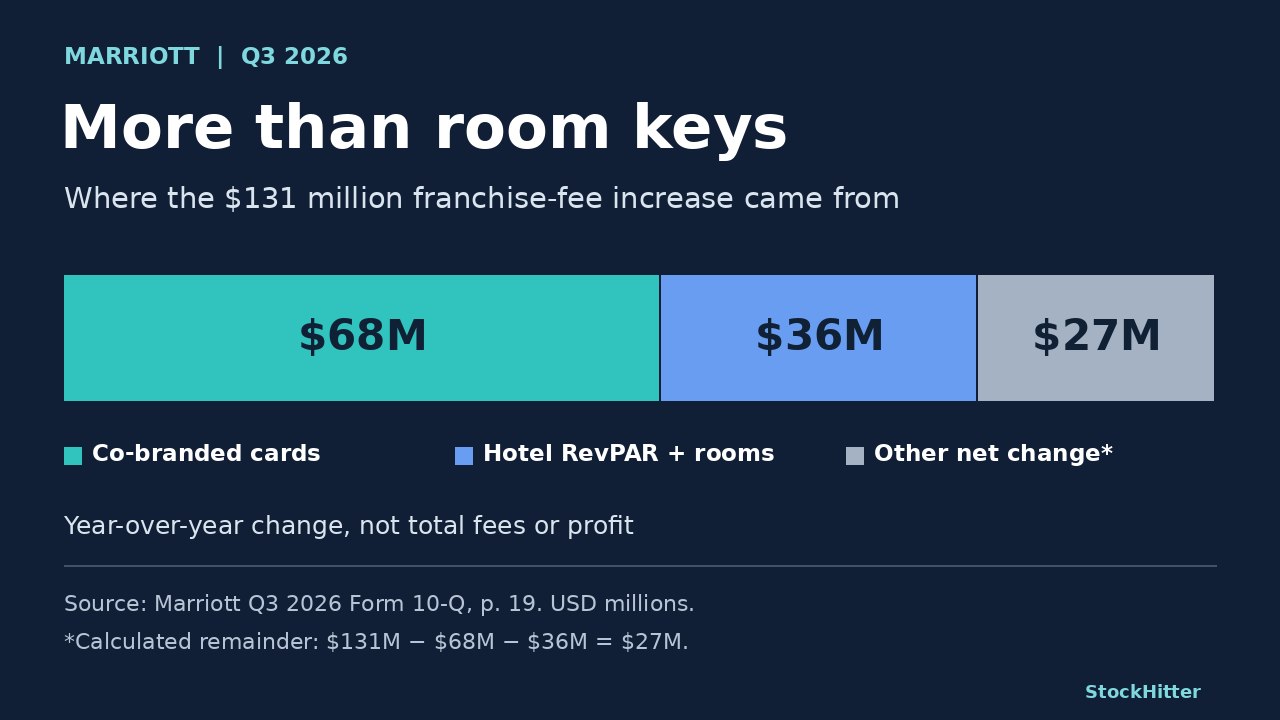
Marriott’s stronger hotel quarter comes with a useful surprise: credit cards supplied more than half of the increase in its franchise fees. Guests were paying more and filling more rooms, but the brand was also earning more away from the front desk. That’s the part of Monday’s report I’d keep beside the travel-demand headline.
Marriott International (NASDAQ: MAR) reported third-quarter franchise fees of $1.007 billion, up $131 million from a year earlier. Its November 2 quarterly filing attributes $68 million of that increase to higher co-branded credit-card fees, versus $36 million from stronger revenue at franchised properties through room growth and revenue per available room, or RevPAR. (Read the quarterly filing.)
The brand earns money beyond the hotel stay
Divide $68 million by the $131 million increase and the card contribution is about 52%. That’s a share of the increase in one fee category, not 52% of Marriott’s sales or profit. The remaining $27 million is the arithmetic difference after those two disclosed drivers, rather than a separately named business.
A hotel sign makes it tempting to picture a company collecting the entire room bill. Marriott’s model is more varied. It franchises, manages and licenses properties, while owning or leasing relatively few. Franchise royalties are typically tied to room revenue; management contracts can combine a revenue-based fee with an incentive tied to hotel profits.
Co-branded cards add another way to earn from the brand. This helps explain why an improving hotel-demand measure and growing fee revenue don’t have to move at the same pace. The room key and the card in the next pocket are doing different jobs.
There’s a particularly useful qualification in the filing. Marriott expects its new U.S. agreements with JPMorgan Chase and American Express to benefit future revenue primarily through cost reimbursements, followed by franchise fees. Reimbursements fund programs and services operated for owners and other counterparties without an added markup. Timing can affect quarterly results. I wouldn’t translate every extra dollar from those agreements into an extra dollar of profit.
The hotel improvement is real, but uneven
Marriott’s earnings release and financial tables show worldwide RevPAR rising 6.5%, with U.S. and Canada growth of 7.4% and international growth of 4.4%. These are year-over-year comparisons for comparable properties across its system, holding currency effects constant.
RevPAR spreads room revenue over available rooms, including those that weren’t sold. It therefore responds to both prices and occupancy. Worldwide average daily rates rose 4.8%, while occupancy increased 1.1 percentage points. Those figures use different units, so adding them together isn’t the way to reproduce RevPAR growth.
The regional details also resist a blanket “travel is booming everywhere” verdict. Comparable systemwide RevPAR declined 5.3% in the Middle East and Africa and 0.3% in Greater China. Stronger aggregate results can coexist with difficult local conditions. For an investor, that matters when deciding how much of a good quarter to carry into the next forecast.
Fee growth doesn’t remove the costs
Gross fees, including base and incentive management fees, reached $1.522 billion, up from $1.338 billion. Yet owned, leased and other revenue after its associated expenses fell to $41 million from $70 million. Renovations, a hotel sale and third-party agreement costs weighed on that result; an expected $12 million insurance recovery partly helped.
Reported net income rose to $794 million from $728 million. The filing also identifies a $29 million tax-valuation-allowance release that helped the tax comparison, while net interest expense increased to $219 million from $194 million. These offsets keep me from treating the fee increase as a shortcut to the bottom line.
It’s a good example of why reading an earnings report beyond its headline means following the specific revenue stream into the filing. “Franchise fees” contains more than a hotel-room royalty, and company revenue contains more than fees.
What the higher outlook actually changes
Management now forecasts full-year worldwide RevPAR growth of 4.5% to 5%, versus 3% to 3.5% in its August outlook. The outlook assumes a continuation of the current macroeconomic environment. Its net-room-growth expectation remains at the low end of 4.5% to 5%. Better expected performance from comparable rooms and a faster-growing room count are separate propositions.
I’d watch whether the hotel improvement broadens across regions and how the card agreements flow through fees versus reimbursements. Monday’s results give Marriott several sources of growth. Understanding what each contributes is more useful than asking a single travel statistic to explain the whole company.