

Affiliate Disclosure: I may earn a commission on any link you click on this site, at no extra cost to you. To learn more, click here.
Last Reviewed October 18, 2026
Hey everyone, Jenna here. True Innovations Report is the newest Stansberry Research pitch to land in my inbox, and it comes with a headline that sounds like a tech rumor: Elon Musk is secretly building an AI phone. I’ve gone through the complete checkout page line by line, and I joined so I could look at the model portfolio myself.
One honest note up front. I’m a new member, so this review is not based on years inside the portal like some of my others. It rests on Stansberry’s sales and checkout pages plus the model portfolio as I pulled it on October 18, 2026.
I’m also an affiliate for Stansberry’s offers. If you sign up through my links I earn a commission at no extra cost to you, and I’d tell you the same thing either way.
- Best for: investors who like early-stage technology ideas and can handle volatility.
- Not for: anyone who wants a conservative, income-focused portfolio.
Short version: True Innovations Report is a monthly tech-stock newsletter from Stansberry Research, and the current pitch is a prediction, not a fact.
- Editor Josh Baylin predicts Musk will launch an AI phone he calls the “Starphone.” Nothing here is confirmed.
- The offer is $129 for the first 12 months, which Stansberry lists at $499. It renews at $199 a year unless you cancel.
- A 30-day refund covers the subscription fee only. The stocks themselves carry real risk of loss.
- The model portfolio has 32 open positions. Older picks show big gains, while picks from the last year or so are far more modest.
- The portfolio numbers are Stansberry’s own reference-price tracking, not trades I made.
True Innovations Report at a Glance
| Metric | True Innovations Report (Oct 2026) |
|---|---|
| Publisher | Stansberry Research (Baltimore, MD) |
| Editor | Josh Baylin, with Senior Analyst John Engel |
| Format | Monthly issue, buy and sell alerts as needed, model portfolio, digital archive |
| Current Pitch | The editor’s “Starphone” prediction and a list of possible suppliers |
| Included Reports | 3 (supplier list, physical AI, Sam Altman convergence), plus a bonus video |
| Bonus | Stansberry Digest (daily), optional 1-year TradeStops Basic |
| Price | $129 for the first 12 months (Stansberry lists the regular price at $499) |
| Renewal | $199 plus applicable taxes, charged automatically each year |
| Model Portfolio | 32 open positions (October 18, 2026), no closed-position list that I could find |
| Refund | 30-day full refund of the subscription fee |
✓ Best For
- Investors who want early exposure to technology themes like AI hardware and chips
- Readers who enjoy a story-driven thesis and can separate it from the numbers
- Subscribers who want a model portfolio plus buy and sell alerts
✗ Not For
- Conservative or income-focused investors
- Anyone who would treat a prediction as a sure thing
- Short-term traders who need constant action
What Is the True Innovations Report?
True Innovations Report is a monthly investment newsletter from Stansberry Research focused on technology stocks. Each issue contains new recommendations from Editor Josh Baylin and Senior Analyst John Engel, plus updates to a model portfolio.
Members also get email buy and sell alerts between issues, a digital archive of back issues (Stansberry says over 100), and the daily Stansberry Digest. It is a research subscription, not a brokerage or an advisory service, so you make every trade yourself.
Who Is Josh Baylin?
According to Stansberry Research, Josh Baylin helped manage $200 million at what the company calls one of the most elite funds in the world before becoming editor of True Innovations Report. I can’t independently verify that fund or the amount, so treat it as Stansberry’s description of his background.
He is joined by Senior Analyst John Engel. I’m not going to guess how the two of them split the research, because I haven’t been a member long enough to see how often their calls change.
The Pitch: Is Musk Really Building a “Starphone”?
The presentation centers on Baylin’s belief that Elon Musk is planning an AI phone. He points to government approvals, acquisitions, deals and trademarks as evidence, and says they all lead to what he calls the Starphone.
His investing angle is a suppliers play. Musk has never built every piece of a product himself, the argument goes, so the companies supplying chips and components could benefit if a device is announced. That is a familiar pattern, which is why the pitch is easy to follow.
What’s reasonable to say
- Component suppliers often move when a major device launch is announced or rumored.
- SpaceX’s Starlink has pursued mobile connectivity, and the sales page says the FCC granted another approval for its Starlink Mobile network. I haven’t independently confirmed that approval.
- SpaceX itself is now a public company. Our guide to SPCX shares after the SpaceX IPO explains how investors can access them and the risks involved.
- Physical AI is a theme that Nvidia’s CEO has discussed publicly, according to the sales page.
What’s speculative
- Whether Musk will launch a phone at all. Baylin calls it his prediction and says he is “convinced,” which is conviction, not confirmation.
- Which companies, if any, would actually supply it. The supplier names are paid content, so I’m not publishing them, and a supply chain can’t be confirmed before a company announces a product.
- The claim that the story will break “any day now.” The sales page uses urgency, and nobody can time an announcement.
- The physical AI figure of $243 billion over the next few years is Stansberry’s number, attributed to market expectations without a named source.
Bottom line: a prediction can be interesting without being investable. Even if the phone is real, a supplier stock can already be priced for the news, and the stocks can fall.
What the Sales Page Says About Past Winners
Stansberry cites several past stock moves to make the case. Per the sales page, Cirrus Logic is up as much as 489% since it began supplying audio chips for the iPhone 6, and Amkor roughly tripled after Apple’s CEO mentioned it. It also cites an 851% past gain on Lumentum in the True Innovations Report.
The page also lists a few far larger figures. I’m not reproducing them, because they are outliers that give a misleading picture of what a typical subscriber should expect. Past performance does not guarantee future results, and a handful of highlighted winners tells you nothing about the full list of picks, including the losers.
I did compare the headline claims with the model portfolio. The returns shown there for two of the sales page’s best-known winners are lower than the sales page figures. That is probably a difference between peak prices and current prices, but it is a reminder that the highlight reel and the live portfolio are not the same number.
What I Found in the Model Portfolio
On October 18, 2026, I pulled the model portfolio. It lists 32 open positions across seven themes, each with a reference date, a reference price, a recent price, a total return that includes dividends, and a Buy or Hold rating. I’m not naming the individual stocks, since that is paid research, but the shape of the portfolio is worth knowing.
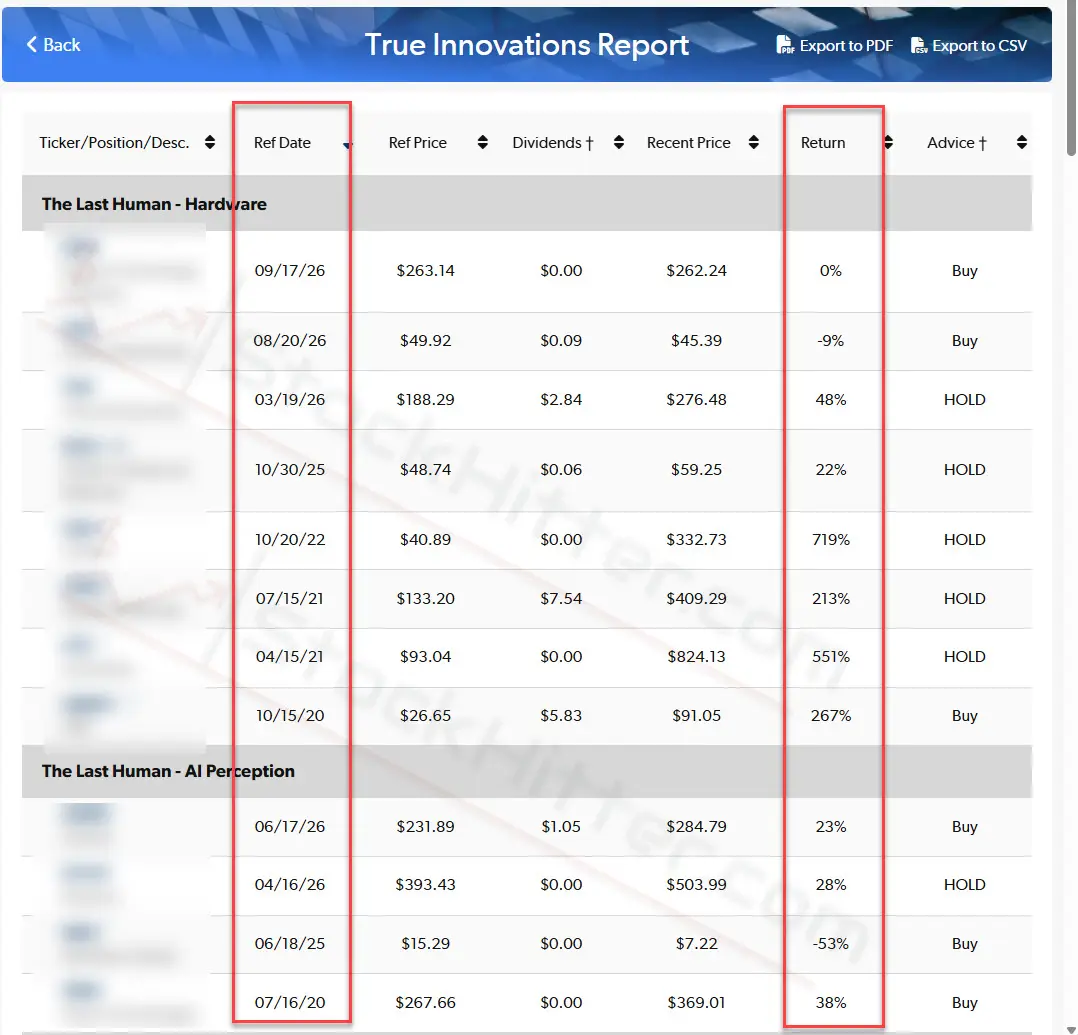
| Portfolio Snapshot (Oct 18, 2026) | Result |
|---|---|
| Open positions | 32 |
| Up / down | 26 up, 6 down |
| Median return | About 40% |
| Range | -54% to 791% |
| Rated Buy / Hold | 24 Buy, 8 Hold |
| Positions up 100% or more | 12 |
| Closed-position list | Not found |
I’m using the median because a few big winners pull the average up and make it look better than a typical pick. The 26-of-32 winners figure is real, but it is also a function of time: some of these positions were opened back in 2019 and 2020.
Older Picks Look Great. Newer Picks Look Normal.
This is the most useful thing I found. When you group the positions by when Stansberry first listed them, the results change a lot. Past performance does not guarantee future results, and a newer subscriber would not have had access to the older prices.
| When the Position Was Added | Positions | Median Return | Up / Down |
|---|---|---|---|
| 2021 or earlier | 11 | About 176% | 11 up, 0 down |
| 2022 to 2024 | 5 | About 34% | 5 up, 0 down |
| 2025 to 2026 | 16 | About 7% | 10 up, 6 down |
| Last 12 months only | 12 | About 12% | 9 up, 3 down |
If you join today, you are buying into the newest picks, and the table shows that group has been far more mixed. Some of that is simply less time. A pick from this summer has not had years to compound. Still, I would not expect a new subscriber to see the 2019 and 2020 numbers.
Results by Theme
| Theme | Positions | What It Covers | Median Return | Range |
|---|---|---|---|---|
| Chips, optical parts and semiconductor equipment | 8 | Semiconductors, optical networking and chip equipment | about 169% | 4% to 791% |
| AI perception | 4 | Sensors, machine vision and navigation hardware | about 24% | -54% to 45% |
| Ambient AI | 2 | Large internet and cloud platforms | about 153% | 130% to 176% |
| Biohacking | 5 | Gene editing, DNA synthesis and life-science tools | about 110% | 13% to 401% |
| Real moments | 3 | Entertainment, gaming and ride-sharing | about 6% | -18% to 34% |
| Defense complex | 5 | Defense contractors, cybersecurity and communications | about -2% | -28% to 752% |
| Invisible infrastructure | 5 | Exchanges, enterprise software and a few niche names | about 12% | -32% to 199% |
Two themes carry most of the heavy lifting: the chip and hardware group and the biohacking group. The defense group is a good example of how the average can mislead, because one standout is propping up a group whose median is slightly negative. The entertainment and ride-sharing group has been the weakest area for a steady return.
Notes on the Numbers
- Reference prices: Stansberry says the portfolio is not meant to show the exact prices you could get in or out, but the value of its insights at the time material is published. Your own entry price would have been different.
- Dividends: the return column is a total return, so it includes dividends.
- Partial sales and corporate actions: a few positions show a positive return even though their latest price is below the reference price. The footnotes explain these as partial sales to hedge gains, stock splits or spin-offs, so the number is not a simple price change.
- Buy ratings on losers: five of the six positions that are down are still rated Buy and one is rated Hold. That may be a patient, long-term view, but it means a losing position is not automatically a sell signal here.
- Sells exist: a footnote shows at least one position was closed in June 2026 after spin-offs. I did not find a separate list of closed positions, so I can’t show you a full win rate on exits.
- Not benchmarked: I didn’t compare these returns with the S&P 500 or a tech index, so I can’t tell you whether the portfolio beat the market.
What’s Included With a Membership
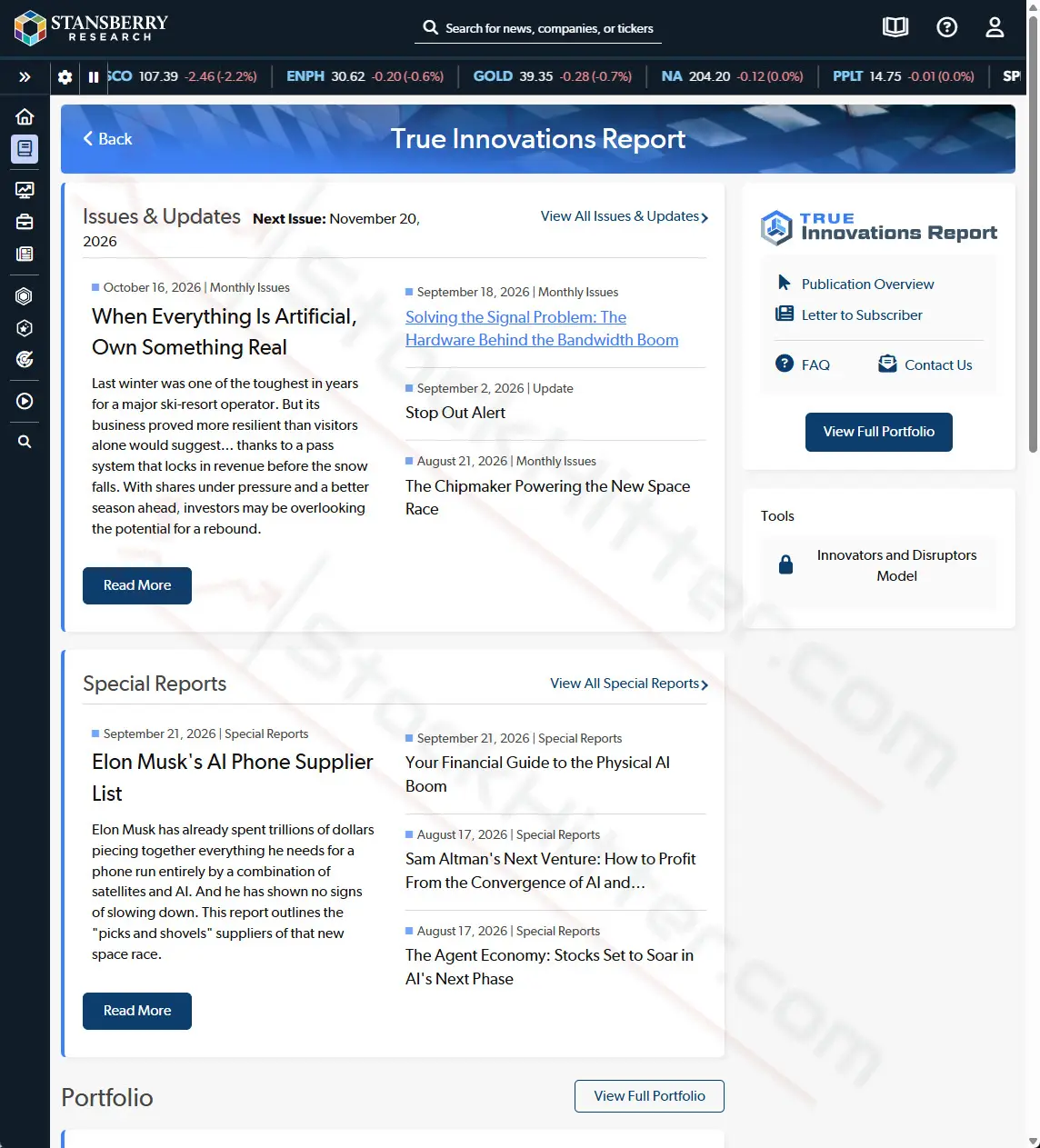
- 12 monthly issues: new recommendations from Baylin and Engel, listed by Stansberry at $499.
- Model portfolio: all buy and sell recommendations, with 24/7 access. I counted 32 open positions on October 18, 2026.
- Buy and sell alerts: email updates between issues.
- Digital archive: over 100 back issues, according to Stansberry.
- Stansberry Digest: a daily market analysis email.
- Bonus video: a recording of a Josh Baylin presentation about an AI-adjacent stock idea (more below).
- Customer support: a Baltimore-based team reachable Monday to Friday, 9 to 5 ET.
The Three Reports

Report titles are Stansberry’s marketing, not my predictions. Each is listed at a $299 stated value.
| Report | What Stansberry Says It Covers |
|---|---|
| Elon Musk’s AI Phone Supplier List | Chipmakers and component suppliers the editor believes are lined up for the Starphone |
| Your Financial Guide to the Physical AI Boom | Names tied to physical AI, including a chipmaker a hedge-fund manager reportedly backed with nearly $1 billion |
| Sam Altman’s Next Venture: How to Profit from the Next Convergence of AI | Stocks tied to a project the sales page says Altman is reportedly building |
Stansberry totals the package at $1,396 in stated value. That figure is the $499 subscription plus three $299 reports. A stated value is what the publisher says it is worth, not what the market pays, so I’d judge the newsletter on its monthly picks and portfolio and treat the reports as extras.
The Bonus Video
The checkout page also advertises a video of a Josh Baylin speech about what it calls an “anti-AI slop” stock, listed at a $2,999 value because, per Stansberry, subscribers paid that much to attend the live event.
The page says the company counts 95% of the Fortune 500 as clients and that Josh sees large upside. Those are Stansberry’s claims and his opinion, and I have not verified either. That $2,999 is not included in the $1,396 package total.
How Much Does True Innovations Report Cost?
| Item | Amount |
|---|---|
| Regular price (per Stansberry) | $499 for 12 months |
| Current offer | $129 for the first 12 months (about 35 cents a day) |
| Renewal price | $199 plus applicable taxes, charged yearly until you cancel |
| Refund window | 30 days, full refund of the subscription fee |
| Optional gift | 1-year TradeStops Basic, pre-checked at checkout |
Read this before ordering: the checkout page says your subscription renews automatically every year at $199 plus applicable taxes. To avoid the renewal charge you have to cancel at least one day before the renewal date. Stansberry says it sends a reminder first, and you can cancel by phone at 1-888-261-2693 or online. Also note the TradeStops gift is a pre-checked box that signs you up for TradeSmith emails. Uncheck it if you don’t want them.
About the 30-Day Refund
The refund covers the subscription fee if you contact Stansberry’s member services within the first 30 days. It does not cover any money you put into stocks, and Stansberry’s own page presents the trial in much stronger language than that. Your investment capital is always at risk, so size positions accordingly.
True Innovations Report Pros and Cons
What Works
- Clear angle: the supplier approach is easy to understand and focuses on parts of a story most people overlook.
- More than one report: a model portfolio, alerts, an archive and a daily digest come with it.
- Entry price: $129 is modest next to many research services.
- 30-day refund window: long enough to read at least one issue and see the portfolio.
- A real, visible portfolio: 32 positions with dates, prices and ratings, so you can judge the record instead of taking a story on faith.
What Doesn’t Work
- The headline is a prediction: the whole pitch hangs on something that hasn’t happened.
- Urgency marketing: “any day now” language is a sales tactic. No one can promise when or whether an announcement comes.
- Highlight-reel marketing: the sales page leans on a few big winners, and the live portfolio shows lower numbers for at least two of them.
- Newer picks are modest: positions added in 2025 and 2026 have a median return of about 7%, nowhere near the older picks.
- Renewal jumps to $199: a 54% increase over the first-year price, with automatic billing.
- No closed-position list: I couldn’t find a full record of exits, so a true win rate isn’t visible.
- Losers stay on the list: five of six down positions are still rated Buy.
Is True Innovations Report Worth It?
In my opinion, if you want a technology-focused research service and you are comfortable with volatile, early-stage ideas, the $129 first-year price and 30-day refund make it a reasonable thing to try. If you are mainly buying in because you think a Musk phone is guaranteed, you are buying a headline.
My approach would be simple: read the first issue, look at the full portfolio with its winners and losers, and decide inside the 30 days whether the research holds up on its own, without the Starphone story. Put the renewal date in your calendar now, and keep position sizes small while you do.
I rate it 4.0 out of 5. The portfolio is transparent and the first-year price is low, but the newer picks have been modest, the renewal is higher, and the headline pitch is a prediction.
Frequently Asked Questions About True Innovations Report
Is the Starphone real?
Not confirmed. It is Josh Baylin’s prediction, based on approvals, deals and trademarks he describes in the presentation. Treat it as an opinion until there is an official announcement.
Can I buy a Starphone stock through this newsletter?
The newsletter gives research and stock ideas. You would place any trade yourself through your own brokerage, and no stock is tied to a confirmed product.
How much does True Innovations Report cost?
The current offer is $129 for the first 12 months. Stansberry lists the regular price at $499, and the subscription renews at $199 plus applicable taxes each year.
Does True Innovations Report auto-renew?
Yes. According to the checkout page, it renews annually at $199 plus applicable taxes until you cancel, and you must cancel at least one day before the renewal date to avoid the charge.
How many stocks are in the model portfolio?
I counted 32 open positions on October 18, 2026, across seven themes. Returns are Stansberry’s own reference-price figures, and past performance does not guarantee future results.
Is there a refund?
Yes. Contact Stansberry’s member services within 30 days for a full refund of the subscription fee. It does not cover investment losses.
Who publishes True Innovations Report?
Stansberry Research, based in Baltimore, Maryland. The editor is Josh Baylin and the Senior Analyst is John Engel.
Is True Innovations Report good for beginners?
It can be, if you keep position sizes small. The stocks are technology-focused and can be volatile, so it is better suited to investors who understand that a single stock can lose a large share of its value.
Questions about my take? Drop them in the comments below.
Jenna
Disclaimer
The information in this review is for educational purposes only and should not be considered financial or investment advice. Nothing on StockHitter.com is a recommendation to buy or sell any security. All investing involves risk, including the potential loss of principal. Past performance of any investment or newsletter service does not guarantee future results. Figures describing the current promotion, including past stock gains, report values, industry estimates and predictions, come from the publisher’s own marketing materials and have not been independently verified. Model portfolio returns are the publisher’s own reference-price tracking, not trades I made, and do not represent the exact prices at which anyone could buy or sell. Always do your own due diligence and consider consulting a licensed financial professional before making any investment decisions.
Affiliate Disclosure: This article contains affiliate links. If you purchase through these links I may receive a commission at no additional cost to you. Review based on the publisher’s October 2026 checkout page and my access to the model portfolio as of October 18, 2026. Review last updated October 18, 2026.