

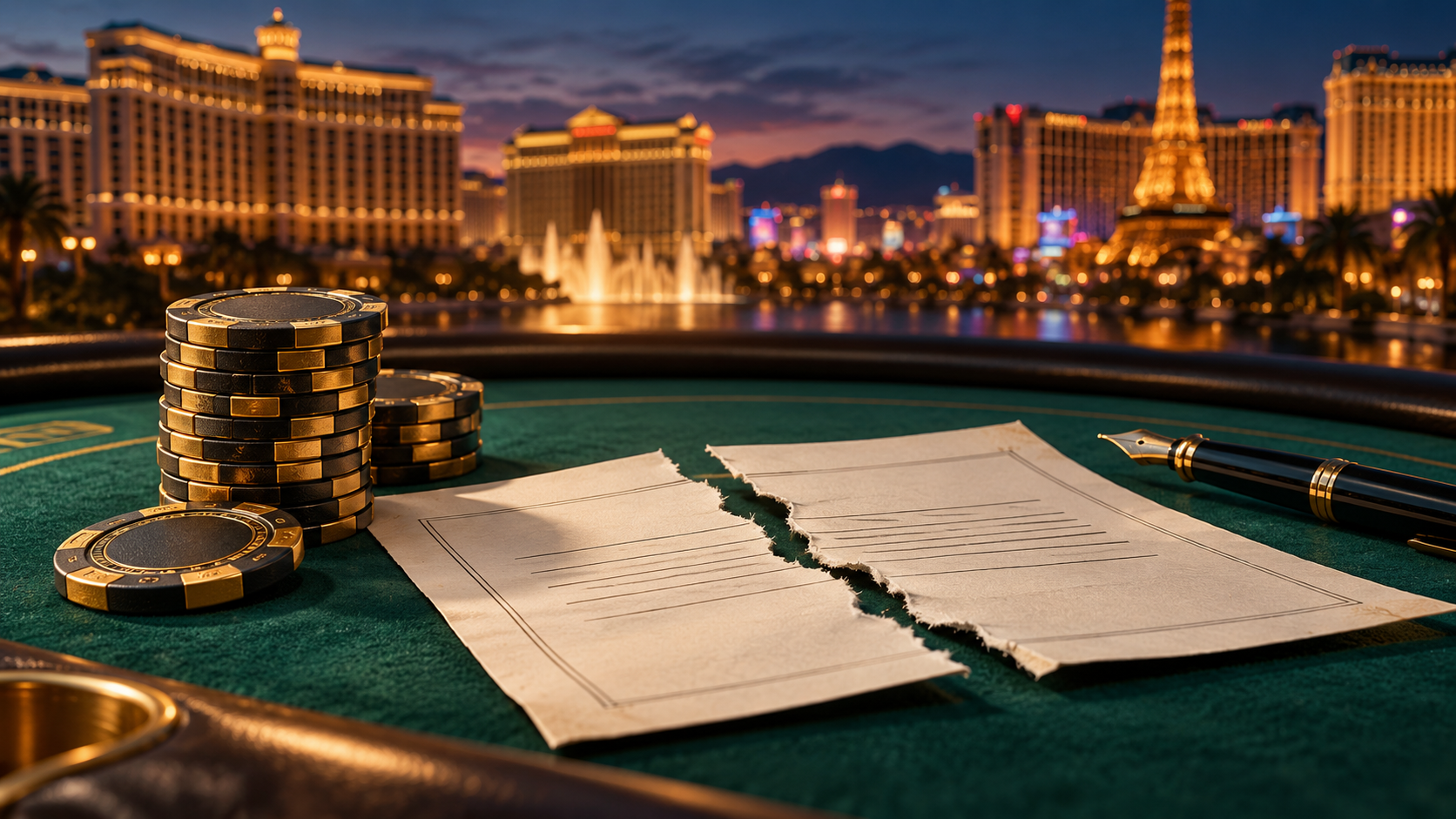
The casino wasn’t the only place MGM investors were making a bet.
For nearly four months, shareholders had a proposed $48.30-a-share cash offer to think about alongside room bookings, casino revenue and the rest of the business. On Wednesday, September 23, People Incorporated withdrew that proposal. MGM shares fell roughly 10% in Thursday trading, according to Reuters’ September 24 report, also carried by StreetInsider. The roughly 10% decline is the snapshot in that report, not a closing result or a live quote.
I can see the appeal of having $48.30 in your head. It’s wonderfully specific. You can multiply it by your share count and start mentally spending the difference. The trouble starts when that arithmetic replaces the question of whether the buyer will actually pay.
The word to notice was “nonbinding”
People’s June 1 proposal was nonbinding. It offered $48.30 in cash for each MGM share People didn’t already own. A price had been put forward; shareholders didn’t have a completed transaction or a guaranteed payment date.
In its September 23 announcement, MGM said a special board committee had spent the preceding months negotiating with People. The company will continue operating independently.
People chairman Barry Diller’s explanation was broad: the ingredients for a transaction hadn’t come together as hoped. The buyer’s own statement, reproduced in full here, also said it retained 66.8 million shares, approximately 27% of MGM, and remained interested in possible strategic alternatives.
People still owns a substantial chunk of MGM, so it has plenty riding on what happens next. Could another proposal emerge? Possibly. I’d leave it out of my base-case valuation until there’s an actual price and set of terms to consider. Otherwise, I’m making the investment work by supplying my own buyer.
The attractive little gap can hide a larger loss
Here’s a deliberately hypothetical example, using round numbers rather than MGM’s actual trading history.
Suppose you pay $45 for a stock with a proposed $50 cash takeover. If the deal closes on those terms, you make $5 a share, or 11.1%, before costs and taxes. On 100 shares, that’s $500. It’s easy to spend more time thinking about that than reading the conditions.
Now suppose the proposal falls apart and the stock drops to $35. You lose $10 a share, or 22.2%. One failure wipes out the dollar gains from two successful trades of the same size.
| Hypothetical outcome | Value per share | Gain or loss from $45 |
|---|---|---|
| Takeover completes | $50 | +$5 / +11.1% |
| Takeover fails; assumed trading price | $35 | −$10 / −22.2% |
In that simplified two-outcome example, the deal needs a success probability above two-thirds just to produce a positive expected dollar return before costs. That calculation ignores timing, dividends, taxes and other possible outcomes. The $35 failure price is an assumption, not a floor, and none of these figures estimates MGM’s value or deal odds.
That price gap exists because investors have to wait and the transaction might fail. Before deciding whether $5 of potential upside is attractive, you need an estimate of what you could lose and how likely each outcome is.
Back to rooms, casinos and bills
MGM’s board pointed to its Las Vegas and regional properties, BetMGM, MGM China and the Osaka development as reasons for confidence in its independent future. I’d want to know how much cash those businesses can produce after paying for the expansion. A list of promising properties gives you places to investigate; it doesn’t tell you what to pay for the shares.
Start with operating cash flow and subtract capital spending to estimate free cash flow. Then examine debt payments and lease commitments. There’s a small bookkeeping trap here: check what’s already been deducted from the cash-flow number you’re using. Subtracting the same expense twice will make your estimate look impressively cautious and thoroughly wrong.
MGM shareholders now have their own calculation to make. Without the proposed cash buyout, what can the hotels, casinos and other businesses earn for them over the years they expect to hold the stock?
Cover up the offer price for a minute
Try this with any takeover stock you own: cover up the proposed offer price and finish the sentence, “I’d own this business at today’s price because…” You’ll need some idea of its earnings, what those earnings are worth and what could go wrong. Write down a valuation range and a plausible downside, then calculate what that downside would cost you across the shares you actually hold.
If you can explain why you’d own it without mentioning the bidder, you have a business case to check against the results. If you keep coming back to “because someone offered more,” most of your case depends on the transaction. That deserves particular attention when you’re deciding how much money to put at risk.
The awkward part for MGM holders is letting go of $48.30 as the reference point. It was a real proposal, and it’s understandable to feel that the withdrawal took something away. But using that number to judge every future share price could keep you waiting for a payment nobody is currently offering.
This article provides general information, not personalized investment advice.
StockHitter may earn a commission if you subscribe through the link below.