

Opinion and analysis | Evidence checked October 30, 2026
Picture the most extravagant version of the sales pitch: international banking gets rebuilt around XRP, national currencies become yesterday’s news, and the people holding the token become outrageously wealthy. All that stands between an ordinary portfolio and financial royalty, apparently, is recognizing the future before everyone else.
That is quite a job description for a cryptocurrency.
There is real news underneath the latest excitement. On October 26, Ripple announced final OCC approval for a national trust bank, with approved activities involving RLUSD’s segregated reserves and fiduciary digital-asset custody. Its announcement describes custody authority upon opening, not an already completed takeover of global banking. This is a meaningful regulatory milestone for Ripple’s infrastructure. It supplies no XRP price target. Ripple’s original announcement
An October 27 CCN article carried by Yahoo Finance paired that approval with $10,000 XRP chatter while questioning whether the approval justified it. That juxtaposition is the problem worth examining: a real business development can sit beside an extraordinary token-price claim without providing the missing calculation. A banking charter does not come with a complimentary price target.
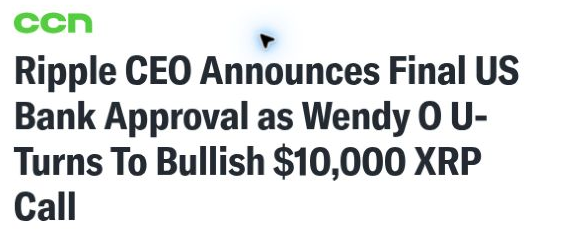
If you haven’t encountered this corner of crypto, yes, the five-figure XRP pitch is real, and it has staying power. A 2019 Mineable video argues for a $10,000 end game. An October 2026 video from The JWK Show ties another $10,000 claim to the Ripple–Robinhood partnership. In between, there are grand market-size calculations, excited comments and enough exclamation marks to qualify as office supplies.
Let’s examine the actual arguments. Below are original videos, screenshots, short transcript excerpts and specific supportive comments, with the missing math beside the evidence. Some recent presenters question the prediction even while putting it in their titles. That distinction matters, too.
Before anyone mistakes this for a victory lap from someone who always knew better: I bought into the story myself. I once held roughly 10,000 XRP, reduced that to about 1,000 a few months ago, and still hold that smaller position. That’s my personal experience, not evidence that my timing was right or that XRP can’t rise.
XRP has real uses. The problem is the leap from a useful payments asset to inevitable, ridiculous wealth. Somewhere between the bank logos and the rocket emojis, a potentially interesting technology gets handed the keys to the entire financial system. The economic argument is apparently supposed to arrive later.
Not every XRP holder buys that extravagant pitch. This isn’t an argument that the token cannot appreciate, either. It’s a demand for the missing evidence: why would the actual uses require sustained demand at prices in the thousands? If that connection isn’t there, enthusiasm is doing the work that analysis should be doing.
The $10,000 pitch has been making the rounds for years
Mineable: a 2019 end game that still attracts believers
Mineable’s June 17, 2019 video had 507,598 views and 11,419 likes when checked on October 30, 2026. In the displayed transcript at 14:22, the creator describes XRP as “designed to operate at ten thousand dollars.” That’s the creator’s conclusion, not a price promise from Ripple. Original passage, 14:22
The argument gets there by dividing a claimed daily payments total by XRP supply, imagining vast asset markets moving through the system, and treating the token’s divisibility as evidence of an intended high price. Those three steps are exactly where the case needs checking.
- Daily payment flow doesn’t equal money permanently parked in XRP. At 6:09, the video divides a daily flow estimate by a token count. But the same liquidity can be reused during a day. A credible valuation needs inventory, turnover and liquidity assumptions, not just a large numerator. The worked example below shows why this changes the calculation.
- Tokenizing assets doesn’t transfer their entire value into XRP. At 7:45, the scenario assumes a vast collection of assets running through XRP. XRPL’s own documentation says token-to-token payments can use XRP when that route is cheaper, and can combine direct and bridged routes. The ledger can represent other assets as separate issued tokens, too. Neither feature establishes that the value of every tokenized bond, stock or property must become XRP’s market value. XRPL’s routing rules · How issued tokens differ from XRP
- Decimal places aren’t a price target. The divisibility argument at 9:16 confuses how small a unit can be with what a whole token must be worth. The protocol defines one drop as one-millionth of an XRP. It doesn’t attach a $10,000 valuation to that unit. My calculator can display extra zeros, too. It has yet to buy me a yacht. XRPL unit definitions
The comments show this isn’t merely a creator talking into an empty room. One seven-year-old comment from @lesmartin2623 describes holding strong and remaining bullish; it showed 24 likes. More recently, @RichieD-g8l treats the creator as early rather than wrong. That comment was displayed as one month old, with four likes. First comment · Recent comment

That second response is revealing: years passing can become evidence of being early rather than a reason to revisit the model. Patience can be sensible. An investment thesis still needs a way to fail its own test.
The JWK Show: a real partnership becomes a giant price conclusion
This example is recent: October 27, 2026. The JWK Show connects the Ripple–Robinhood announcement and a claimed $1.2-quadrillion-plus derivatives market to five-figure XRP. At 7:09, its displayed transcript concludes: “And this is how XRP hits $10,000.” The page showed 9,191 views and 396 likes at our check. Original passage, 7:09
The partnership is real. The leap from that partnership to this token price is what needs proof.
- The announcement is narrower than the video’s sweeping interpretation. At 6:36, the video portrays Robinhood’s activity broadly as powered by XRP and RLUSD. Ripple’s actual release specifies retail and institutional RLUSD expansion, RLUSD institutional settlement on XRPL, treasury-management tools and Prime financing. It doesn’t establish that every Robinhood transaction requires XRP. Read the original partnership announcement
- A market’s headline size doesn’t tell us what share this partnership captures. The video moves from a huge derivatives-market number at 3:49 to $10,000 XRP at 3:58. A derivatives notional amount is not a pot of economic wealth waiting to be deposited into a token. The video does not establish that those contracts all settle through XRP, how much XRP participants must hold, or the price needed to support that activity. The announcement supplies no $10,000 target.
- RLUSD, the ledger and XRP play different roles. The release does describe XRP and RLUSD as underpinning Ripple’s capabilities. That is not proof that XRP has no involvement. It is also not proof that the full value of RLUSD settlement becomes demand to hold XRP. Follow the actual asset flows before ordering the celebratory island.
BULLRUNNERS: the comments go further than the presenter
The October 21 BULLRUNNERS video discusses the $10,000 claim but explicitly says the number isn’t the presenter’s own. He cautions against relying on a long-shot target and refuses to promise a price at 13:58. Fair enough. The comments still provide clear examples of people embracing the possibility. The video showed 751 likes and 225 comments at our check. Watch the original video
- The headline number remains an unsupported outcome, even when a video discusses it cautiously. Read the presenter’s qualifications at 6:23–7:03 and 13:58, not just the thumbnail. Discussing a forecast does not validate its assumptions. The presenter’s closing qualification
- Adding stocks, bonds and GDP doesn’t produce an XRP valuation. A supportive comment from @gatton5010 argues that large market totals make $10,000 possible sooner than expected; it showed 15 likes. Asset values and annual output are different measures, and neither tells us the XRP inventory needed for settlement. The actual bridge route depends on price and liquidity. Comment · XRPL routing documentation
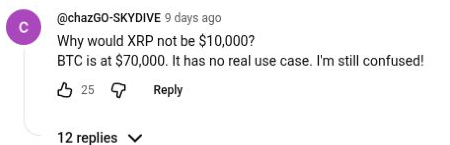
- Bitcoin’s per-coin price cannot establish XRP’s fair value. @chazGO-SKYDIVE argues for the five-figure price by comparing it with Bitcoin’s per-coin price. That comment showed 25 likes. A per-unit comparison skips the supply measure and the demand supporting each asset. Using XRP’s original 100 billion tokens as a clearly labeled benchmark, $10,000 implies $1 quadrillion. That isn’t a mathematical impossibility or a required cash inflow; it is a very large valuation to justify. Comment · Original XRP supply
This is the useful evidence of belief: specific comments endorsing the idea, with visible like counts. We don’t have to pretend every video view is a vote for $10,000.
Crypto Sensei: the title shouts while the discussion applies the brakes
Crypto Sensei’s October 23 video discusses a $10,000-in-2027 prediction. Yet at 4:02 its transcript calls the nine-month scenario “not a credible 9-month base case.” Later, the host considers much longer timelines without claiming to know. The page showed 957 likes and 318 comments at our check. Watch the original video

- The host’s own qualification undercuts a near-term certainty story. His 4:02 assessment matters more than the headline’s enthusiasm. This is commentary on a prediction, not a verified timetable for a $10,000 token. The relevant passage
- The proposed $10,000 operating threshold still needs a model. A comment by @DrScottPerlman, which showed two likes, argues that the anticipated scale of business cannot run below that price and expects a switch to be flipped. XRPL’s technical rules specify transaction fees and reserves in XRP, not a requirement for a particular dollar market price. A hypothetical model may argue that a certain use case needs more liquidity; it must demonstrate that model rather than present the price as a protocol rule. XRPL fees · XRPL reserves
- Agreement doesn’t repair the missing calculation. @andrewaguirre1976 explicitly backs the prediction under discussion. The comment was displayed as six days old, with no visible likes. That is explicit support, but it adds no evidence for the forecast. Original comment
These are selected supportive examples, not a representative poll; skeptical comments also appear. Video and comment counts are snapshots checked October 30, 2026, and will change. The point is straightforward: the enthusiasm exists. Now the economic case has to earn it.
The claim vs. the evidence
Real adoption deserves attention. Each price claim still needs its own proof.
| The leap | What the evidence establishes |
|---|---|
| Bank approval → price target | Approved trust-bank activities, not a regulator-backed XRP valuation. Ripple announcement |
| Tokenized assets → equal XRP demand | Issued tokens can represent assets separately from native XRP. XRPL documentation |
| Real payments → global dominance | SBI’s 2023 announcement describes named XRP remittance routes, not every bank or payment. SBI announcement |
| Fee burning → imminent scarcity | Fees destroy XRP; the scale depends on fees and transaction counts. XRPL fee rules |
The current crypto-law news is real. The price guarantee is not.
The recent OCC stablecoin rule is a useful place to start. On October 21, 2026, the Office of the Comptroller of the Currency issued its final GENIUS Act rule for payment-stablecoin activities under its jurisdiction. The rule takes effect January 18, 2027. That is a real regulatory development, with a future effective date, not a declaration that XRP must become the world’s money. OCC final-rule bulletin
The Federal Register rule concerns payment stablecoins: assets with an issuer’s fixed-value redemption obligation and a represented stable monetary value. Don’t casually substitute a market-priced XRP token for that category, or confuse XRP with Ripple’s RLUSD stablecoin. Clearer rules could help compliant digital-payment businesses. They do not supply an XRP price target.
CLARITY is a separate market-structure bill. The Senate’s September 15, 2026 record shows a 49–50 rejection of cloture on the motion to proceed to H.R. 3633, a procedural vote rather than final passage. That dated vote is not evidence of an enacted XRP windfall. Official Senate vote
There is a reasonable bullish argument that regulatory clarity can encourage investment and adoption. There is no shortcut from that possibility to a particular token’s guaranteed return.
First, separate the company, the network and the token
Ripple is a technology company. The XRP Ledger, or XRPL, is a blockchain. XRP is that ledger’s native digital asset. They’re connected, but they aren’t interchangeable. The XRPL’s own overview makes that distinction.
So a headline about Ripple winning business raises a question, not an automatic conclusion: What does this particular product actually require customers or service providers to buy and hold?
Ripple’s current payments page offers fiat and stablecoin settlement, including RLUSD and other stablecoins. Its FAQ also describes XRP as a possible bridge asset. That is a range of payment options, not a promise that every dollar crossing Ripple’s network becomes a dollar invested in XRP. Ripple Payments product documentation
The difference is already visible in a named banking announcement. On October 15, 2026, Cross River announced an integration of RLUSD, Ripple’s dollar-backed stablecoin, into its core banking infrastructure, supporting transactions on XRPL. The bank said customers could access RLUSD through an API; availability was limited to certain states. This is meaningful ledger adoption. The principal asset described in that announcement is RLUSD, not XRP. Cross River’s release
XRP still has a role in ledger fees and reserves. But a small XRP requirement associated with moving a stablecoin is not the same thing as buying the payment’s entire value in XRP. That distinction is rather inconvenient for a thumbnail promising generational wealth.
Yes, there is real XRP payment use
A fair critique has to include the strongest evidence on the other side.
In September 2023, SBI Remit announced XRP-based remittances to bank accounts in the Philippines, Vietnam and Indonesia. Its description was specific: SBI VC Trade would send XRP in response to remittance requests, and Tranglo would handle payment to the recipient’s bank account. SBI also described an XRP bridge service to Philippine digital wallets operating since 2021. SBI Remit’s announcement
That’s much better evidence than a collage of banking logos. It identifies the asset, the participants and the payment flow.
It does not establish that every receiving bank holds XRP, that the service dominates international payments, or what its XRP payment volume was in October 2026. The announcement supports the service it describes, not a planetary takeover.
Nor does every exchange between tokens on XRPL require XRP as the intermediate asset. The ledger’s cross-currency documentation describes using XRP when that route is cheaper, with direct and bridged routes potentially combined. The relevant variables include available liquidity and the cost of execution. XRPL cross-currency payments documentation
Useful? Clearly possible, and demonstrated in a named implementation. Guaranteed four-figure token? We haven’t crossed that bridge.
A trillion dollars moving is not a trillion dollars sitting still
The most important distinction in this debate is between payment flow and inventory held to support it.
Imagine a purely hypothetical payment provider with $1 million of reusable liquidity. If it can recycle that liquidity 100 times over a period, it can support $100 million of payment flow during that period. That doesn’t mean it held $100 million at once.
The same money can move more than once
HYPOTHETICAL EXAMPLE · ONE GIVEN PERIOD
$1 million
Reusable liquidity
Inventory available at a time
× 100
Turns of that liquidity
Reuse during the same period
= $100 million
Cumulative payment flow
Not an amount held all at once
This is an illustration, not a model of XRP’s actual liquidity or fair value. Real providers need buffers. One-way flows, volatility, fragmented markets, trading spreads and settlement bottlenecks complicate reuse. Some holders may also retain tokens for reasons unrelated to payments.
Still, the arithmetic exposes the missing step. Taking a huge annual payments number and treating it as the amount of XRP that institutions must permanently own confuses activity over time with a balance at a moment in time.
Faster reuse can reduce the inventory required for a given flow. More business can increase demand, but the effect depends on how much XRP is needed, by whom and for how long. You can’t responsibly erase those variables because the resulting price target looks better without them.
There is another leap worth catching: a bridge asset used briefly between two currencies does not thereby become the world’s currency. Bridging a payment and replacing the units in which people price goods, receive wages and hold savings are different jobs. A successful bridge need not conquer the destination countries’ currencies to be useful.
What $1,000 and $10,000 actually imply
The $10,000 forecast deserves more than a dramatic thumbnail. Start with what the number actually implies, then ask what could support it.
The XRP Ledger started with 100 billion XRP. Using that original supply as a transparent valuation benchmark produces these figures. This is not today’s circulating market capitalization, and the original figure does not deduct subsequently burned tokens. XRPL&#