

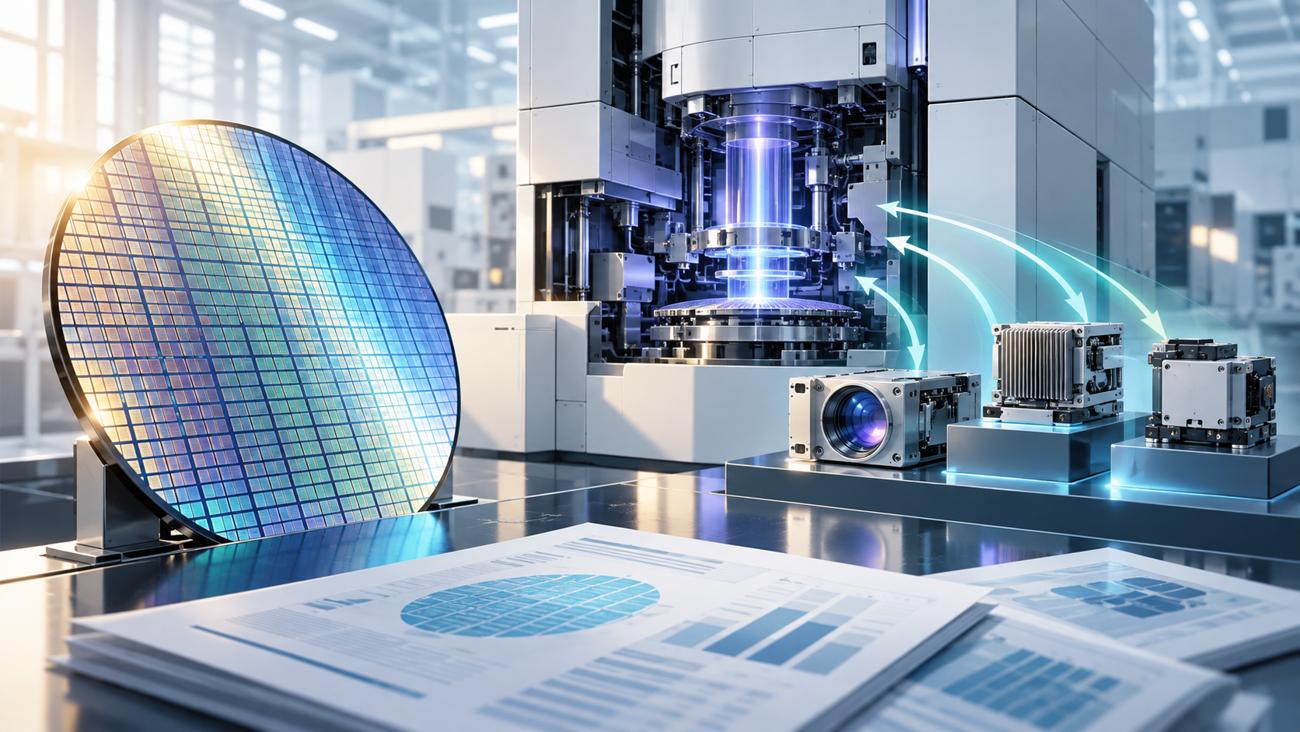
ASML’s latest quarter has a useful little twist: some of the excitement is about machines its customers already own. Chipmakers want more production capacity, and upgrading existing equipment is helping ASML earn more while it works on delivering additional systems. Getting more out of equipment already on the factory floor is worth a closer look.
The Dutch chip-equipment supplier reported €11.662 billion in third-quarter sales and €4.960 billion in net income on October 14. Those are substantial results. The interesting investor question is how much came from operating performance and how much from an investment valuation gain. Pricing changes expected in future years belong in a separate bucket. There’s plenty to unpack.
The installed machines are doing more financial work
In its October 14 release, ASML reported €3.289 billion in Installed Base Management sales. That label covers service and field options, including upgrades. It isn’t all upgrade revenue, and it shouldn’t be treated as a subscription-style recurring sales figure.
Chief Financial Officer Roger Dassen said this business came in about €400 million above guidance, primarily because of upgrades. Management also attributed the quarter’s stronger-than-expected gross margin to that demand. Gross margin reached 57.5%, above the 55% to 57% range ASML had forecast in July.
There’s a practical reason this matters. Dassen explained that upgrades can add capacity within customers’ existing factory footprints. For ASML, that creates another way to serve demand besides shipping a whole new machine. For investors, it means new-system shipments alone won’t tell the entire sales story.
The next comparison is already available. ASML’s investor presentation forecasts about €3.7 billion of installed-base sales in the fourth quarter, within total sales of €14.2 billion to €15.2 billion. It projects gross margin around 57%. Those are management forecasts, not money already earned.
A strong operating quarter, with a separate investment boost
The unaudited U.S. GAAP financial statements show operating income of €5.173 billion, compared with €2.468 billion a year earlier. That more than doubled before the separate equity-investment gain entered the calculation. ASML delivered real operating improvement.
Further down the statement, ASML recorded a €509.7 million gain on equity investments, before tax. In the company’s prerecorded CEO and CFO interview, Dassen identified roughly €500 million from revaluing its first investment tranche in Mistral AI.
That valuation gain helped the profit picture, but it isn’t revenue from selling or upgrading chipmaking equipment. I wouldn’t subtract a pretax figure from after-tax net income and present the answer as adjusted earnings, either. The arithmetic would look neat; the accounting would have a complaint.
This is a good place to use our guide to reading an earnings report beyond headline EPS. Here, operating income helps isolate the business performance before that investment gain. Net income captures a broader set of items. Both are useful, provided we don’t ask them to answer the same question.
Today’s margin and tomorrow’s pricing are different stories
Dassen said the effect of completed value-based pricing discussions with key customers isn’t really visible in 2026. He expects it to become partly visible during 2027, with the full effect in 2028 and beyond. So those arrangements shouldn’t get credit for this quarter’s margin improvement.
The full-year sales forecast also needs a careful comparison. ASML now expects €44 billion to €45 billion, versus €43 billion to €45 billion in July. The floor moved up by €1 billion; the ceiling stayed put. The new outlook calls for gross margin around 56%, compared with the earlier 54% to 56% range.
Looking further out, management says currently planned supply for 2027 and 2028 won’t fully meet expected customer demand. It’s investigating additional capacity for 2028. That is an expansion opportunity, with execution work still ahead. Supplier availability, export restrictions and order delays or cancellations remain disclosed risks.
Some customers are expressing interest in orders for 2029 and 2030, according to ASML. That gets my attention, but it doesn’t establish that those orders have been booked.
What I’d watch next is whether installed-base sales and margins keep supporting the operating story as new-machine output expands. ASML has shown that upgrades can matter right now. Future pricing and long-range demand add possibilities, but they need their own evidence as those years arrive.
Results cover the quarter ended September 27, 2026, and are unaudited under U.S. GAAP. All monetary figures are euros. This analysis uses the October 14 release, financial statements, presentation and prerecorded management interview; it excludes the later live investor call.