
Arista Networks Stock 2026: Inside the AI Networking Moat
Updated: May 2026 | By Jenna Lofton, StockHitter.com
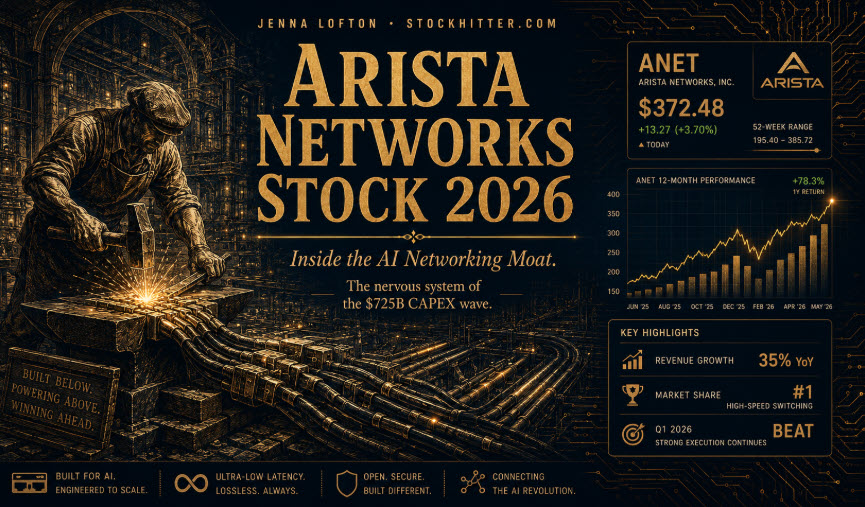
The Short Version: Arista reported $2.71 billion in Q1 2026 revenue, beat estimates by $100 million, and raised full-year guidance to $11.5 billion. The stock sold off anyway on margin pressure concerns and supply chain commentary. That selloff is the more interesting story than the beat, and it is worth understanding before you decide what to do with it.
Key Takeaways
- Arista reported Q1 2026 revenue of $2.71 billion, up 35.1% year-over-year, beating the consensus estimate of $2.61 billion.
- Non-GAAP EPS of $0.87 beat the estimate of $0.79 by 10%, up 31.8% from the prior year.
- Full-year 2026 revenue guidance raised to $11.5 billion, representing 27.7% growth.
- AI fabric revenue target raised to $3.5 billion for 2026, more than doubling AI sales year-over-year.
- Gross margin came in at 62.4%, down from 63.4% last quarter, on supply chain cost pressures.
- Arista reports holding the number one market share in high-speed switching above 10 gigabit Ethernet. That position did not change this quarter.
- The stock sold off after earnings. The business did not deteriorate. Those are two different things.
When a Beat Produces a Selloff, Pay Attention
Arista Networks beat revenue estimates by $100 million, beat EPS estimates by 10%, raised full-year guidance, and increased their AI fabric revenue target to $3.5 billion. The stock sold off roughly 13% in the days following the report.
That kind of reaction deserves analysis rather than panic. When a business beats on every metric and the stock declines, one of two things is happening. Either the market was priced for perfection and anything short of a blowout triggers selling. Or the market spotted something in the details that the headline numbers obscure.
In Arista’s case, it was both. Gross margin came in at 62.4%, down from 63.4% last quarter, on supply chain cost pressures management flagged directly on the earnings call. The Q2 revenue guidance of approximately $2.8 billion edged past the analyst consensus of $2.78 billion but did not clear it with the same authority as the Q1 beat. For a stock trading at a premium multiple, a narrowing beat margin on guidance is enough to trigger profit-taking.
None of that changes the underlying business. The AI networking moat is intact. The market share position is intact. The $3.5 billion AI fabric target for 2026 represents more than doubling AI sales year-over-year. The selloff is a valuation story, not a business story.
Experience Transparency
I have watched this pattern play out with infrastructure companies for 15+ years. The market sells the news when expectations are priced in. The business usually continues compounding regardless. Arista has beaten consensus revenue estimates for multiple consecutive quarters. One quarter of margin compression on supply chain costs — which management flagged transparently and attributed to specific, identifiable factors — does not break a thesis built on structural demand and a defensible market position.
The Q1 2026 Numbers in Full
Arista reported Q1 2026 revenue of $2.709 billion, up 35.1% year-over-year and 8.9% sequentially from Q4 2025. The consensus estimate was $2.61 billion. Revenue came in $100 million above the high end of Arista’s own guidance of $2.6 billion.
Product revenue was $2.311 billion. Service revenue was $397.7 million. The product-to-service mix reflects a business still in heavy deployment mode, where customers are buying hardware before they fully ramp the associated service contracts.
Non-GAAP EPS of $0.87 beat the estimate of $0.79 by 10.1% and represents 31.8% growth from the $0.65 reported in Q1 2025. GAAP EPS was $0.80. Operating income was $1.29 billion at a 47.8% operating margin. Net income was $1.11 billion at a 40.9% net margin. Cash flow from operations was $1.69 billion.
Gross margin was 62.4%, within the guided range of 62% to 63% but down from 63.4% last quarter. CFO Chantelle Breithaupt attributed the compression to supply chain cost pressures, specifically related to the components required to meet accelerating AI networking demand. That is a demand-driven cost problem, not a competitive pricing problem. The distinction matters.
For Q2 2026, Arista guided to revenue of approximately $2.8 billion, which edged past the analyst consensus of $2.78 billion. Full-year 2026 revenue guidance was raised to $11.5 billion, representing 27.7% growth.
The Number That Actually Matters: $3.5 Billion in AI Fabric
The headline revenue figures are important. The AI fabric target is the number that defines Arista’s investment thesis for 2026.
Arista raised their AI fabric revenue target to $3.5 billion for the full year. That represents more than doubling AI-specific sales from the prior year. AI fabric revenue – the networking infrastructure specifically designed for AI training and inference clusters – is the highest-growth, highest-margin segment of Arista’s business and the segment most directly exposed to hyperscaler CAPEX spending.
CEO Jayshree Ullal stated that Arista now reports commanding the number one market share in high-speed switching in the greater than 10 gigabit Ethernet category. That position, if sustained, is the foundation of the entire investment thesis. The hyperscalers building AI clusters need high-speed switching. Arista sells more of it than anyone else in this category. As AI cluster buildouts scale, Arista’s addressable market scales with them.
The $3.5 billion AI fabric target within an $11.5 billion total revenue guide means AI is now approximately 30% of Arista’s business and growing faster than the rest of the company. That mix shift toward AI-specific infrastructure is exactly what investors in this space want to see.
What the XPO MSA Announcement Means
Buried in the Q1 earnings release was an announcement that deserves more attention than it received: Arista launched the XPO MSA, a new multi-source agreement designed to reduce networking racks by up to 75% and save up to 44% of floor space compared to traditional pluggable optics.
Floor space and rack density are not abstract concerns for AI data center operators. A single large GPU cluster requires enormous physical space, power, and cooling infrastructure. Every rack eliminated from a data center represents real cost savings on real estate, power contracts, and cooling systems. A technology that can cut rack count by up to 75% is not an incremental improvement. It is a step-change in data center economics.
The XPO MSA positions Arista directly in the data center efficiency conversation, not just the networking conversation. That expands the addressable market and deepens the relationship with hyperscaler customers who are simultaneously trying to scale AI capacity and control the cost of doing so.
Wall Street Reality Check
The post-earnings selloff produced analyst commentary that is worth noting. The consensus price target sits at $180.46, implying approximately 28% upside from where the stock traded after the earnings reaction. Analysts flagged supply chain constraints and extended product qualification cycles as the primary near-term risks. Both are real. Neither changes the structural demand picture. Arista is not losing market share. It is navigating supply chain friction while trying to meet demand that exceeds its current supply capacity. That is a different kind of problem than declining demand.
The Moat: Why Arista Is Hard to Displace
Market share data points get cited frequently. They matter less than the structural reasons why market share stays where it is. For Arista, those reasons are deeper than most investors appreciate.
Arista’s EOS operating system is the first structural advantage. EOS runs across Arista’s entire switching portfolio, from campus to data center to AI spine deployments. A network operator who learns EOS does not want to retrain on a competitor’s operating system. The institutional knowledge embedded in a large enterprise’s network team is a genuine switching cost that does not show up in product specifications.
The net promoter score is the second signal. Arista reported a 2026 net promoter score of 89, with 94% of customers rating the company strongly positive. An NPS of 89 is exceptional by any industry standard. In enterprise networking, where customers interact with the product daily and where failures have immediate operational consequences, an NPS of 89 reflects genuinely differentiated product quality. Customers who score a vendor that highly are typically not actively shopping for a rip-and-replace alternative.
The AI-specific technical differentiation is the third advantage. Arista’s 7800 series – the Universal AI Spine – is purpose-built for the latency and bandwidth requirements of GPU cluster communication. The Virtual Output Queuing architecture eliminates head-of-line blocking, which is a specific failure mode that degrades performance in AI training workloads. Competitors building general-purpose switches do not natively address this problem. Arista does.
The Competitive Landscape: Is Anyone Catching Up?
Cisco is the most obvious competitor to evaluate. Cisco holds significant enterprise networking market share in traditional environments and has been investing in AI networking capabilities. Cisco’s acquisition of Splunk and their ongoing investment in AI-specific networking products signals that they take the AI infrastructure opportunity seriously.
The gap between Cisco and Arista in AI-specific deployments remains significant. Arista’s software-defined architecture and EOS operating system were built for the cloud era from the ground up. Cisco’s product portfolio evolved from the enterprise networking era and has been adapted for cloud and AI deployments. Adaptation is slower than native design, and in a market moving as fast as AI networking, that matters.
Nvidia’s acquisition of Mellanox gave Nvidia a networking capability through InfiniBand that is competitive with Arista in specific AI training cluster deployments. InfiniBand has historically dominated the highest-performance AI training fabrics. The Ultra Ethernet consortium – which Arista helped found – is positioning open Ethernet standards as an alternative to InfiniBand. Arista benefits if Ultra Ethernet gains adoption because the standard is built on architecture where Arista already leads.
Marvell Technology is a less-discussed competitor that is worth watching. Marvell’s custom ASIC capabilities are being deployed in hyperscaler networking infrastructure at an increasing rate. If hyperscalers move toward more custom silicon in their networking layer, Marvell becomes a larger factor in the competitive picture.
The Supply Chain Issue: What Management Actually Said
The supply chain commentary on the Q1 earnings call produced most of the post-earnings concern. It is worth reading carefully rather than reacting to the summary.
Arista flagged extended product qualification cycles as a factor that could delay revenue recognition. In enterprise networking, customers must qualify new hardware before deploying it at scale. The qualification process involves testing the product in the customer’s specific environment, which takes time regardless of how quickly Arista can manufacture and ship the product. Extended qualification cycles do not indicate demand weakness. They indicate that customers are moving through their qualification pipelines as fast as their internal processes allow.
The gross margin compression to 62.4% from 63.4% was attributed to component cost increases driven by supply constraints. Arista is experiencing the same supply chain dynamics as every other hardware manufacturer trying to meet AI infrastructure demand. The costs of key components are elevated because demand for those components exceeds supply. That dynamic is a function of the overall AI infrastructure buildout, not a specific Arista problem.
Management’s tone on the call was confident rather than defensive. The guidance raise to $11.5 billion for the full year and the AI fabric target increase to $3.5 billion are not the outputs of a management team worried about their competitive position. They are the outputs of a management team navigating supply constraints while demand exceeds their current capacity.
Valuation: What $11.5 Billion in Revenue Means for the Multiple
Arista trades at a valuation premium to traditional networking hardware companies. That premium is justified by the growth rate, the margin profile, and the AI-specific demand tailwind. Whether the current price fully reflects those factors is the question investors need to answer for themselves.
The full-year guidance of $11.5 billion at 27.7% growth, with a 47.8% operating margin, puts Arista in a category that does not have many peers. At $2.71 billion in quarterly revenue with operating margins near 48%, Arista generates more cash per dollar of revenue than almost any hardware company in the market.
The analyst consensus price target of $180.46 implies 28% upside from post-earnings levels. That consensus reflects the view that the selloff overreacted to the margin compression and supply chain commentary and that the structural demand picture justifies a higher price. Whether that view is correct depends on how quickly supply chain costs normalize and whether the AI fabric revenue target of $3.5 billion is achievable within the year.
My view: Arista’s valuation is more defensible than Palantir’s because the revenue base is larger, the margins are more stable, and the competitive position is more clearly established. For the AI infrastructure portfolio, Arista is the position I size largest because the risk-adjusted case is cleaner.
What to Watch Next Quarter
The Q2 2026 report is scheduled for August 4, 2026. Three numbers will determine whether the post-earnings selloff was an overreaction or a legitimate warning.
Gross margin is the first. If gross margin recovers toward 63% or above, the supply chain cost pressure was transitory and the selloff was an overreaction. If gross margin compresses further, the cost pressure is structural and the thesis requires reassessment.
AI fabric revenue progress is the second. The $3.5 billion full-year target implies approximately $875 million per quarter. Q2 results will reveal whether Arista is on pace to hit that target or whether the extended qualification cycles are creating timing risk.
Q3 guidance is the third. Arista’s guidance cadence has been conservative relative to actual results. If Q3 guidance implies an acceleration back toward 35% growth, the full-year picture stays intact. If guidance implies deceleration below 25%, the story changes.
Bottom Line
Arista beat on revenue, beat on EPS, raised full-year guidance, doubled its AI fabric revenue target, and reports holding the number one market share position in high-speed switching. The stock dropped roughly 13% on margin compression and supply chain commentary that management addressed directly and attributed to demand-driven cost pressure, not competitive deterioration. That is a post-earnings overreaction, not a business inflection. The AI networking moat is intact.
Further Reading
- AI Infrastructure Stocks 2026: The Full Picks-and-Shovels Playbook – where Arista fits in the broader five-layer stack
- Louis Navellier’s Growth Investor Review – Navellier’s quantitative framework is built to track exactly the kind of earnings acceleration and beat pattern Arista has been producing
Disclosure: This article is for informational and educational purposes only and does not constitute investment advice. The author does not hold a position in Arista Networks (ANET) at the time of publication. Always conduct your own research before making investment decisions.
