

The Short Version: AI infrastructure is a capital-intensive theme spanning chip design, manufacturing, networking, power, cooling and software. This October guide follows the business models and the risks rather than treating a mixed-basis spending total as a guaranteed order book. I hold positions in this space. The picks-and-shovels idea is a research framework, not a promise of durable returns. Here is how to evaluate it in 2026.
Key Takeaways
- The AI investment narrative has shifted from large language models to the physical infrastructure layer – networking, chips, power, and cooling.
- Hyperscaler capex disclosures differ in period and lease accounting. They also include non-AI spending, so this guide does not present a single AI-only total.
- Arista Networks, Palantir, Nvidia, and Datadog represent four distinct layers of the AI infrastructure stack – each with a different risk/reward profile.
- Suppliers can benefit without choosing the winning AI application, but still face competition, customer concentration, spending cuts and valuation risk.
- Observability and operational AI deserve attention alongside hardware. Their growth rates and revenue definitions must be compared on consistent periods, not ranked by narrative.
Follow the Infrastructure, Not Just the Headline
When I talk to people about AI investing, they almost always want to know about the next ChatGPT. Which company is building the smartest model. Which startup is going to disrupt Google. Which stock is going to 10x because it has “AI” in the pitch deck.
That’s the wrong question. And after 15+ years of watching market cycles play out, I can tell you it’s almost always the wrong question at moments like this one.
The right question is: who’s selling the shovels?
The picks-and-shovels analogy is useful because it asks who sells necessary tools to many customers. Take it too literally and it becomes a fairy tale with mining equipment. Suppliers can overexpand, lose customers and go broke too. The analogy helps organize research; it does not prove which stocks will win.
The AI market is not structurally identical to a gold rush. Model developers, cloud platforms, chip suppliers and enterprise software companies overlap, compete and buy from one another. Public investors can study several layers, but access to one layer does not make it a better investment at every price.
I hold positions in this space. Nvidia, Palantir, and a few others I’ll cover here. This guide is my attempt to lay out the full AI infrastructure stack – from the hardware layer at the bottom to the operational software layer at the top – so you can make informed decisions about where to invest your own money.
Experience Transparency
I added to my Nvidia position in Q3 2025 and opened a starter position in Palantir shortly after their first “Rule of 40” quarter broke 100. I don’t recommend anything on StockHitter that I wouldn’t put my own money behind. These positions inform my perspective on this article – that’s the point of disclosing them.
What Hyperscaler Spending Does—and Does Not—Tell Us
Capex can mean servers, networking, buildings, land and other long-lived assets. It is not synonymous with AI-only spending, signed supplier revenue or an immediate cash payment. Software subscriptions may also be operating expense rather than capex.
Two dated examples show why adding headlines is risky. Microsoft’s July 29 call put calendar-2026 capex near $175 billion after a shift in lease classification, without reducing underlying investment expectations. Meta’s July 29 release put 2026 capex at $130 billion–$145 billion including finance-lease principal payments. These are forecasts using different accounting bases.
For a supplier, the useful questions are narrower: What has been ordered? When can it be delivered? What margin will it earn? How much cash must the supplier invest first? A hyperscaler can spend more while one supplier loses share or earns less on each sale.
That’s the picks-and-shovels opportunity worth researching: a group of businesses with different economics, not one giant guaranteed payout.
The AI Infrastructure Stack: A Layer-by-Layer Breakdown
Think of AI infrastructure as a five-layer stack. Each layer is necessary. Each layer has publicly investable companies. Each layer has a different risk profile.
Layer 1: Chip Design, Foundries and Memory (The Foundation)
Everything starts with compute, but the companies play different roles. NVIDIA and AMD design processors and accelerators; foundries such as TSMC manufacture chips for customers. Memory suppliers and advanced packaging providers solve additional constraints. GPUs are useful for parallel calculations, while CPUs and specialized accelerators also perform AI workloads. “Chip company” is not one interchangeable business model.
NVIDIA is a major supplier of AI accelerators and the associated systems and software. Its August 26 Q2 fiscal 2027 release reported $89.0 billion of Data Center revenue, up 117% year over year, and described Vera Rubin as in full production. That updates the older H100/Blackwell-only framing. It does not imply every AI workload depends on NVIDIA.
The risk at this layer includes customer concentration and alternatives. AMD accelerators and customers’ own chips, including Google TPUs and Amazon Trainium, compete for some workloads. Software compatibility, availability, power use and total cost matter alongside benchmark speed. The semiconductor layer is not a simple “buy Nvidia and walk away” story. It requires ongoing monitoring.
AMD is another accelerator designer to study. Its July 23, 2026 MI400-series announcement is a more current product reference than the MI300X. A product launch is not proof of customer utilization, profitability or a cheaper stock. Compare earnings periods and valuation definitions before claiming one designer trades at a discount to another.
Layer 2: High-Speed Networking (The Nervous System)
Large distributed training jobs depend on fast, reliable communication between accelerators. A network bottleneck can leave expensive compute waiting for data. Workloads differ, so requirements for bandwidth, latency and cluster size need to be evaluated rather than assumed.
This is where Arista Networks enters the research picture.
Arista supplies high-speed Ethernet networking and its EOS software platform. In its August 4 Q2 2026 results, revenue grew 37.7% to $3.036 billion. That is a useful operating signal, not proof of an unassailable moat or of a specific market-share ranking.
A consistent operating system can reduce the work involved in managing a large network and create switching costs. Customers can still use multiple vendors, develop alternative architectures or push prices lower. Test the moat through customer wins, margins and renewal or replacement behavior; do not assume displacement is unlikely simply because equipment is already installed.
AI networking involves both Ethernet and InfiniBand. Ultra Ethernet develops Ethernet capabilities for demanding AI and high-performance-computing workloads; it is not evidence that Ethernet itself has become obsolete. Arista’s exposure is tied to the adoption and economics of its Ethernet products, so it does matter which architectures customers choose.
Wall Street Reality Check
Ethernet switches rarely get the glamorous part of the story. That makes them worth researching, not automatically cheaper. Compare customer concentration, margins and a current valuation before deciding the networking supplier is a better investment than the chip designer.
Layer 3: Data Center Infrastructure (The Body)
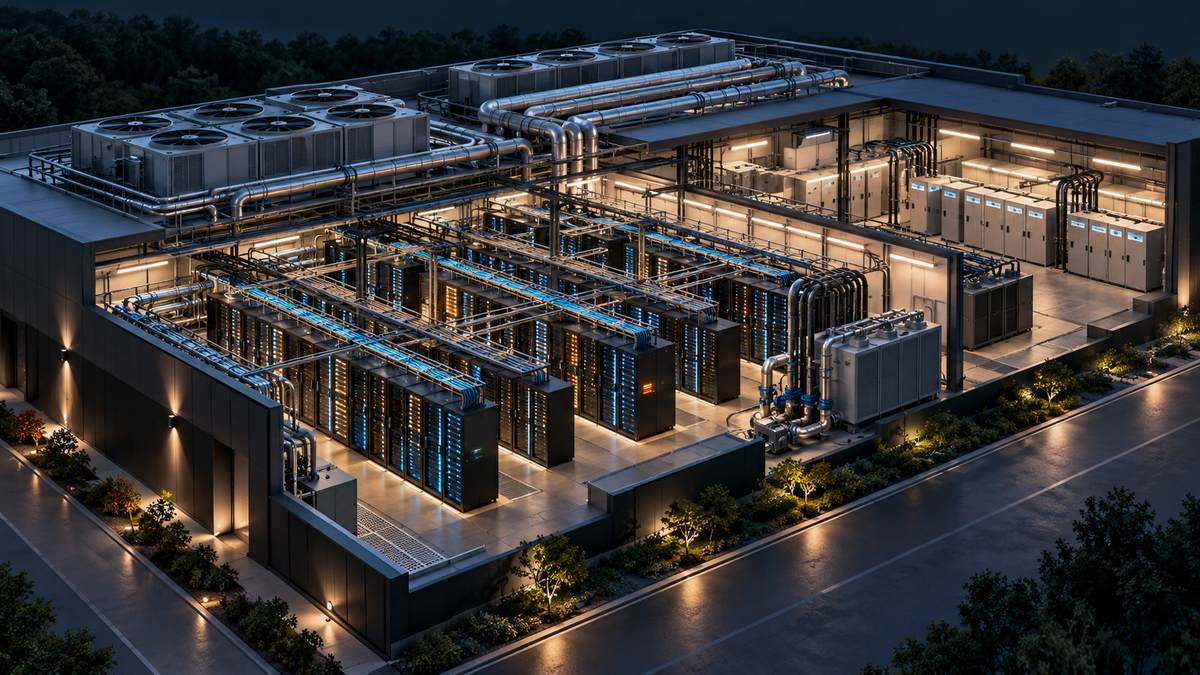
Data centers are the physical housing for every layer of the AI stack. Building them at the scale the hyperscalers are targeting requires real estate, power contracts, cooling systems, and construction timelines that are measured in years, not months.
Power availability, interconnection queues, equipment lead times, water and land use, permits, financing and construction execution can all limit a data-center project. A large customer may have plenty of capital and still face a long wait for a usable site. Smaller operators may face both physical constraints and funding pressure.
This creates research opportunities in power equipment, electrical distribution, cooling, construction and generation. Each link earns money differently. A utility’s allowed return, an equipment supplier’s margin and a data-center landlord’s lease economics are not the same thing simply because all three have an AI customer.
Vertiv supplies thermal-management and power infrastructure for data centers. Denser computing can increase the engineering demands its products address. The business case still needs evidence in orders, margins and cash generation; a less glamorous company does not automatically compound quietly. Our Vertiv analysis examines those tradeoffs.
Layer 4: The Software Infrastructure Layer (The Brain’s Operating System)
Above the hardware layer sits the software that orchestrates it. This includes cloud platforms, AI development frameworks, and – increasingly – the operational AI software that enterprises are deploying to run actual business workflows.
Palantir Technologies represents the most interesting story in this layer in 2026.
Palantir sells software used in government and commercial data environments. Its AIP platform is intended to help organizations apply AI to operational work with controls and governance. That does not mean every deployment is fully auditable by default or that every customer’s use is identical.
Palantir’s August 3 Q2 2026 results reported 93% year-over-year revenue growth and a 62% adjusted operating margin. The company’s Rule of 40 score was therefore 155%, using its rounded percentages. GAAP operating margin was 47%.
Definition check: Palantir adds revenue growth and adjusted operating margin, not free-cash-flow margin. Other software analyses use other margin definitions, so compare like with like. A high score describes growth and profitability under that formula; it neither supplies a fair share price nor erases stock-based compensation. AIP is not separately disclosed as a revenue segment in that release.
Palantir remains a software business whose valuation needs a current, consistently defined calculation. Growth in adoption can support its operating case, but does not prove the share price is justified. Compare the expected cash flows with slower-growth scenarios rather than inferring the market’s intentions. My view is that it does accelerate, which is why I hold the position.
Layer 5: Observability and Operational Intelligence (The Immune System)
The fifth layer is observability: software that helps teams understand what their applications and infrastructure are doing. It deserves research even when it is less visible than the chips. That is not a claim that it offers the best expected return.
Production systems can develop unexpected model behavior, latency problems, failures and security issues. Observability software collects signals such as logs, metrics and traces to help teams investigate. It can improve visibility, but does not guarantee that every outage or security incident will be prevented.
Datadog is one provider in a competitive observability and security market. AI systems can add monitoring requirements around model behavior, latency, cost and security. The resulting spending depends on customer usage, pricing and vendor selection; more technical complexity does not automatically produce more revenue for one vendor.
Datadog’s August 6 Q2 2026 release reported $1.12 billion of revenue, up 36%, and about 4,720 customers with annual recurring revenue of at least $100,000. GAAP operating income was about $5 million, compared with $257 million on a non-GAAP basis. Read the reconciliation: a strong growth story does not make compensation and other excluded costs disappear.
The same Q2 release described general availability for Bits Code, Bits Chat and Bits Agent Builder. These products illustrate its expansion into AI-assisted operations, but an announced capability is not the same as a separately disclosed revenue stream. Watch adoption and customer spending, not only the release calendar.
From Experiments to Production: A Thesis to Test
Enterprise AI can move from pilot programs into production workflows at different speeds. Some deployments are already important to operations; others remain experiments or fail to justify their cost. Customer case studies are useful, but they do not establish one adoption timetable for the entire economy.
When AI moves from experiment to production dependency, the requirements change dramatically. Reliability becomes non-negotiable. Governance becomes a compliance issue. Observability becomes an operational necessity rather than a nice-to-have. Security becomes a board-level concern.
This transition is one reason to research infrastructure alongside applications. A supplier may serve several applications, reducing dependence on any single winner. It can still lose if customers build internally, switch vendors or cut spending. Application and infrastructure businesses both need valuation work; neither layer wins by definition.
The Neocloud Opportunity: Beyond the Hyperscalers
AWS, Microsoft Azure, Google Cloud and Oracle Cloud are examples of large cloud platforms. Specialized AI-cloud providers, often called neoclouds, offer another business model. This is a category description, not a ranking of four companies by market share.
Neoclouds focus on AI-oriented compute and related services rather than the full breadth of a general-purpose cloud platform. Provisioning speed and total cost vary by workload, contract, utilization and availability. “Specialized” does not automatically mean faster or cheaper.
Nebius is a publicly traded example. Its August 12 Q2 2026 results reported revenue of $582.3 million, up 454%, with $236.2 million in adjusted EBITDA but a $190.4 million GAAP loss from continuing operations. Growth starts from a smaller base than the large platforms, and the gap between adjusted EBITDA and earnings matters in a capital-intensive business. See our Nebius analysis for financing and execution risks.
A neocloud can face substantial funding needs, customer concentration, asset depreciation and delivery risk. Those risks differ from the economics of an established networking or software supplier. Compare signed capacity commitments with powered, deployed and revenue-generating capacity; they are not interchangeable.
Where the Supply Chain Bottlenecks Are (And Why They Matter)
Understanding where the physical constraints in the AI supply chain are located helps identify which companies hold pricing power and which are commoditized.
Advanced fabrication and packaging can constrain supply, but process nodes, yields, customer qualifications and locations differ. In its October 15 Q3 2026 call, TSMC discussed N2 production and capacity expansion. That is a more useful basis for research than declaring only two manufacturers capable or dismissing every competitor for years. Geographic concentration and ramp execution remain risks.
High-bandwidth memory sits alongside accelerators and helps feed them data. Memory capacity, qualification and packaging can limit usable systems even when a processor is available. Investigate each supplier’s actual products, customer qualifications and capacity plans before assuming that a bottleneck guarantees lasting pricing power.
Optical interconnects carry data within and between large computing networks. Faster links can create demand for transceivers, lasers and related components, but the architecture and distance determine where optics are useful. Copper is not disappearing from every connection. Check which components a supplier sells and how much of the growth it can capture profitably.
Coherent, Lumentum and Fabrinet are names to research in the optical supply chain, with different product and manufacturing exposures. A history correction matters here: II-VI acquired Coherent in July 2022, and the combined company adopted the Coherent name in September 2022—not the reverse. Supply-chain positioning is a starting point for analysis, not a promise of durable stock returns. That is the distinction between research and surface-level stock tips.
The Valuation Question: How to Think About AI Infrastructure Multiples
Every conversation about AI infrastructure investing eventually reaches valuation. A multiple is meaningful only with a dated share price, share count, debt and cash treatment, and a clearly identified earnings or cash-flow period. No live forward multiples are quoted here because a stale quote can make a careful business analysis misleading.
The right comparison depends on the layer and the company. Use historical multiples as context, then examine how growth, margins and capital needs differ.
For NVIDIA and Arista, test how slower customer spending or lower margins changes earnings and cash flow. Hardware sales are not automatically recurring subscription revenue. A customer may keep using yesterday’s hardware without buying the same amount again this year.
For Palantir, revenue growth and the Rule of 40 can inform an operating assessment, but they do not replace a valuation model. Include dilution and examine GAAP results alongside adjusted margins. A company does not become exempt from valuation because its comparison group looks less exciting.
For Datadog, compare usage growth, retention, competition and the costs excluded from adjusted results. A revenue multiple cannot be compared directly with an earnings multiple, and none of these stocks should be declared the cheapest without a consistent, current calculation.
The practical approach I use: position size to the conviction level and the valuation cushion. Arista and Nvidia get larger positions because the business quality and valuation are both more comfortable. Palantir is a smaller position because the conviction is high but the valuation leaves less room for error. Datadog is the smallest because the competitive dynamics require the most monitoring.
What I Keep Seeing Retail Investors Get Wrong
I’ve watched enough market cycles to notice patterns. The AI trade is producing a few specific mistakes that I see repeatedly, and they’re worth naming directly.
The most common one is chasing the narrative instead of the cash flow. Every quarter produces a new hot story – a chip architecture announcement, a model benchmark, an enterprise deployment press release. The investors who buy on narrative and sell on narrative get chopped up. The investors who anchor to whether a business is generating cash, and growing that cash generation, tend to survive long enough to actually make money.
Second- and third-order suppliers are worth investigating, including power equipment, optics and memory. Less attention does not reliably mean a lower valuation or a better entry point. Smaller suppliers may bring customer concentration, financing or liquidity risks that the headline names do not share.
The mistake that bothers me most is turning a plausible multi-year theme into a promise that spending cannot peak. Data centers may need more investment over time, yet individual orders can pause and suppliers can lose relevance. Build a thesis with conditions that could disprove it: weaker utilization, reduced customer budgets, falling margins or returns on capital that fail to justify expansion.
The Risk Factors That Actually Matter
No investment thesis is complete without an honest accounting of what can go wrong.
The biggest risk to the AI infrastructure trade is a CAPEX pullback by the hyperscalers. If revenue or returns disappoint relative to the investment being made, customers may reduce or defer capex. The effects would vary by supplier, contract and delivery schedule. The magnitude of that hit would depend on how severe and sustained the pullback was.
The second risk is technical disruption. Changes in processors, networking, models or software can alter the equipment and services customers need. An established supplier can face lower demand even if AI usage keeps growing. Product cycles can change quickly, while replacing installed infrastructure may take longer. Both horizons matter.
The third risk is geopolitical and regulatory: advanced-chip supply chains cross borders, export restrictions affect who can buy certain products, and data centers face local power and permitting constraints. A disruption could affect availability, costs or delivery schedules. The size of the risk cannot be read directly from a stock chart.
Risk controls can limit concentration, but cannot ensure that an investor stays profitable or captures an eventual upside.
The 2026 AI Infrastructure Watchlist
Based on the framework laid out above, here are the companies I’m watching across each layer of the stack. This is not a buy list – it’s a monitoring list organized by where each company sits in the infrastructure hierarchy.
Chip Design and Memory: Nvidia (NVDA), Advanced Micro Devices (AMD), Broadcom (AVGO), Micron Technology (MU), SK hynix. Foundry exposure is a separate business model, with TSMC as one example.
Networking Layer: Arista Networks (ANET), Cisco Systems (CSCO), Marvell Technology (MRVL), Coherent Corp (COHR)
Data Center Infrastructure: Vertiv Holdings (VRT), Eaton Corporation (ETN), Digital Realty (DLR), Equinix (EQIX)
Operational AI and Data Software: Palantir Technologies (PLTR), Snowflake (SNOW). These businesses have broader uses than AI alone.
Observability and Security: Datadog (DDOG), CrowdStrike (CRWD), Palo Alto Networks (PANW)
Neoclouds: Nebius Group (NBIS), CoreWeave (CRWV)
How to Evaluate Exposure Without Over-Concentrating
The practical question for most readers is how to actually build exposure to AI infrastructure without over-concentrating in any single name or layer.
Start by mapping existing exposure. A broad equity fund may already own several companies discussed here. Adding a chip designer, a networking company and a data-center supplier can increase dependence on the same customer budgets rather than provide three independent sources of diversification.
Then compare business models, balance sheets and downside scenarios. A software company’s cash needs differ from a cloud operator building physical capacity. Smaller or less familiar suppliers deserve more research, not an automatic allocation.
Entry price still matters in a multi-year theme. Spreading purchases over time changes timing risk but does not guarantee a lower cost, prevent losses or repair an overvaluation. Whether any of these securities is suitable depends on an investor’s circumstances; this watchlist is educational, not a portfolio prescription.
Final Thought from My Portfolio
The AI infrastructure trade is not a momentum play. It’s a structural shift in how computing resources are built and deployed, happening at a speed and scale that the market has not fully priced in across every layer. I hold Nvidia and Palantir because I believe the infrastructure build-out is in the early middle innings, not the late ones. That view can be wrong. But it’s informed by 15+ years of watching technology capital expenditure cycles, and this one has characteristics I haven’t seen combined before: genuine product-market fit, enterprise adoption at scale, and hyperscaler CAPEX commitment that makes the demand visible multiple quarters in advance.
One thing I’ve found genuinely useful for staying current on the CAPEX themes covered in this article: a few financial research newsletters that track this space with real analytical depth. The reviews of Louis Navellier’s Growth Investor and The Skousen Report are starting points for comparing those services. Check current terms and verifiable evidence; no paid service replaces your own review of company filings. I’ve reviewed both in detail if you want the full breakdown before subscribing.
Disclosure: The author holds long positions in Nvidia (NVDA) and Palantir (PLTR) at the time of publication. This article is for informational and educational purposes only and does not constitute investment advice. Always conduct your own research before making investment decisions.